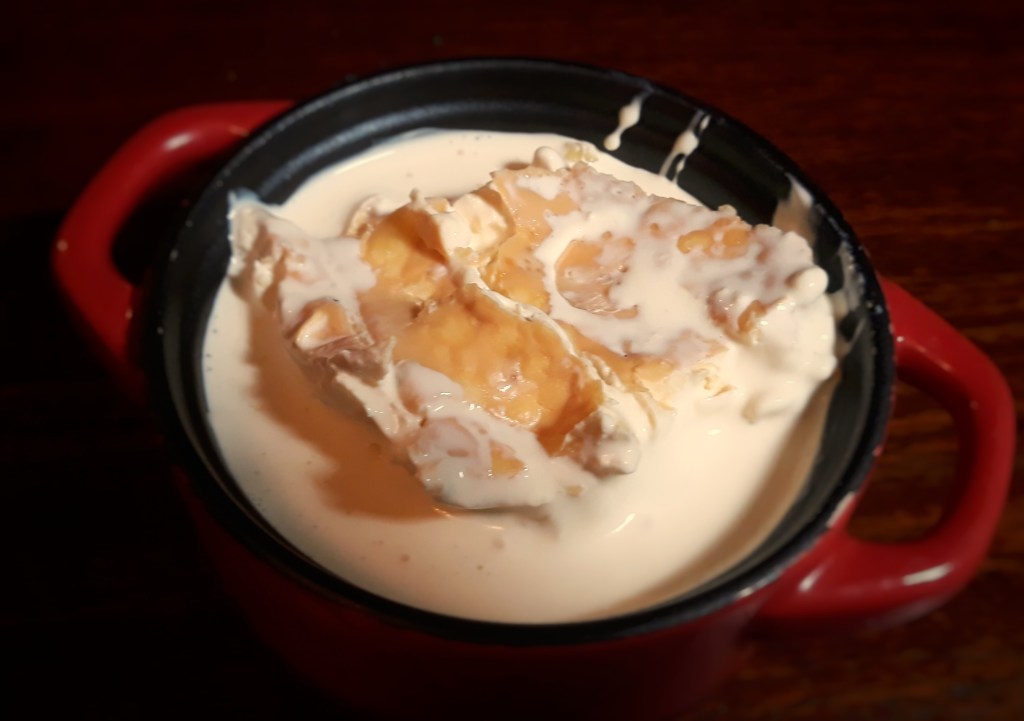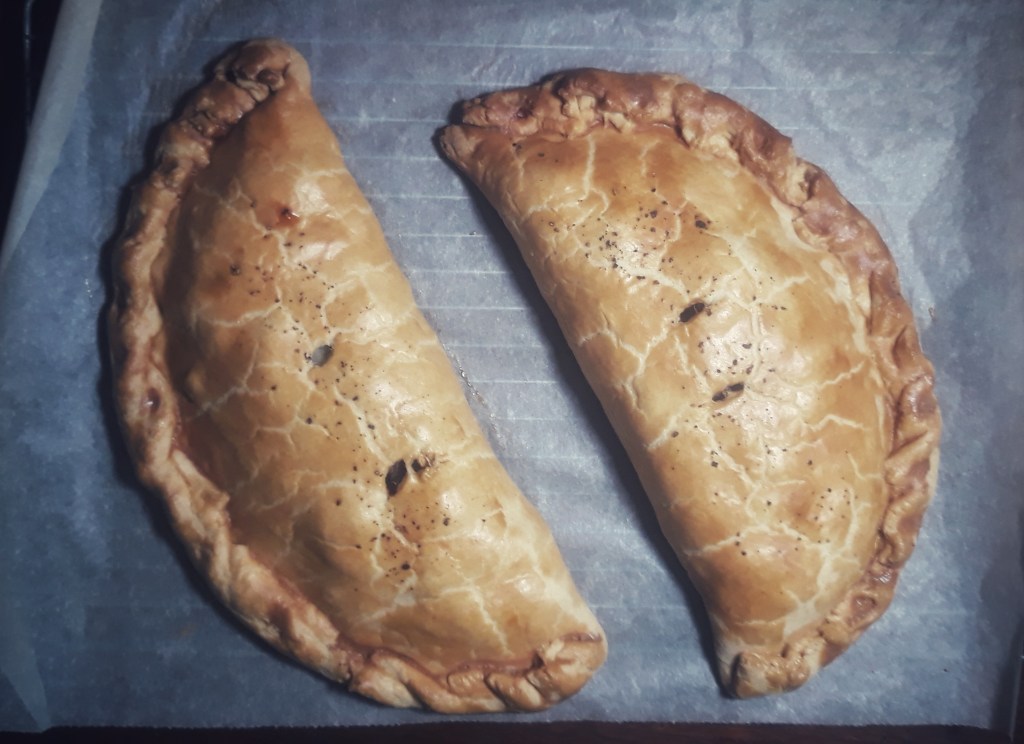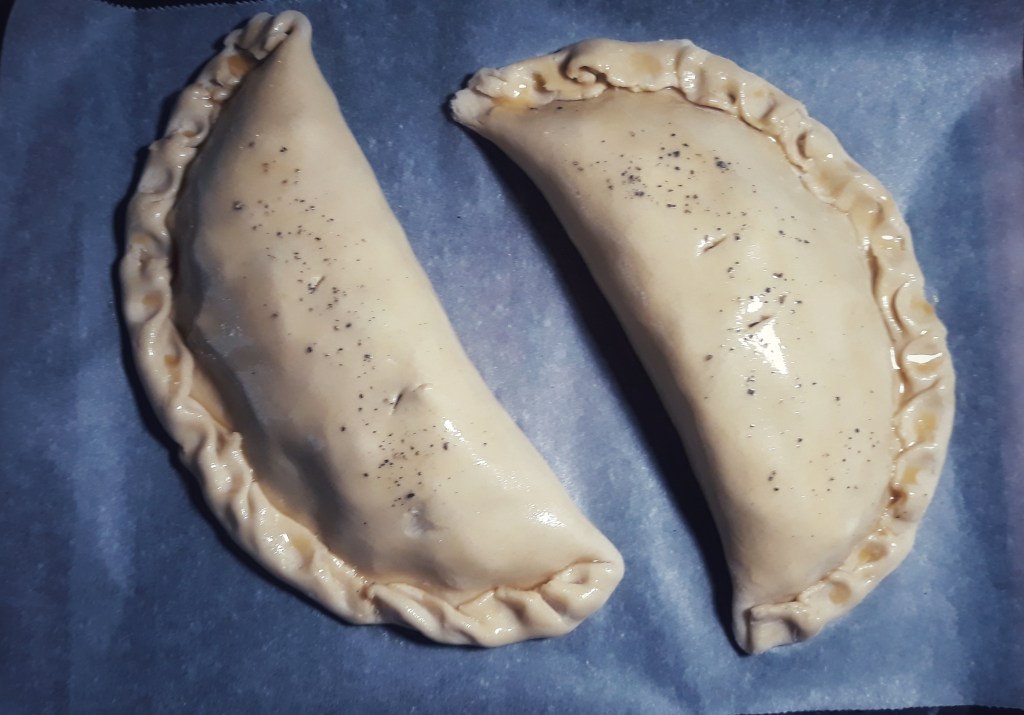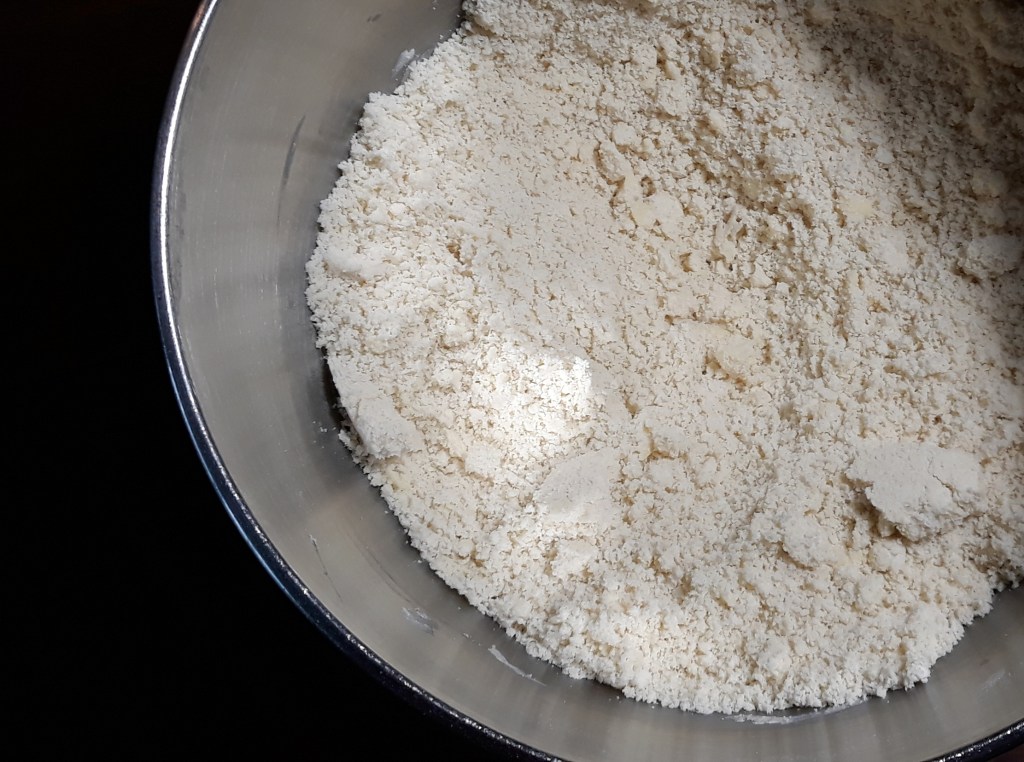
The last in a quartet of gooseberry posts – I promise I will change the subject next post.
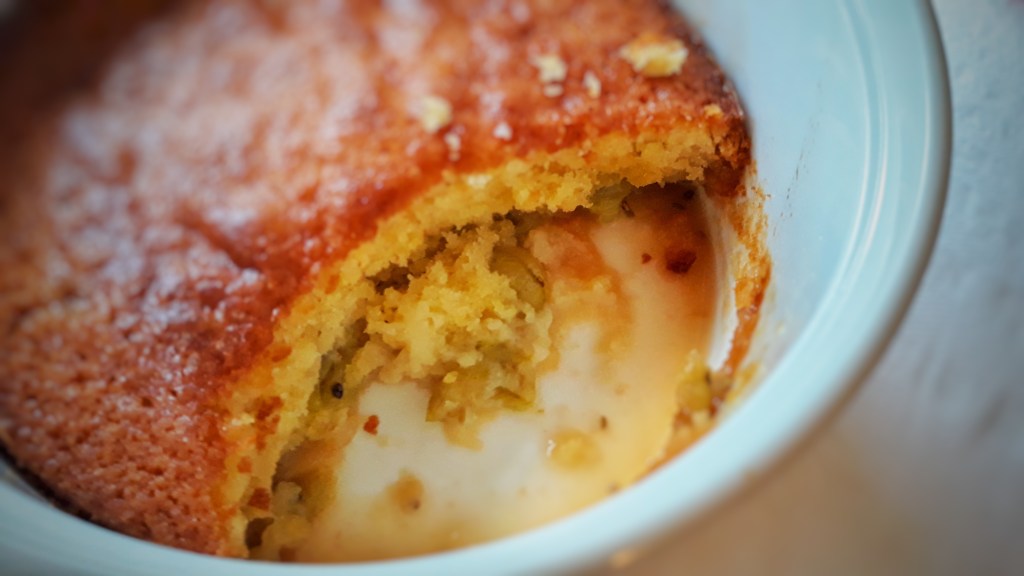
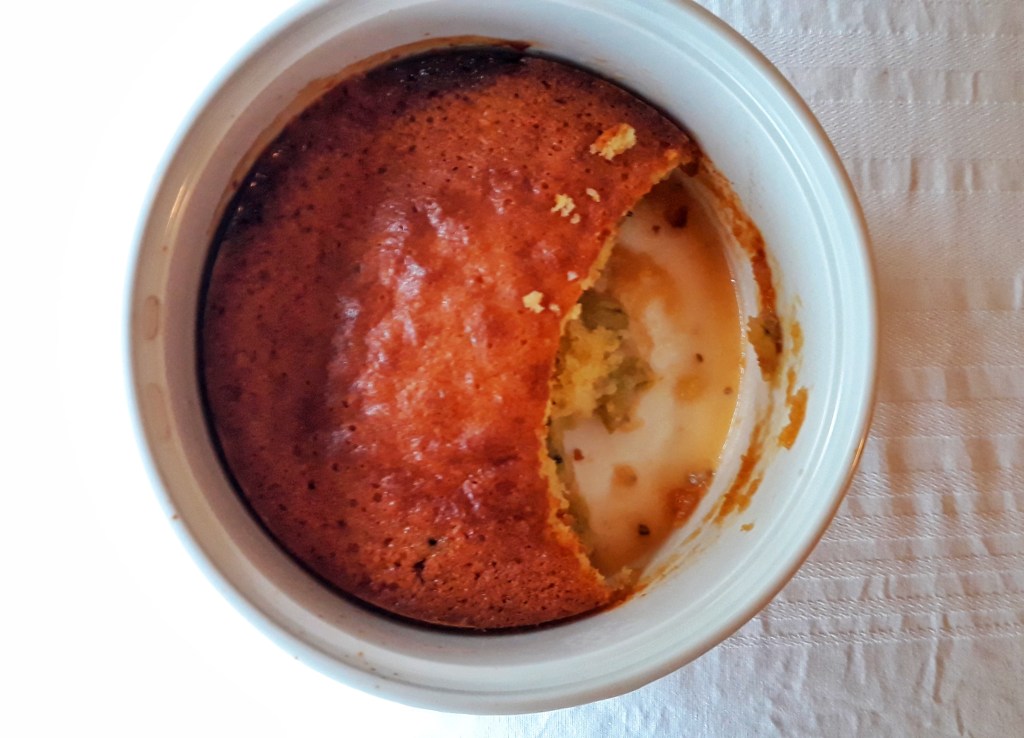
In my honest, humble opinion this is the best
gooseberry dessert recipe. It’s old-fashioned and simple to make – gooseberries
are baked with a little brown sugar and a knob or two of butter, all covered in
cake sponge. The berries are still very sharp and are perfectly balanced with
the warm, sweet sponge. This is much more superior to the better-known Eve’s
pudding – stewed cooking apples covered in sponge cake. I suspect this would work
excellently with blackcurrants.
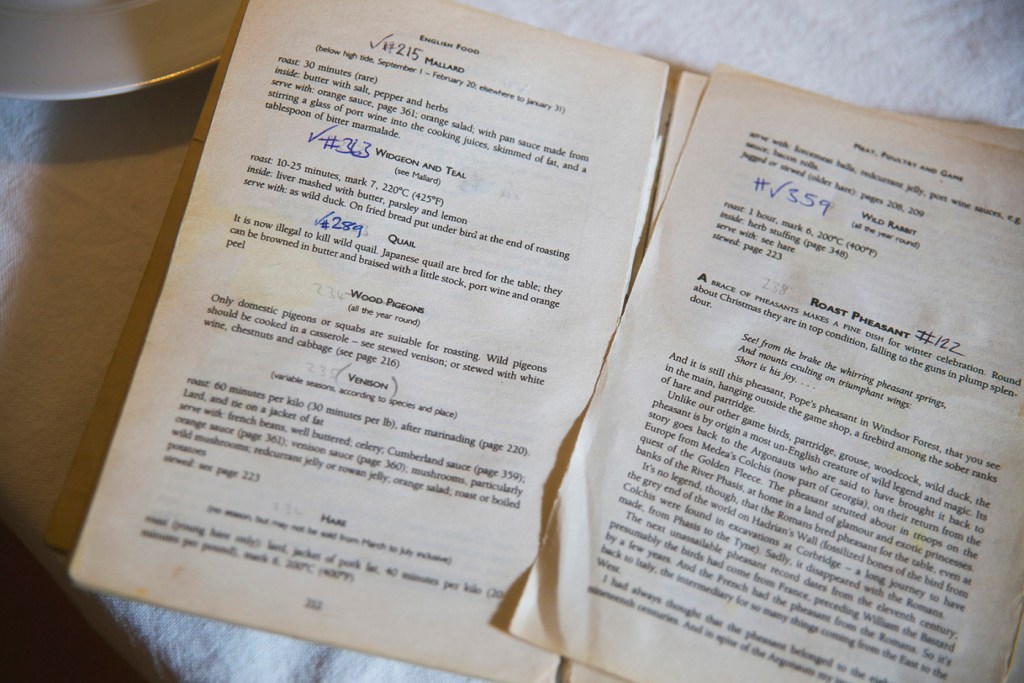
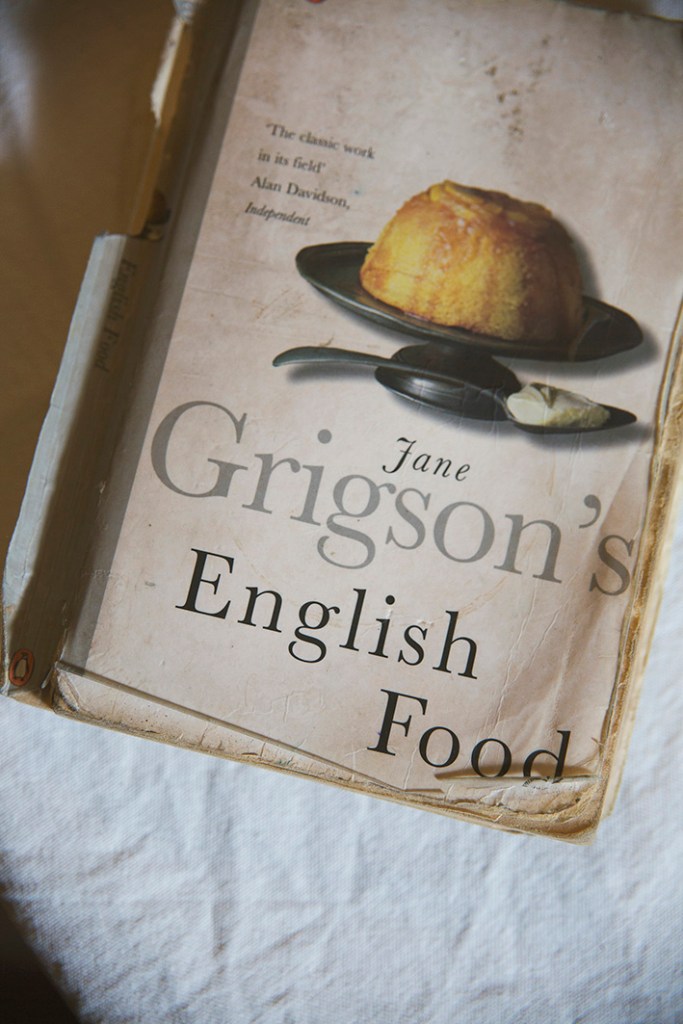
This recipe crops up in my traditional English or British cookery books, but I first heard of it from Jane Grigson (as I have many dishes) in her book English Food.
For the pudding, you can make any amount of topping, it’s
dependent upon whether you like a thin or thick layer of sponge and the
dimensions of your baking dish. I used a soufflé dish of diameter around 7
inches/18 centimetres. I think this is a good amount for this size, and for
most family-sized dishes.
The sponge is made using the all-in-one method, so make sure
your butter is extremely soft to ensure a light topping.
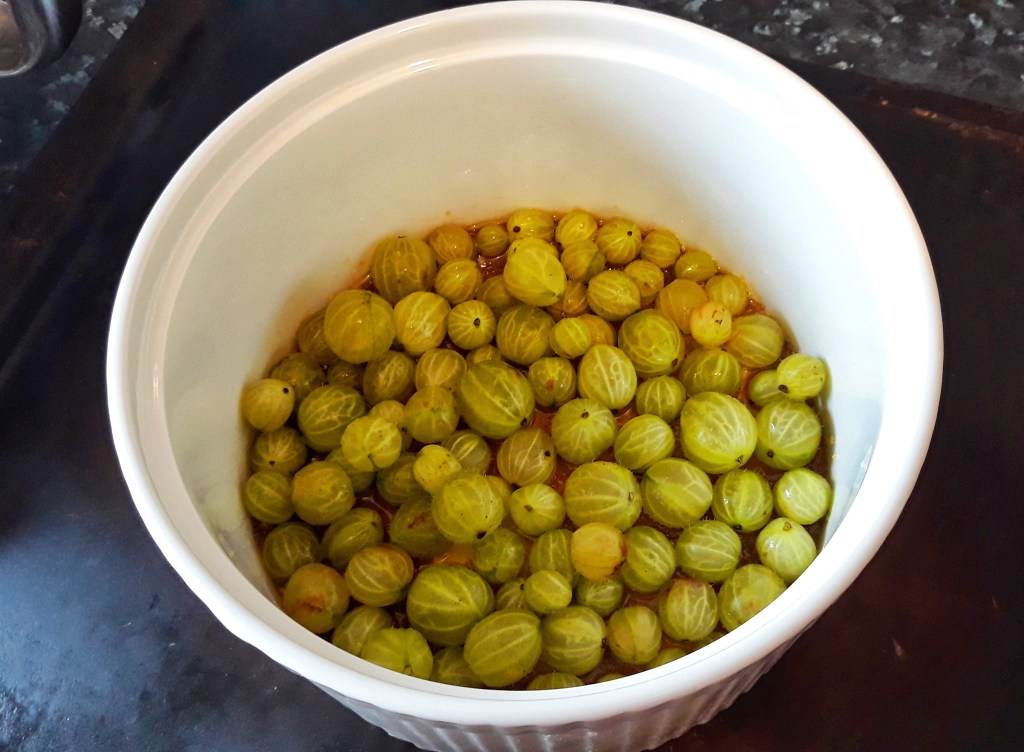
Scatter the sugar and dot the butter on the bottom of your
baking dish and cover with the gooseberries; you are aiming for a generous
single layer of them.
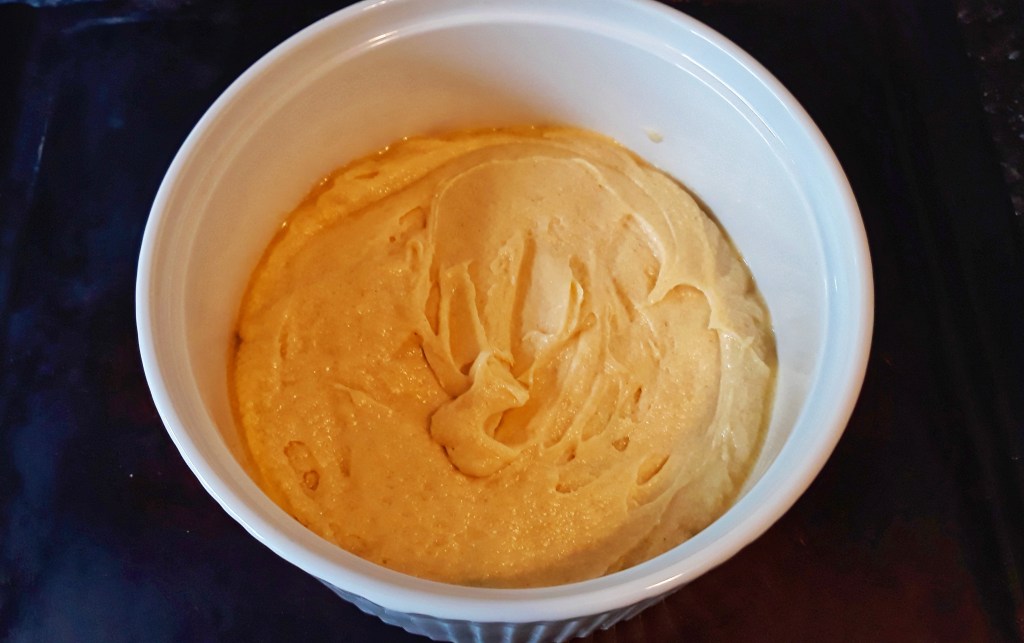
Place the butter, flour, caster sugar and eggs in a bowl and
beat together with an electric mixer until the mixture is smooth and
well-combined. Using a large spoon or spatula, add the cake batter in big
spoonfuls over the gooseberries and level it, you don’t have to be very neat
here, the baking batter will flatted itself out.
Place in the oven and bake for around an hour until the top
is a deep golden-brown colour.
Serve immediately with custard or lightly-whipped cream sweetened with a little icing sugar.
If you like the blogs and podcast I produce, please consider treating me to a virtual coffee or pint, or even a £3 monthly subscription: follow this link for more information.
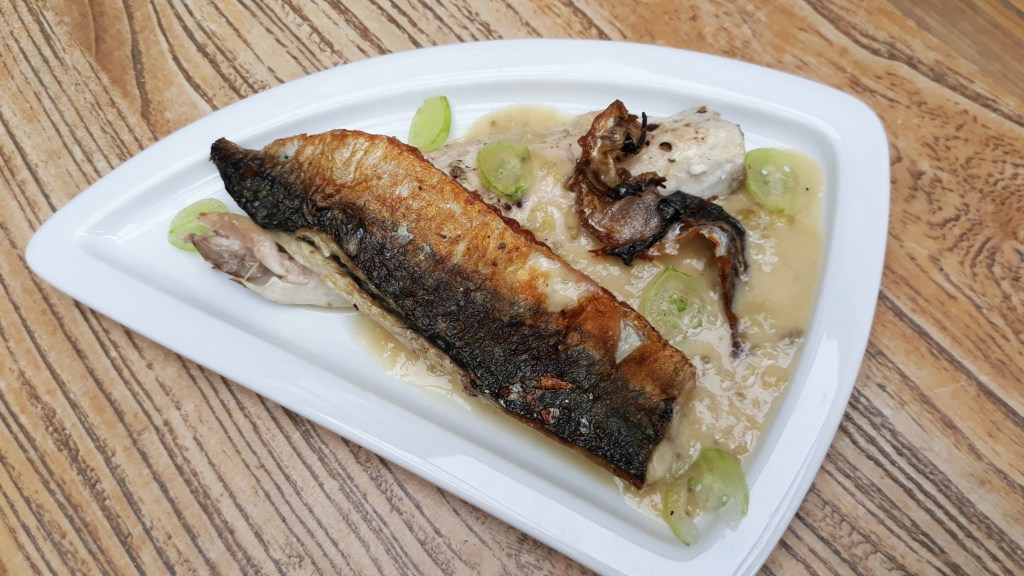
I was kindly given part of a large crop of gooseberries by my friends Kit and Ellie, their two bushes have been prolific this year. Earlier in the summer, I used some of their underripe berries to make a sauce to accompany mackerel, but now they were large and quite sweet.
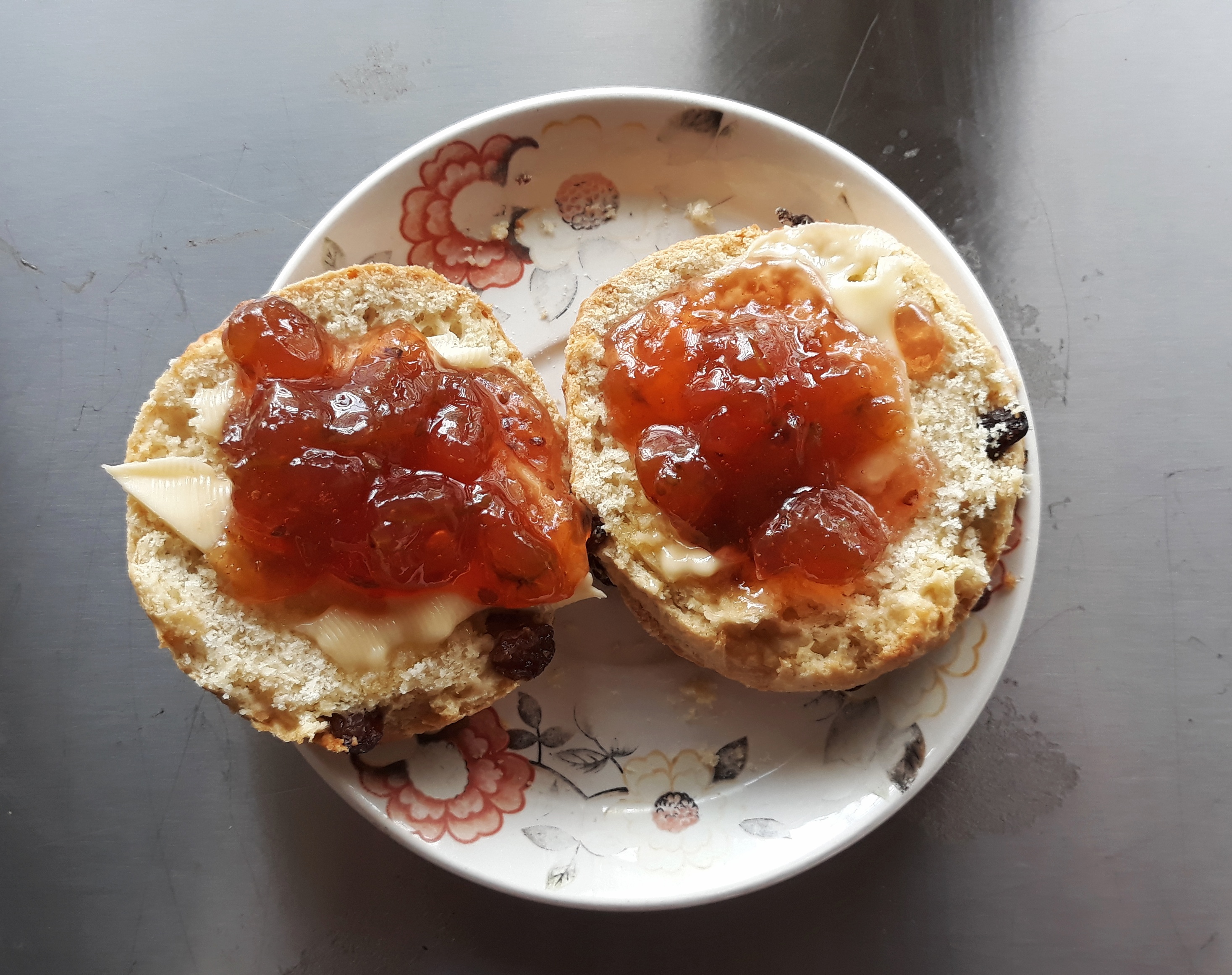
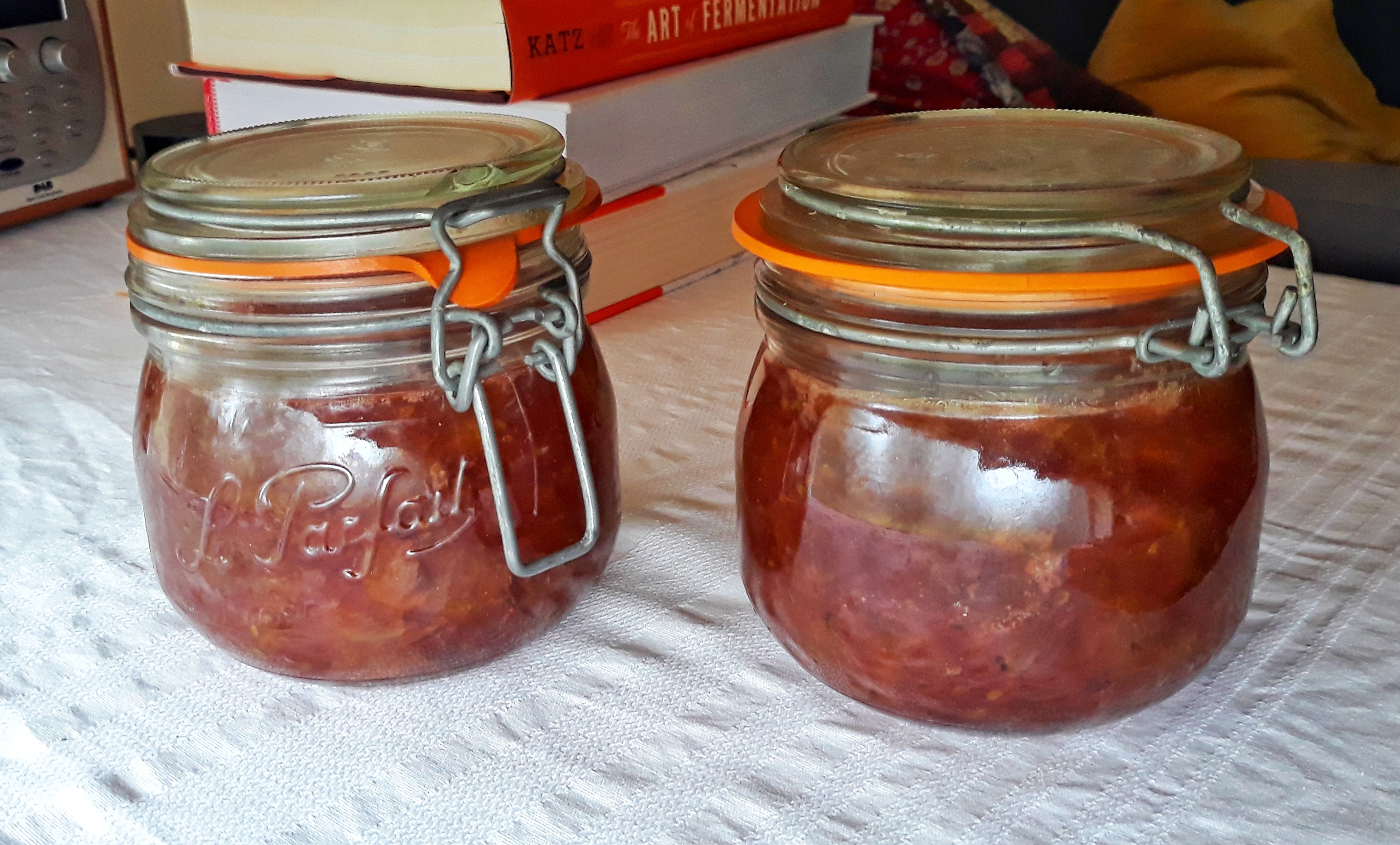
I made the lion’s share of them into gooseberry jam and
thought I would give you a recipe, as it is so easy to make, and you are
unlikely to find it in the shops. If you don’t know of any gooseberry bushes,
try a greengrocer – I have spotted them in quite a few shops this year.
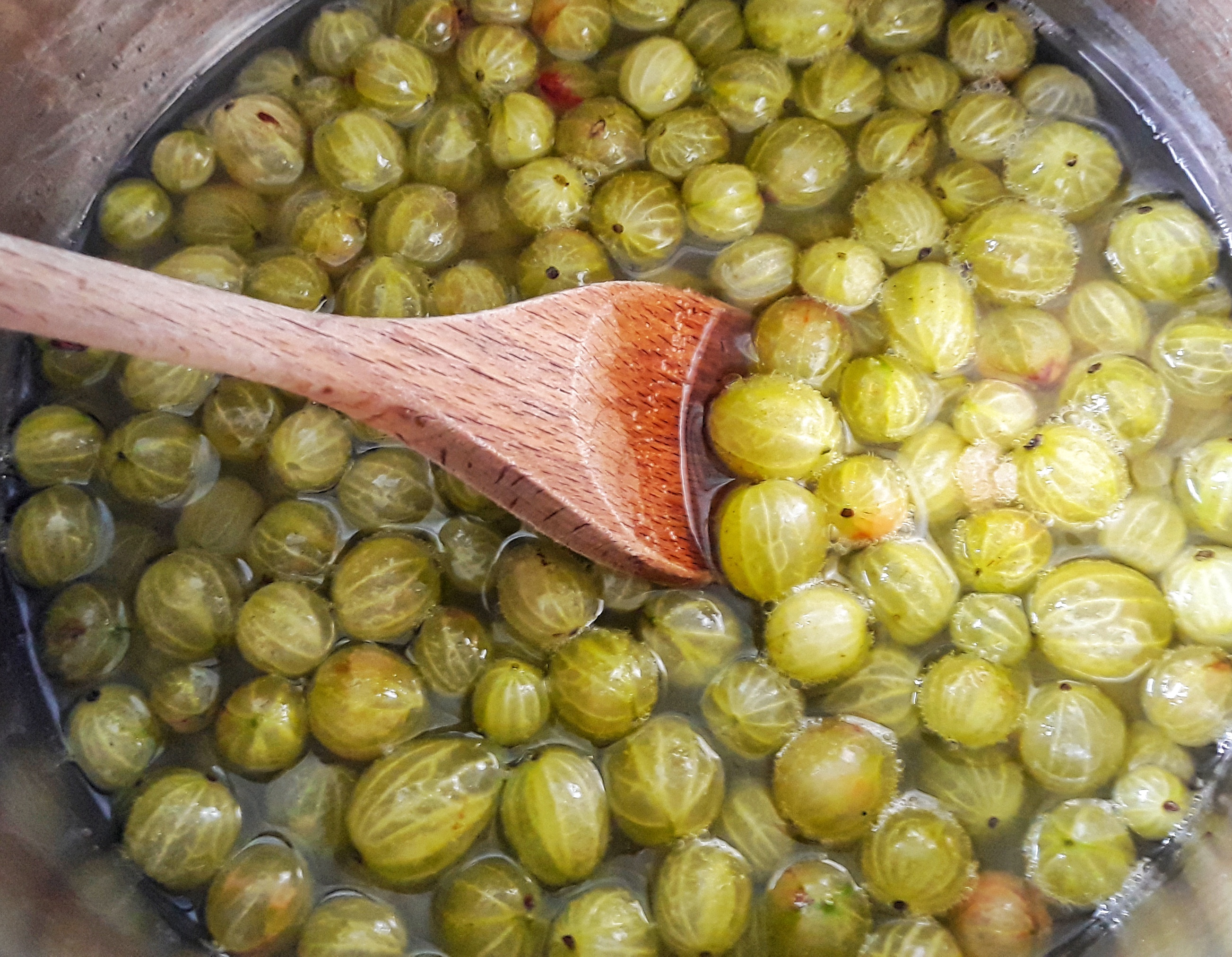
The great thing about gooseberry jam is that the
gooseberries change in colour, adopting an appetising warm pinkish hue with the
intense heat of jam-making. This change is apparently due to the anthocyanins
in the gooseberries interacting with metal ions leached from the cooking vessel
itself.
Gooseberries are not as juicy as their red, white and blackcurrant relatives so they need a bit of extra added water to help dissolve the sugar. Gooseberries are high in pectin, especially when young, so there should be enough to set the jam. However, if they are late season and ripe, you might want to replace a small proportion of the sugar with jam sugar, which contains pectin, to give them a helping hand.
The jam I made is simple: gooseberries, sugar and water, but
if you have any of the extras in the ingredients list below, feel free to add
them if you like.
The jam makes a great roly-poly or Victoria sponge filling.
The quantities below makes around 1 litre of jam, and it is
easy to scale up or down depending upon the amount of gooseberries you have to
hand.
1 kg gooseberries, washed, topped and tailed
1 kg granulated sugar (or 800 g granulated and 200 g jam
sugar, if the gooseberries are ripe
500 ml water
Optional extras: A dozen elderflower heads wrapped in
muslin, a good bunch of sweet cicely tied with twine or replace 250 ml of the
water with Muscat wine.
Before you start, place a saucer in the freezer.
Place all the ingredients in a large, heavy based saucepan on a medium heat.
Stir occasionally and when all of the sugar has dissolved, turn the heat up to bring the gooseberries to a really good boil. After around 15 minutes – by now they should have a pinkish tinge about them – test to see if you have got a set. Either take the jam’s temperature with a temperature probe and see if it is 105°C, or take a teaspoon of the mixture and place a few drops on your very cold saucer you had stored in the fridge, let it cool for a minute and see if the drops wrinkle when you push them with a finger.
You can use a candy thermometer instead of a probe, but I
find them imprecise. However, if you have a trusty one, by all means slot it
down the inside of jam before you start to boil it.
Leave the jam to cool for 15 minutes and skim any scum with
a large spoon or ladle.
Have some sterilised jars ready and ladle in the jam. A jam
funnel is helpful here. Alternatively, pour the jam into a Pyrex or stainless-steel
jug rinsed out with scalding water and carefully fill your jars. Seal when
still very hot.
I have written at length about setting points and sterilisation, so if you are unsure, have a look at this post here for a walk-through.
Last post I wrote about the delicious gooseberry. Since I wrote it, I have seen them in quite a few shops, including Morrison’s, so I am feeling good about the gooseberry’s culinary future.
You’d think after all these years, I’d be better at taking photographs!
It is important to remember that gooseberries can be served
with meat and fish in rather the same way as tart Bramley apples are: oily fish
such as mackerel is the classic pairing, but I have found recipes that match it
with chicken, goose, pork and mutton or lamb. Sauces and stuffings are made
with the small new tart berries, with just a little sugar. The simplest sauce
being made from halved berries, chopped mint and sugar. The ingredients are
mixed, covered and left to macerate for several hours. Delicious with barbequed
mackerel or herring, and the fact it isn’t cooked means the gooseberries retain
their vibrant green colour.
I mentioned that in France it is known as the mackerel
currant, because it is only ever really served with the oily fish, and even then,
it’s considered particular only to Normandy. It did start life as an English
dish, but as there was much communication between England and Normandy during
the mediaeval period, it’s no surprise that they picked up some tips from the
English during centuries of toing and froing.
I’ve taken elements from three different recipes to come up with mine: Jane Grigson’s English Food (1992), Eliza Acton’s Modern Cookery for Private Families (1847) and Elinor Fettiplace’s Receipt Book (1604). Talent borrows, genius steals and all that. Many of the ingredients are optional, so if you want a cleaner tasting sauce, omit the cream and maybe the butter too. If you are interested, there’s also a great recipe for a gooseberry stuffing for mackerel on my other blog.
It’s a delicious combination – simply grilled mackerel and
the tart sauce, and maybe a green salad on the side. It’s telling you that
summer is here! This pairing is largely forgotten now, but look in some older British
cookery books and you’ll see it crop up again and again.
If you like the blogs and podcast I produce, please consider treating me to a virtual coffee or pint, or even a £3 monthly subscription: follow this link for more information.
Young, green, small gooseberries are required for recipes
that are served with savoury food – the later, large sweet ones are best used
in desserts (recipes for those coming soon).
250 g gooseberries, topped and tailed
50 ml water
50 ml white wine, or a dash of cider vinegar
50 g sugar, or to taste
good pinch of ground ginger
salt and pepper
a knob of butter (optional)
2 to 3 tbs double cream (optional)
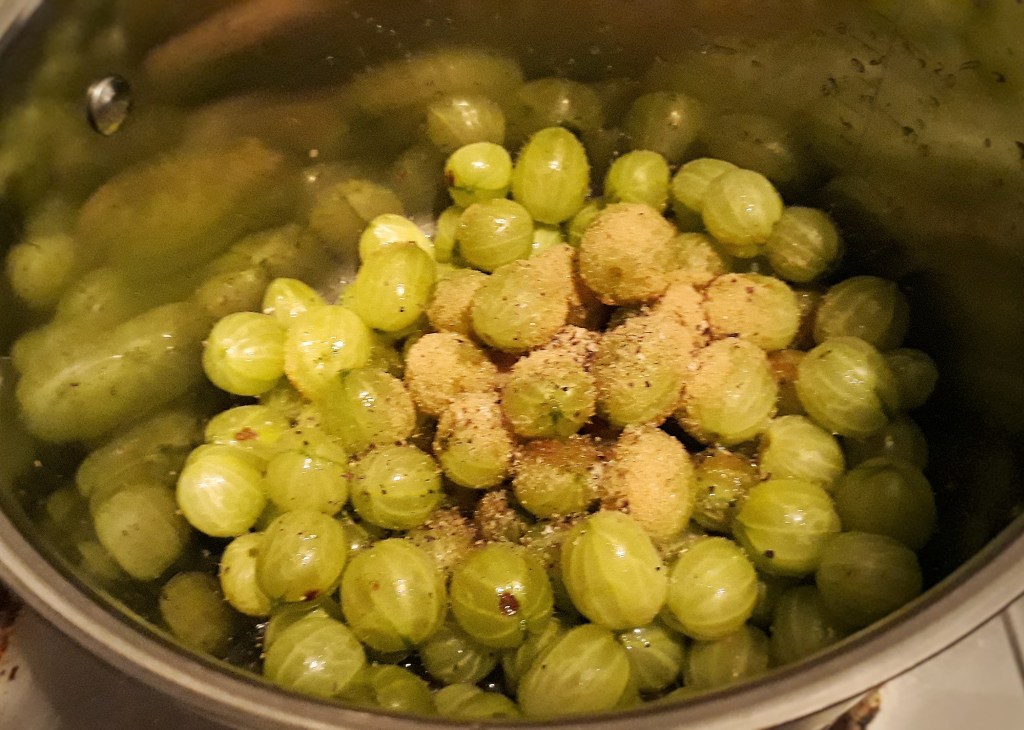
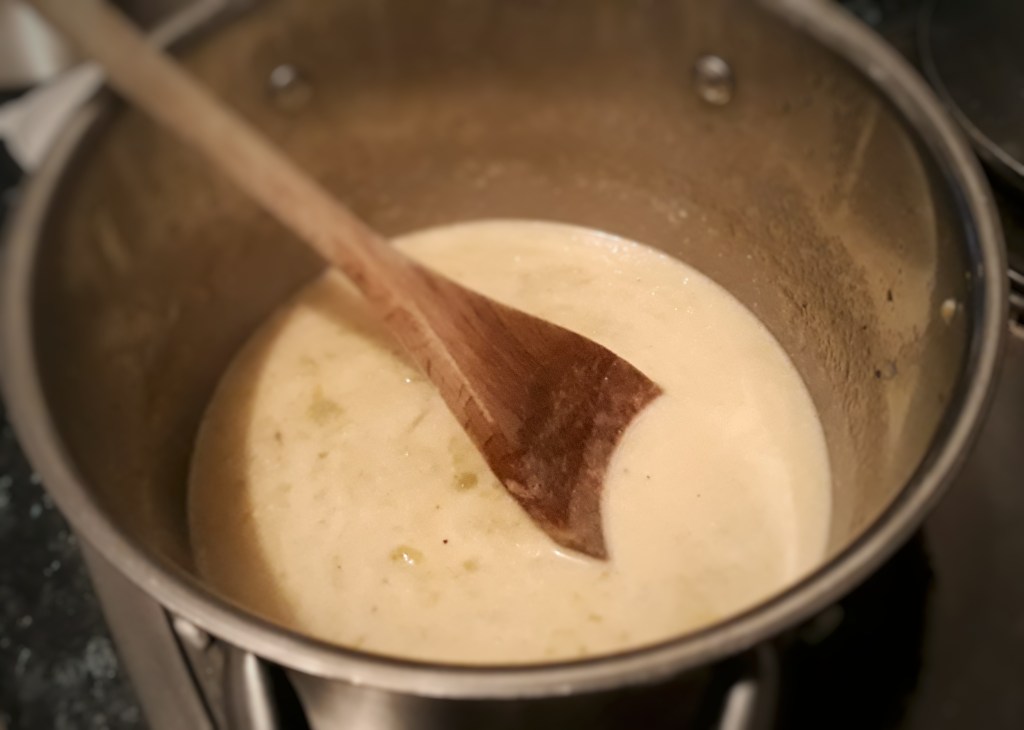
Put the gooseberries, water, wine or vinegar and sugar in a saucepan and cook until the gooseberries go pale in colour and start to become very soft, crushing them against the side of your pan with a wooden spoon. Season with salt and pepper.
If you want a very smooth sauce with no seeds or pulp, whizz
the whole thing in a blender and pass through a sieve. I like to leave mine
with some texture, but it’s up to you. If you did pass it through a sieve put
it in a clean pan and put it over a medium heat.
Smooth or pulpy, beat in your butter with whisk or spoon
until it becomes glossy, then add the cream.
Add more sugar if you like – remember it isn’t supposed to
be sweet like apple sauce.
Serve alongside grilled or fried mackerel, but also pork,
chicken or goose.
Hello lovely followers. Just a quickie to let you know that the sister blog to British Food: A History, Neil Cooks Grigson has moved from Blogger to WordPress. It makes much more sense to have them on the same format.
If you’ve never checked it out, now is your chance – there’s over 400 recipes on there, all fully reviewed. There are some amazing ones, and a fair few disasters, warts and all. So if there’s a classic English dish or recipe you’ve always wondered about, chances are I’ve cooked it up.
Just click on this link here and follow – I’d be most grateful!
I’ll be putting a few posts on there to help newcomers get up to speed on the project in the coming weeks, so keep an eye out.
Last post I wrote all about the mediaeval dish Blanc Mange, an almond and rice stew served with chicken or fish. Obviously, I couldn’t let the opportunity pass to give you a recipe for the dessert blancmange we know and love (or hate).
Blancmange went from a savoury to a sweet dish somewhere
around 1600 – 1604 is the earliest recipe for it I can find that sounds like
the pudding we eat today.
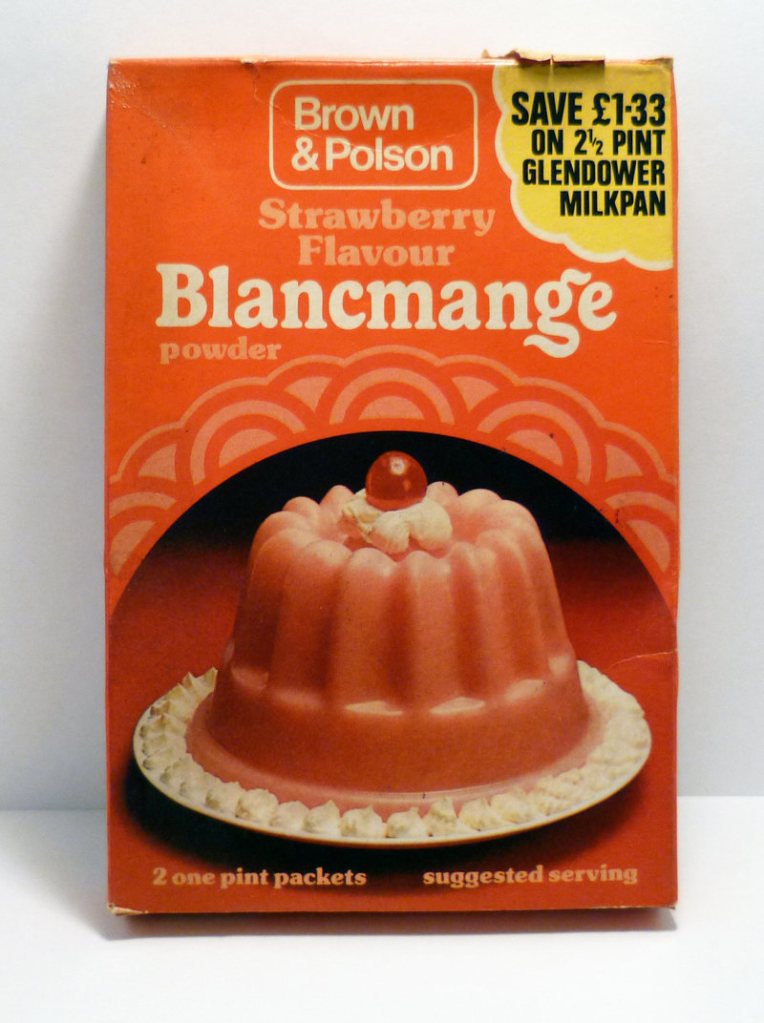
When one thinks of blancmange, a shuddering over-sweet pale
pink mass doused with cloying raspberry flavouring is imagined. This is not a
proper blancmange. When I make one, I go back to basics.
photo: unknown
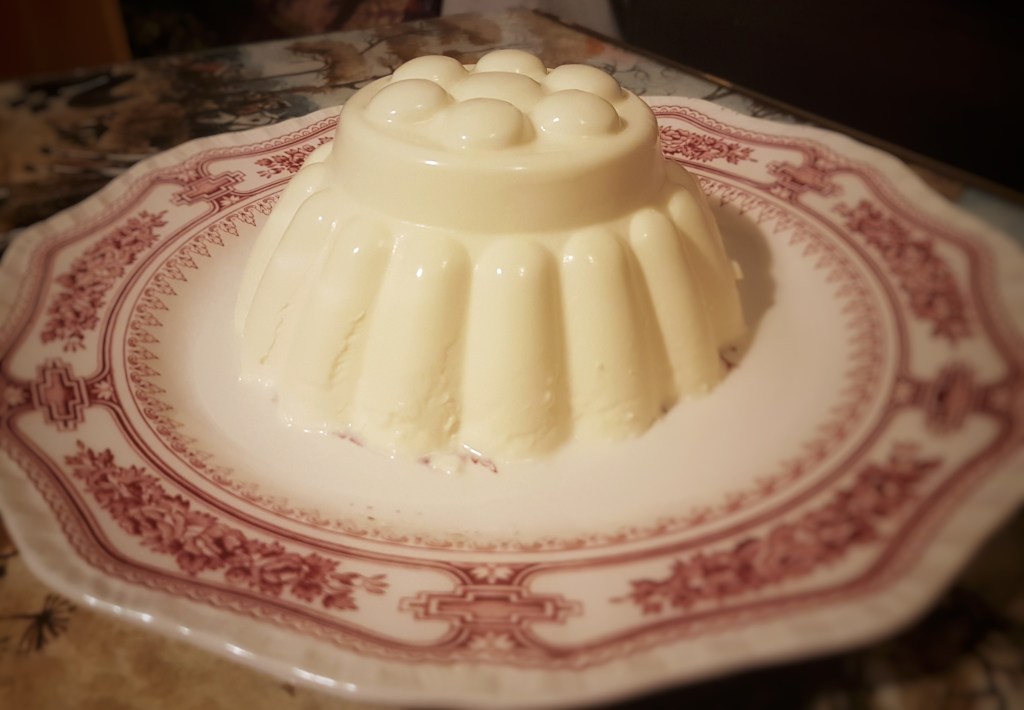
Blancmange should be a simple affair: cream, milk, sugar and
almond extract set with gelatine. In the recipes from earlier than the 20th
Century, the gelatine would have been prepared in house from calves’ feet or
pigs’ trotters. There was an alternative setting agent called isinglass which
is made from the dried swim bladders of fish.
By the way, the pronounced almond flavour of almond extract is not supposed to emulate that of regular almonds, but of bitter almonds which were high in cyanide and therefore used in small, highly aromatic doses. Other things were sometimes added to this basic mixture: lemon zest, cinnamon, brandy and rose water all crop up in recipes through the centuries.
If you like the blogs and podcast I produce, please consider treating me to a virtual coffee or pint, or even a £3 monthly subscription: follow this link for more information.
The blancmange went rather downhill once you could buy it in packet form. The almond extract or bitter almonds replaced with almond flavouring and instead of gelatine, cornflour was used. This is the dessert that many people hate. I must confess to quite liking the preparatory blancmange, but then, I’ll eat anything. It shouldn’t be called blancmange though, as it is quite a different beast; fake flavour and thick cornflour base making the final pud less jiggly and delicate. I suppose that after the realisation you could set custard with cornflour instead of egg yolks, the ‘magic’ formula was applied to blancmange.
I like to serve blancmange with a compote of cherries
flavoured with a dash of kirsch and some delicate shortbread biscuits, but it
is pretty good served all on its own. Who needs panna cotta!? If you want to
turn the blancmange out of its mould, it is worth brushing the inside with a
thin layer of sunflower oil so that it is easier to turn it out.
Makes 600 ml:
250 ml whole milk
gelatine leaves (see method)
100 g caster sugar
300ml double cream
1 tsp almond extract
Heat up the milk in a saucepan and as you wait, soak the gelatine leaves in cold water – check the instructions in the packet and use the correct number to set 600 ml except use one leaf fewer than instructed – you want a good wobble.
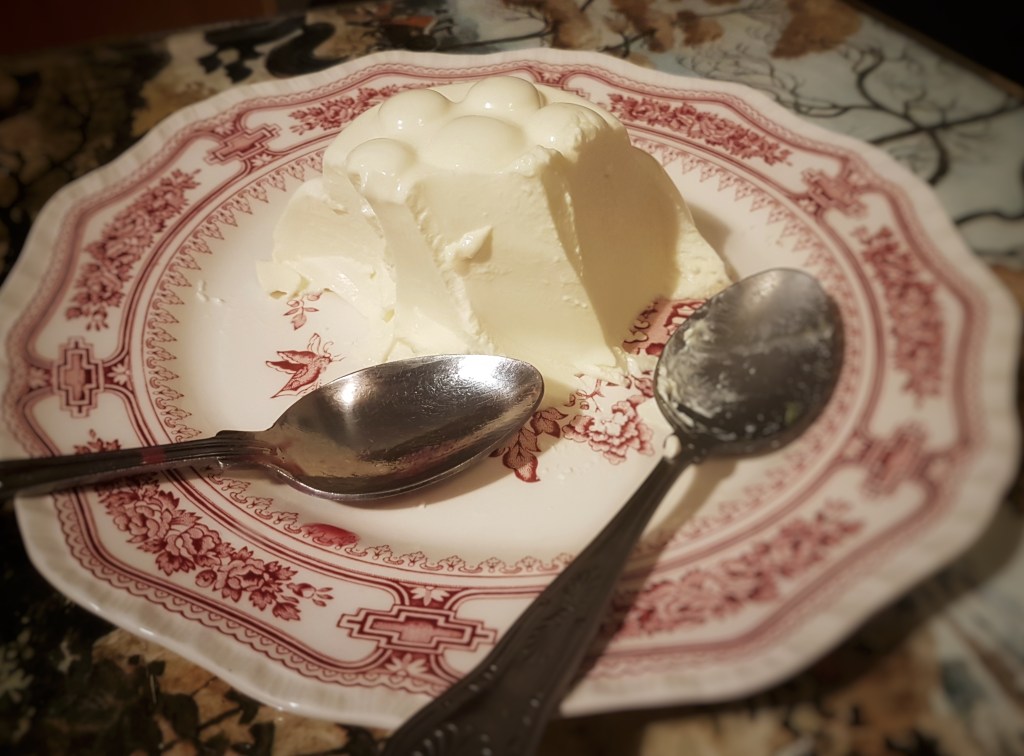
A good wobble…
When the milk is very hot, squeeze out the excess water from
the gelatine and whisk it into the milk along with the sugar. Once dissolved,
add the double cream and almond extract. Pour into your mould or moulds, cover
with cling film or a plate and refrigerate overnight. If you like, you can whip
the cream until floppy and stir it through the milk when it is just warm. This
way you get a mousse-like consistency – good if you want to serve it at a
dinner party.
To turn out the blancmange, dip the moulds in hot water for
around 10 seconds. To make it release you may have to carefully coax the blancmange
from the inside edge of the mould with your finger; if you can move it away
easily, it should come out. Place a serving plate on top and quickly flip it
over – the blancmange should release, if not, simply dip it in the water for a
further 10 seconds.
Once turned out, you may find that some of the blancmange has
melted, so tidy up the plate with a piece of kitchen paper before serving.
I’m carrying on the medieval almond milk theme (I will move away from this topic, I promise) with another post on what could be described as mediaeval England’s national dish – blanc mange. Blanc mange – literally white food – was a simple stew of poultry and rice poached in almond milk. Over the centuries, it evolved into the wobbly dessert we know and love (or hate) today. In France almond soups thickened with rice or bread are still eaten, so it appears that the blanc mange diverged into two different dishes: cold pud and creamy soup.
Blanc mange wasn’t just popular in England, but over the whole of mediaeval Europe. It began life as a Lent dish of rice, almond milk and fish such as pike or lobster, but people liked it so much that it was eaten at every meal, where the fish could be substituted with chicken or capon. Outside of Lent it could be flavoured with spices such as saffron, ginger, cinnamon and galangal, seasoned with verjuice, sugar and salt. It is thought that the dish originates from the Middle East, the part of the world we imported rice and almonds.
It’s worth mentioning that although a Lent dish, no commoner
could afford this meal even in its most basic form– imported rice and almonds
were very expensive, as were farmed chickens. This was commonplace food for the
richer folk of society.
Here’s an example of a blanc mange recipe from around 1430:
For to make blomanger. Nym rys & lese hem & washe
hem clene, & do þereto god almande mylke & seþ
hem tyl þey al tobrest; & þan lat hem kele. & nym þe lyre of
þe hennyn or of capouns & grynd hem small; kest þereto wite grese &
boyle it. Nym blanchyd almandys & safroun & set hem aboue in þe dysche
& serue yt forþe.
This recipe seems to be for a blanc mange served cold or warm;
the rice is cooked in the almond milk and cooled while the capon or chicken is poached
separately. Saffron and almonds are sprinkled over the dish before serving.
If you like the blogs and podcast I produce, please consider treating me to a virtual coffee or pint, or even a £3 monthly subscription: follow this link for more information.
I’ve looked at a few recipes and they don’t really change over the next two hundred years – always chicken or fish, rice and almond milk and a few mild spices, sometimes served hot, sometimes cold and often adorned with slivered almonds fried in duck or goose fat and a sprinkle of sugar, all before being served forth. They also seem extremely bland with most recipes containing no spices at all. That said, many of our favourite foods are bland: white bread, mashed potatoes, avocados and mayonnaise all belong in the bland club, so bland does not equal bad. In fact, bland food is usually comfort food, and I strongly suspect that this is what is going on here, a bland white food, served at every meal no matter how grand. Blanc mange was mediaeval comfort food, the macaroni cheese of its day!
The blanc mange went from a chicken and rice dish to wobbly
pudding somewhere around 1600 it seems. A 1596 recipe uses capon meat, ginger,
cinnamon and sugar, and is pretty much identical to the recipes from 1400, but
then I find in Elinor Fettiplace’s Receipt Book of 1604 that she gives
instruction for a cold sweet. She describes a moulded dessert set with calves’
foot jelly (i.e. gelatine), almonds, rice flour, rosewater, ginger and cinnamon.
Mediaeval Blanc Mange
I’ve combined the methods of several recipes from the fifteenth and sixteenth centuries. The important thing to remember is that mediaeval almond milk would have contained sugar, salt and a little rosewater, so if you want to use the modern shop-bought stuff, you might want to add a little of all three for authenticity. Alternatively, you can have a go at making some yourself.
The spices I went for were ginger and cinnamon, but you can
add white pepper, galingale and saffron too if you like.
The only thing I have done differently to the original
recipes is to leave my chicken on the bone; bones stop the chicken drying out
in the cooking process and flavour the dish.
1 chicken jointed into 8 breast pieces, 4 thigh pieces and 2
drumsticks, skin removed
3 tbs duck or goose fat
white rice measured to the 300 ml line of a jug
½ tsp each ground cinnamon and ginger
1 ½ tsp salt
small handful slivered almonds
Demerara sugar and more salt for sprinkling
Pour the almond milk in a saucepan and heat up to almost
boiling. Meanwhile, in a large saucepan melt one tablespoon of the goose or duck
and when hot, tip in the rice. Stir to coat the rice grains in the fat, then
add the spices and salt. Add the chicken pieces and hot almond milk and stir
just once more.
Turn the heat down to low, place on a lid and simmer gently
for 25 minutes.
When the time is almost up, fry the slivered almonds in the
remaining fat until a deep golden-brown colour.
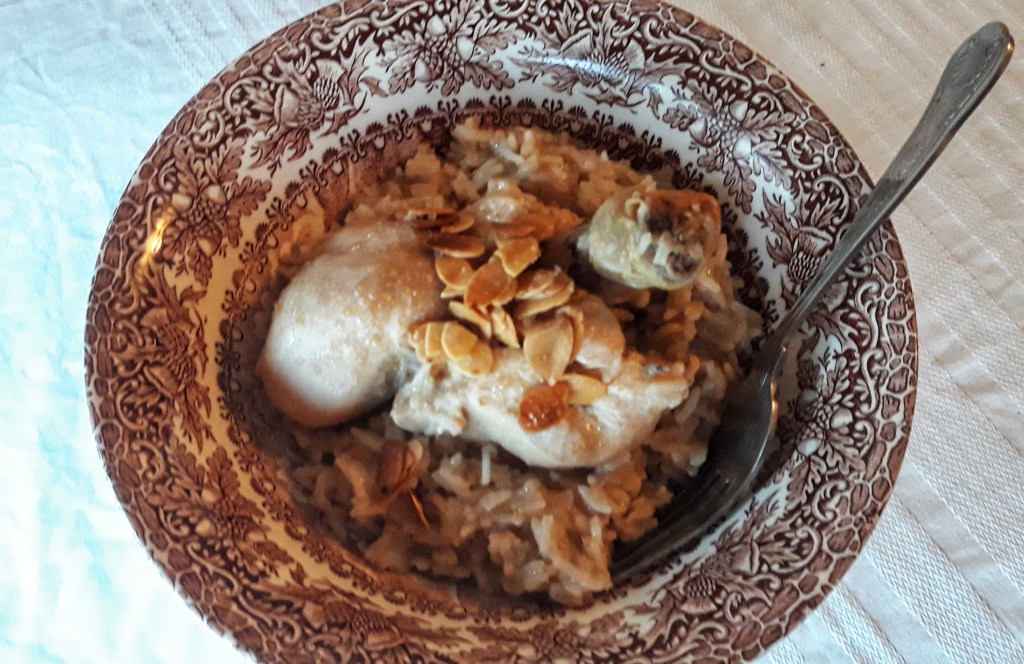
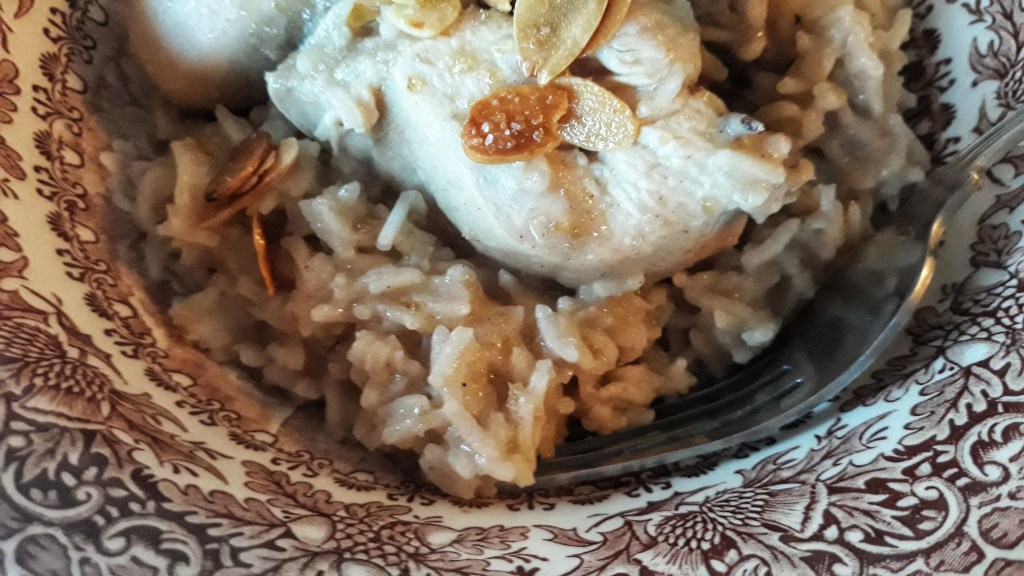
Serve the chicken and rice in deep bowls with the almonds, salt
and sugar sprinkled over.
There you go, pretty easy stuff really. And the verdict?
Well, it was quite bland, but pretty tasty with all of the adornments, and the
flavours developed a lot over night when I reheated some. The sugar wasn’t as
weird tasting as you might expect, and the mild scent of rose water really
lifted the dish. The almonds fried in duck fat were amazing, and I’ll certainly
be stealing that idea. Will I make it again? Probably not, I must admit, but it
was an interesting experiment. Next post, I’ll give you a very easy recipe for
a proper dessert blancmange, one of my favourite things to eat. Until then,
cheerio!
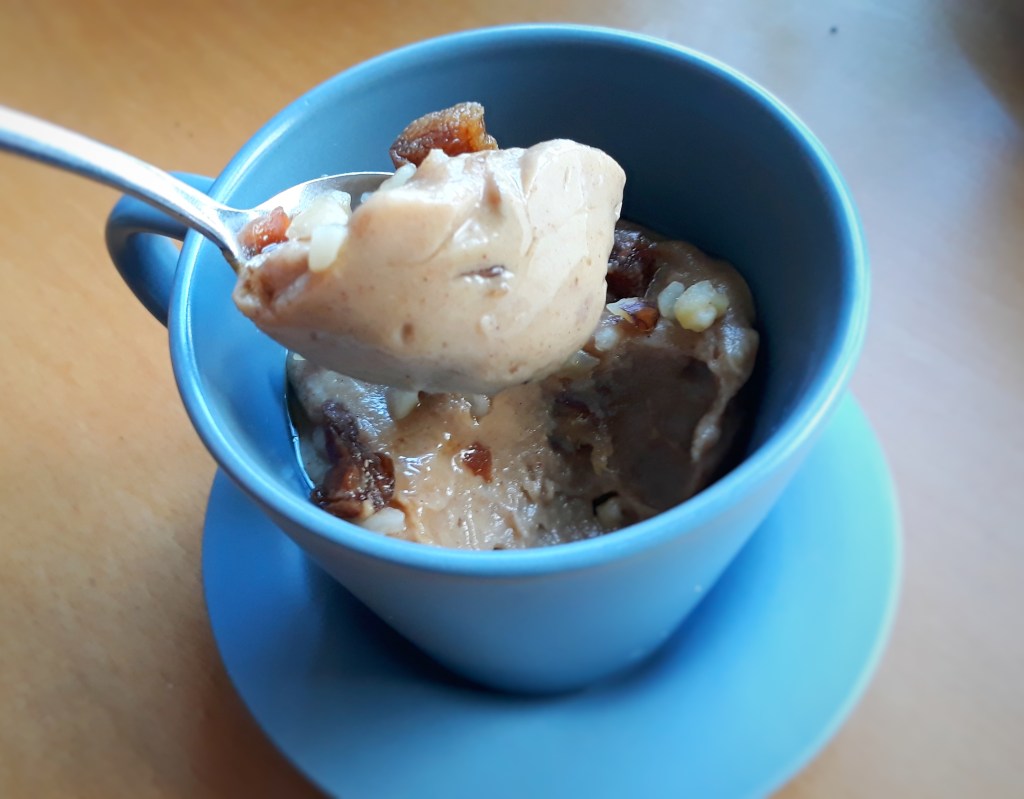
Last post I wrote about my little experiment making almond milk. With my batch I decided to make a mediaeval recipe from the first cook book in English, Forme of Cury. It was written around 1390 by the cooks of King Richard II; I’ve written about it and cooked up a few recipes from it before.
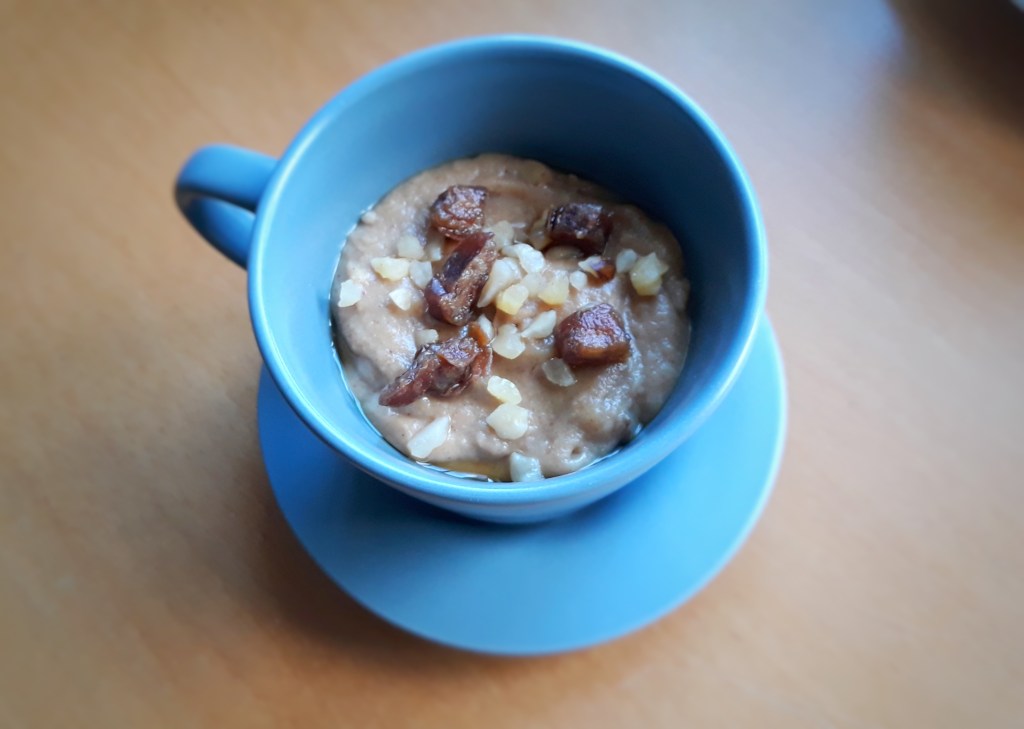
The one I chose is called Rosee, and it is like a pudding – in the American sense of the word
– i.e. a thick custardy dessert. This one is thickened with rice flour instead
of eggs like a regular custard and is flavoured with rose petals (“with flours of white rosis”) as well as
some ginger and cinnamon. It’s not the right time of year for roses, so in lieu
of the blooms, I used some rose water instead. It’s also flavoured with pine
nuts and dates, which also adds a little texture. Sugar is the sweetener –
which wasn’t refined to pure white in the 1400s, so I used soft light brown
sugar to replicate this.
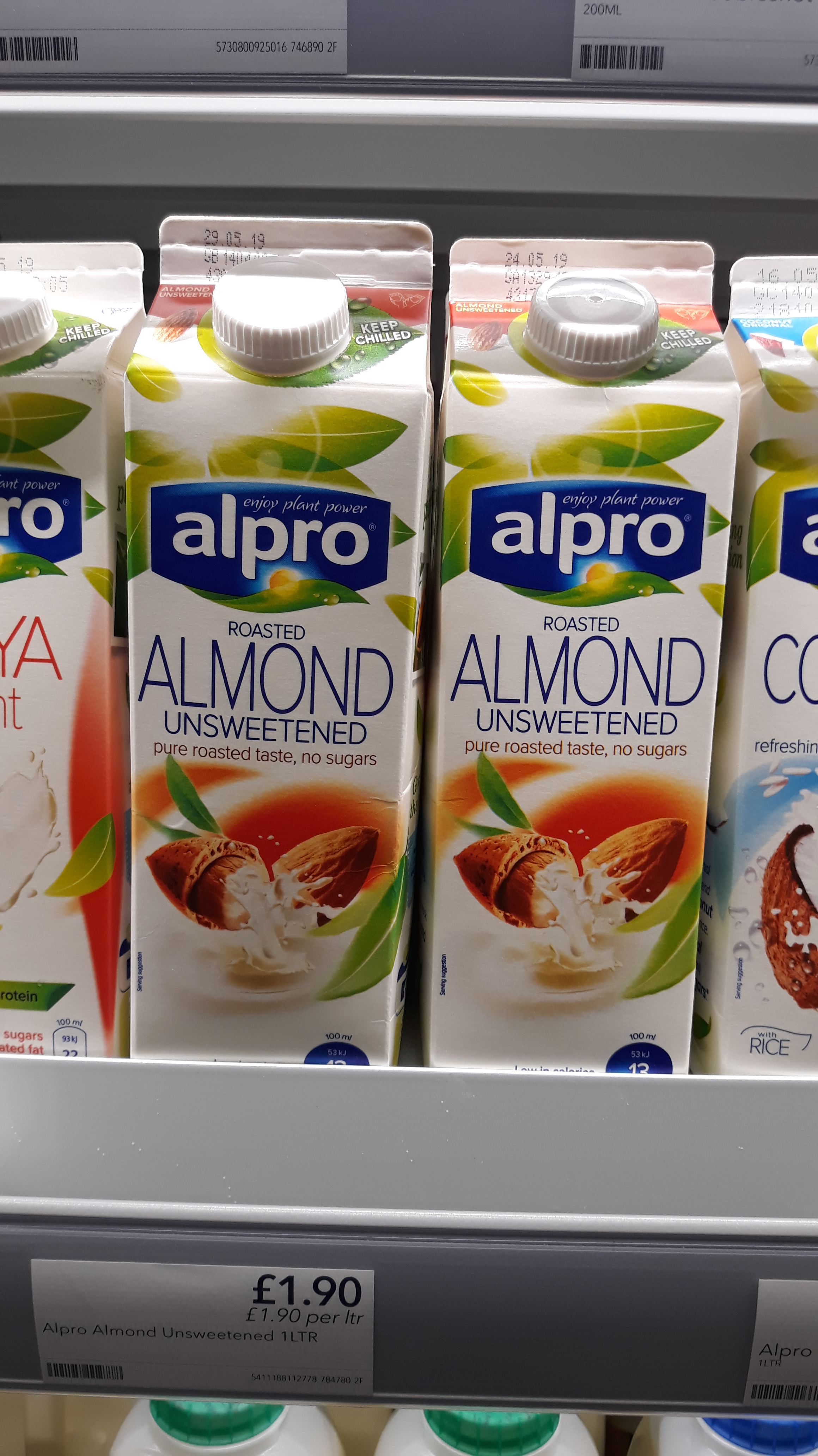
You don’t have to use mediaeval almond milk, you can buy it,
or just use regular cows’ milk.
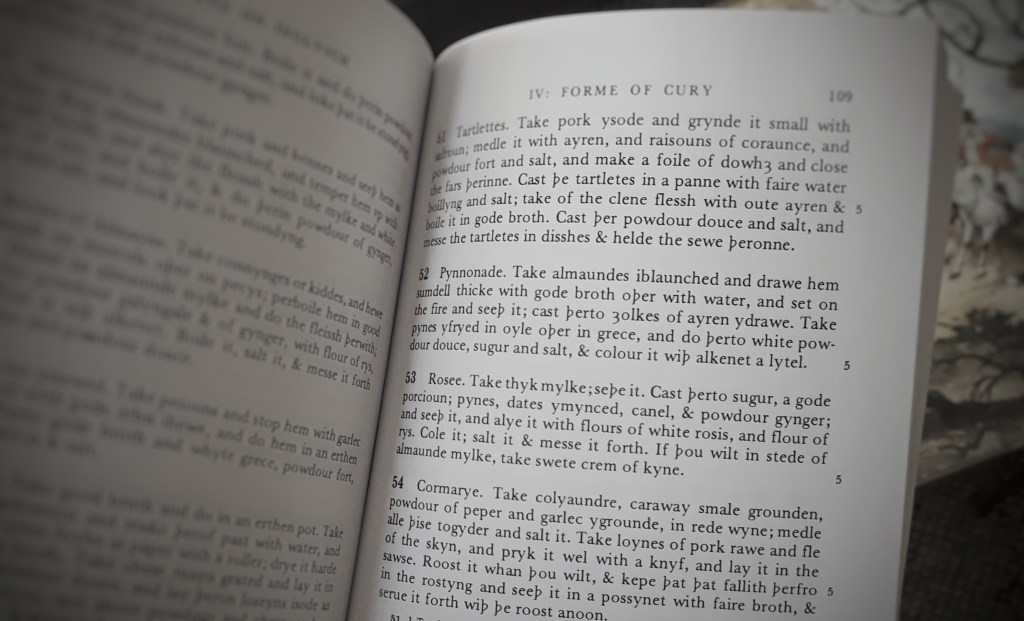
Here’s how it is written in Forme of Cury. It’s hard to decipher, but once you know the now
defunct letter thorn (þ) is makes a th sound (so seþe is pronounced seethe), it makes it a lot easier.
If you like the blogs and podcast I produce, please consider treating me to a virtual coffee or pint, or even a £3 monthly subscription: follow this link for more information.
Rose Pudding 1390:
Take thyk mylke; seþe it. Cast þerto
sugur, a gode porcioun; pynes [pine nuts], dates ymynced, canel [cinnamon], & powdour ginger; and seeþ I, and alye [mix] it with flours of white rosis, and flour of
rys. Cole it; salt it and mess it forth. If þou wilt in stede of almaunde
mylke, take swete crem of kyne [cows].
Hopefully you get the gist – it takes a while to tune in!
I didn’t follow the method exactly – I used my own cook’s logic to the dish – but I made quite a delicious pudding, and it didn’t feel as though it was a vegan dessert. A knob of butter or a glug of cream, goes a long way with making food satisfying, but I genuinely didn’t miss them. It really goes to show that the King and his court did not go without during Lent!
25 g pine nuts or chopped mixed nuts, plus extra for
decoration
2 to 3 tbs rose water
Put the flour and spices in a small saucepan and whisk in
the milk, starting by adding just a third of it at first to prevent lumps. When
all of the milk has been added, put the pan on the heat and bring to a simmer,
stirring well with a wooden spoon or small whisk as it begins to thicken. Add
the sugar, salt, dates and nuts. Keep it simmering very gently for around 10
minutes to cook out the flour. If it looks like it will be too thick, add more
liquid (it sets quite firm, so when it is hot, you’re looking for the
consistency of thick double cream).
Remove from the heat and add the rose water – I like quite a
lot, but it can be rather overpowering, so add enough that seems just right and
then add a shake more. By doing this you are compensating for the fact it will
be served cold, the flowery aroma less pungent.
Pour into serving cups – I went for small coffee cups – scatter
with a few more dates and nuts and cover with cling film to prevent a skin
forming. Pop them in the fridge until set.
Half an hour before you want to serve them, take them out of
the fridge to take off the chill.
Over recent years, as we have become more aware of people’s food intolerances and allergies there has been a great rise in the amount of plant-based milks consumed in the western world. We’ve also realised that there are many benefits associated with the cutting down of animal products in our diets. One of these plant milks – almond milk – is actually having a Renaissance because it was a food that used to be consumed in abundance in mediaeval Europe. Indeed, if I was writing this 20 years ago, it would be appearing in my ‘Forgotten Foods’ series on the blog.
As you may know, mediaeval Christians fasted a lot. There
were two great fasting episodes: Advent and Lent. Every Wednesday, Friday and
Saturdays was a fast day, meaning that around half of the days of the year were
spent fasting. No meat or animal produce was allowed to be eaten, except for
fish which was considered cool and calming and so appropriate for these days of
solemnity.
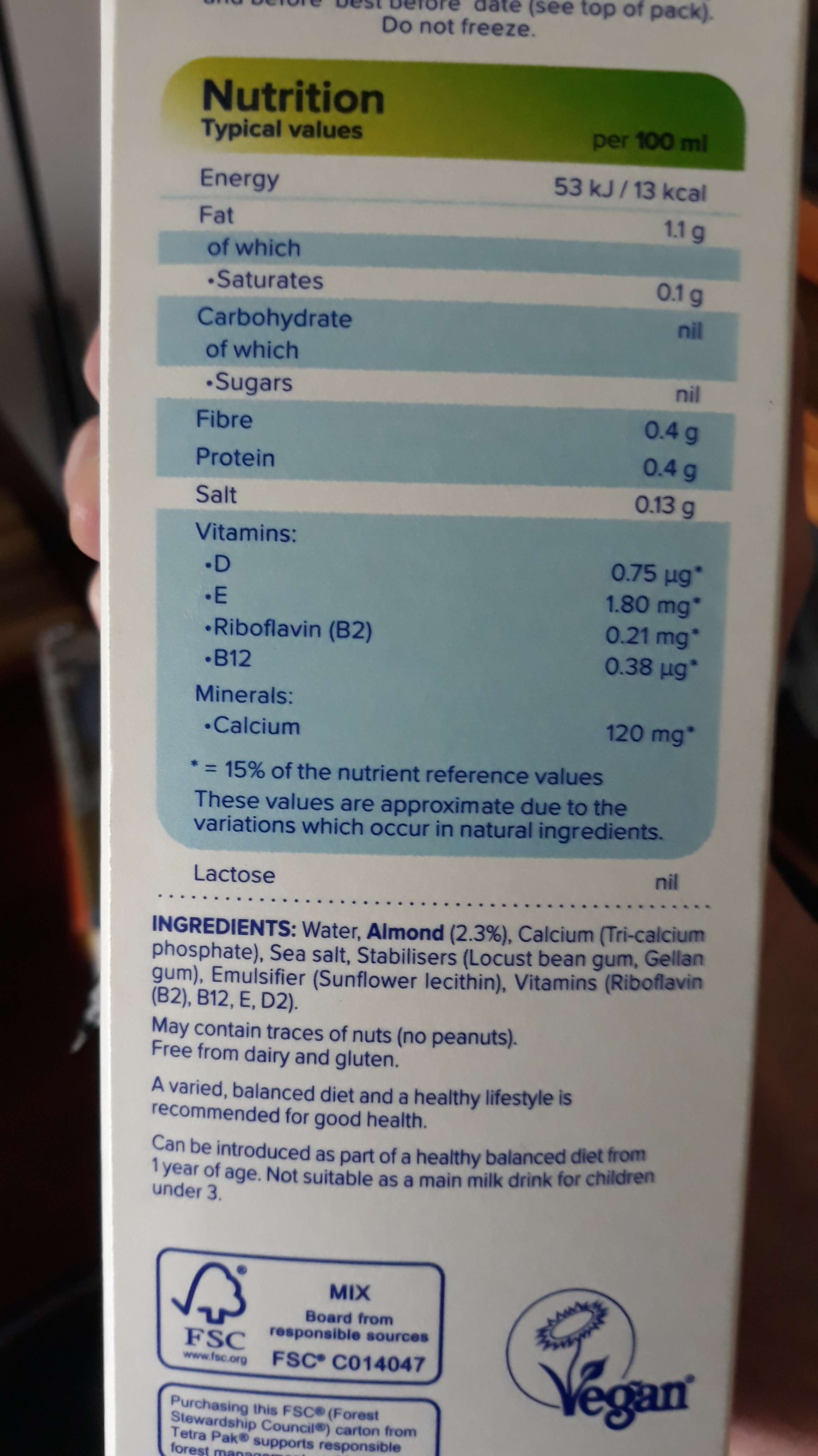
The nutrition contained within almond milk. Notice the added ingredients.
Just like the people do today, mediaeval folk tried to make
alternative products that could fill the same satisfying gastronomical niche as
the real thing. Almond milk was one of those products.
Almonds were imported (as they are now) and very expensive.
Households were expected to make almost all their own food and drinks and
almond milk was no exception. The expense and effort required to make it made
it a fasting ingredient reserved only for the rich, and they consumed a lot of
it. King Edward I went through a startling 40 000 pounds of almonds in just two
years!
I must admit I quite enjoy modern almond milk as a drink or in
porridge but find it otherwise a little insipid, so I was interested in finding
out how mediaeval people went about making it and what it was like. From my
reading, it seems to be thicker and more substantial than todays, where it was
refined into a thick almond cream or curdled to make a kind of almond curd
cheese. I’m not sure if this would be possible using the almond milk of today!
On the other hand, modern almond milk may be more
nutritious. When people moved from cow’s milk to plant-based milks, many didn’t
realise there would be a massive drop in their consumption of nutrients like
calcium and vitamin D. This led to concerns that people would become deficient,
and so modern manufacturers fortify almond milk with extra nutrients to help
people to achieve their recommended nutritional allowances for the day.
If you like the blogs and podcast I produce, please consider treating me to a virtual coffee or pint, or even a £3 monthly subscription: follow this link for more information.
Making Mediaeval Almond Milk
The basic method was acquired from the Arabs who were
supplying much of the almonds themselves via the vast network of trade routes
that stretched out through Eastern Europe, the Middle East and beyond.
The begin almonds would be pounded very fine, sometimes with
a little spring water or rose water to stop them oiling; they didn’t want to make almond nut butter by
accident! After this initial exhausting task, the almonds would be soaked in
spring water (though I have found references to soaking them in barley water
too). After soaking, it was passed through a strainer and seasoned with salt
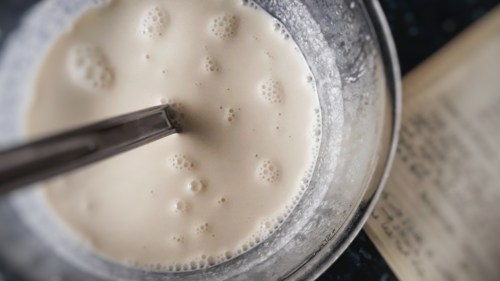
and some honey or sugar. Cream could be made by boiling the milk down until
very thick or made into curds by adding vinegar before straining. I came across
this recipe for an almond cheese so thick, you could slice it:
Take almond milk, and
boil it, and when it is boiled take it from the fire, and sprinkle on a little
vinegar. Then spread it on a cloth, and cast sugar on it, and when it is cold
gather it together, and leche it [slice it] in dishes, and serve it forth.
So how does mediaeval almond milk compare to compare to
todays, and how is it to use as an ingredient?
I updated the mediaeval approach to making almond milk, but the ingredients essentially remain the same.
100g ground almonds
2 tsp rose or orange-flower water (optional)
1 tsp sugar or honey
A good pinch of salt400 ml boiling water
60 ml white wine (optional)
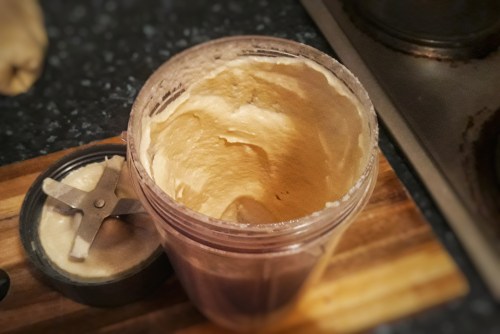
The first task is to get those ground almonds super-fine.
Put them in a blender (a Nutri-bullet style blender is perfect) with the rose
water and about 50 ml of the hot water and blitz in pulses until very smooth. Add
the rest of the boiling water and leave to stand and soak for around 20
minutes.
Give the milk a good swish around and pass it through a
sieve to remove any large pieces of ground almond. Sweeten with the sugar or
honey, add the wine if using and allow to cool.
The mediaeval almond milk is now ready to use.
The Verdict
Well I must say, I was quite impressed with the end result. It
was more substantial than bought almond milk in both texture (it was creamy)
and taste (the honey, salt and rose water). It wasn’t chalky or gritty either like
I expected. I don’t recommend adding the wine however; it put the flavours out
of kilter for me, but each to their own I suppose.
I heartily recommend making some. I made a rose-flavoured pudding (see next post) and I even tried making the cheese with the left-over almond milk.
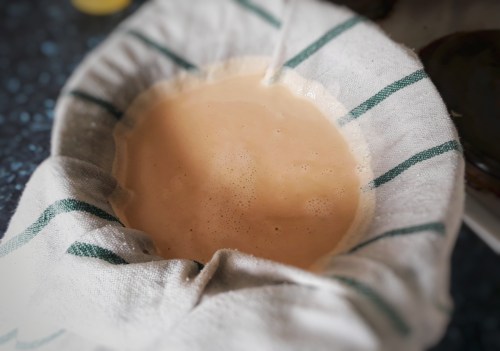
I was rather odd in flavour, I added soft dark brown sugar and a couple of tablespoons of red wine vinegar, let it stand for a few hours and then passed it through a scalded tea towel sat in a sieve. It could make an interesting mediaeval version of a Yorkshire Curd Tart I think.
Many traditional recipes require fresh or dry breadcrumbs; they are an integral part of many puddings and savoury dishes. They are present in small amounts in sausagemeat, terrines and other early meat puddings absorbing the fats, or may be the main constituent in the stuffing for a roast bird. They are also sometimes used in dumplings instead of wheat flour. In sweet puddings they provide body and structure to custards such as Queen of Puddings, or the cheese and egg mixture in aYorkshire Curd Tart.
Dried breadcumbs can be sprinkled over the tops of dishes (such as myMacaroni Cheese) or used to coat something ready for deep or shallow-frying. I have memories of my mum buying those oddly-orange coloured packs of dried breadcrumbs to coat her fish before frying it. Well, needless to say, making your own will not result in everything it touches look like a Findus Crispy Pancake.
Making Fresh Breadcrumbs
Fresh breadcrumbs require stale bread, and I think that only
real bread – i.e. a loaf made at home or in a real traditional or artisan
bakery – makes decent breadcrumbs. Factory-made supermarket bread and tends to
go mouldy before it goes stale due to its high-water content.
The type of bread is typically white bread, but you can use
any you want, especially if there is only a small amount required, but wholemeal
and sourdough breads will impart their own flavours if the main constituent. White
bread and brioche are best for sweet puddings.
Unless the bread is very well-coloured, I don’t usually
remove the crusts, even if the recipe says I should. Feel free to remove them
yourself, I don’t mind the odd brown speckle in the final dish.
Making them couldn’t be easier. If you have a blender or food processor, simply tear the bread in small chunks and blitz. Usually slower speeds work best. Regular blenders can be a little tricky because they taper at the blades; however, dust off that Nutri-Bullet; they work excellently for breadcrumbing.
If you don’t have a food processor or blender, you can go
old-school and grate the bread by hand with a large cheese grater with a good
grip on it. Good quality bread will crumb easily, so it isn’t the chore you
might expect it to be.
Your breadcrumbs can be used straight away or frozen for later. Whenever you have stale bread in the house, crumb it and freeze it and it’s there waiting for you the next time you have the uncontrollable urge to make a Treacle Tart!
Making Dry Breadcrumbs
If dry breadcrumbs are what you are after, just take your
fresh crumbs and spread them on a dry baking tray and pop them in the oven set
to around 110°C. Check them after 20 minutes
and give them a mix around. Keep baking in bouts of 20 minutes until you are
satisfied that they are completely dry. Let them cool and place in an airtight
box. They will keep happily for several weeks.
If the crumbs are not fine enough, blitz in a clean but
bone-dry food processor until they are as fine as you desire, and great for a
posh Scotch Egg.
If you like the blogs and podcast I produce, please consider treating me to a virtual coffee or pint, or even a £3 monthly subscription: follow this link for more information.
At the end of last year, I finally had the opportunity to visit the United States to visit old friends – and haunts – in Houston, St Louis and Chicago, as well as discovering new cities such as Dallas, New York and New Orleans. It was a crazy whistle stop road trip and no mistake.
Having lived on both sides of the Pond, I can really appreciate the American influence on British cuisine. So much deliciousness has drifted over the Atlantic to wedge itself firmly in the psyche of British – nobody in the UK could possibly imagine a world without mouth-watering pulled pork, pillowy cinnamon buns or squidgy chocolate brownies (and blondies!).
One of the best foods of all is Mac and Cheese, and although considered very much an all-American (or perhaps the American) meal, macaroni cheese has its origins firmly planted in Britain.
Macaroni cheese emigrated to the US and Canada with the British settlers, but it wasn’t until the 1930s, during the Great Depression, that it really became part of American culture. Millions were starving, but one entrepreneurial salesman from St Louis, Missouri had the idea to combine nonperishable dried pasta with dried processed cheese. It could be mass produced and priced low. It was a huge hit, quickly establishing itself as the ‘American Housewife’s Best Friend’, feeding a family of four for just twenty cents. It literally saved a nation from starvation.
Elizabeth Raffauld
The first mention of it my side of the Pond can be found in the 1769 classic cookbook The Experienced English Housekeeper by Elizabeth Raffauld. It says To Dress Macaroni with Parmesan Cheese:
Boil four ounces of macaroni till it be quite tender and lay it on a sieve to drain. Then put it in a tossing pan with about a gill [a quarter of a pint] of good cream, a lump of butter rolled in flour, boil it five minutes. Pour it on a plate, lay all over it parmesan cheese toasted. Send it to the table on a water plate, for it soon gets cold.
All the elements of a modern macaroni cheese: the appropriate pasta, a proto-béchamel sauce, plenty of cream and lots of cheese; perhaps surprisingly, parmesan cheese.
But we can go back even further; back to the 1390s in fact, with Britain’s earliest cookbook Forme of Cury. Pasta made from breadcrumbs (I must try it sometime) cooked in a velouté sauce (like a béchamel but made with stock instead of milk), and something called chese ruayn which was a hard cheese similar in taste to brie, resulting in something half-way between macaroni cheese and a lasagne. I wonder if there’s an extant French cheese that could fit the bill if I tried to cook this dish?
Take good broth and do in an earthen pot. Take flour of payndemayn [high quality white bread] and make thereof past[e] with water, and make therof thynne foyles as paper with a roller; drye it hard and seeth [simmer] it in broth. Take chese ruayn grated and lay it in dishes with powdour douce [a mix of warm spices such as cinnamon, cloves etc], and lay on the loseyns [the pasta sheets] isode as hole as thou myst, and above powdour and chese; and so twyce or thrice [i.e. layer it up], & serve it forth.
This dish must have remained popular because macaroni and other pasta dishes using cheese and velouté sauce appear crop up again in Eliza Acton’s 1845 book Modern Cookery for Private Families. There is also the more familiar béchamel sauce version. What is interesting is that there is a variety of cheeses used in these recipes: Cheddar, Parmesan, Gruyere and blue Stilton all feature. I love blue cheese, so this one really stood out for me and I have adapted it below.
If blue cheese isn’t your thing, replace it with another. Cheddar, red Leicester or a mature Lancashire would all work. This recipe produces a rather saucy macaroni cheese, if you prefer a thicker consistency, add an extra 50 grams of pasta.
If you like the blogs and podcast I produce, please consider treating me to a virtual coffee or pint, or even a £3 monthly subscription: follow this link for more information.
Blue Stilton Macaroni Cheese
Serves four:
30 g plain flour
30 g butter
400 ml hot full-fat milk
150 ml double cream
200 g macaroni
1 slice stale bread
½ tsp chopped fresh rosemary leaves, or ¼ tsp fried rosemary (optional)
225 g Stilton cheese, grated
200 g Gruyere or Cheddar cheese, grated
Pinch Cayenne pepper
Salt and freshly-milled black pepper
First of all make a roux by melting the butter in a saucepan. As soon as it has finished foaming, tip in the flour and mix well with a small whisk or wooden spoon. Cook on a medium heat for a couple of minutes, stirring frequently. If the roux starts to brown, turn down the heat.
Beat in around a quarter of the milk with your whisk, adding another quarter once the first lot is fully incorporated. Repeat until all of the milk is used up. Add the cream and allow the béchamel sauce to simmer gently for around 10 minutes. Make sure you stir every minute or so, to stop the flour sticking to the bottom of the pan.
Meanwhile cook the macaroni in plenty of salted water – follow the instructions on the packet and cook for two minutes less than the instructions state.
Make the bread into breadcrumbs by pulsing in a food processor. If using, add the rosemary half way through the pulsing process.
Take the sauce off the heat and drain the pasta. Stir in the cheeses, mixing until fully incorporated. Tip in the pasta and mix. Now season well with salt, black pepper and Cayenne pepper.
Pour the whole lot into a baking dish of a capacity of 1.5 litres, or thereabouts and bake for around 20 minutes at 180°C until brown and bubbling and the breadcrumbs are well-toasted.
Serve straight away with crusty bread or a rocket salad.