Category Archives: Uncategorized

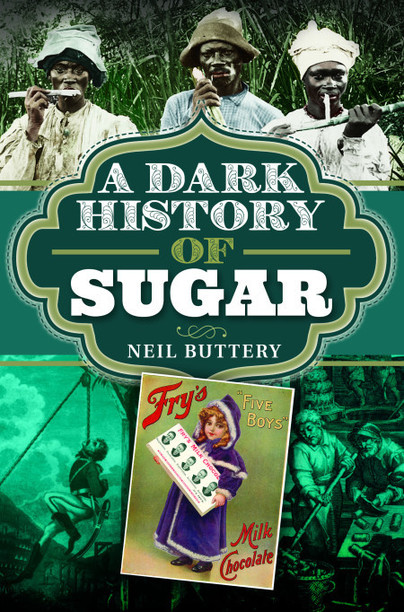
A Dark History of Sugar – out 30 April 2022

Regular readers of the blog will know that I have been working on a book all about sugar’s dark side over the last couple of years, and I am very pleased to announce that A Dark History of Sugar will be published on 30 April 2022 by Pen & Sword History. It is – as far as I know when I write this – available in the UK and Australia from this date. North America, you’ll have to wait a little longer for it: 30 May.

Before I tell you all about the book, I thought I’d let you know that if you pre-order via Pen & Sword’s website (so there’s not long left) you can get 25% off the cover price. The book is, of course, available from other booksellers. I will be receiving some copies, which of course will be signed by Yours Truly. I’ll let you know when they are available. I’m not sure as yet how much I’ll be able to sell them for, but hopefully it’ll be under the cover price. Keep your eyes peeled here and on my social media.

In fact there’s another reason to look at my social media: I’ll be doing some competitions on here, but also on Twitter and Instagram on, or around, publishing day. If you don’t follow me already I am @neilbuttery on Twitter and dr_neil_buttery on Instagram.

Okay, let’s talk about the book.

Writing it was very involving and sometimes even distressing and upsetting; unfortunately the history of this everyday and all-too-common commodity contains possibly the darkest in human history. But why is its history so bad? Well, it’s because it’s so good.

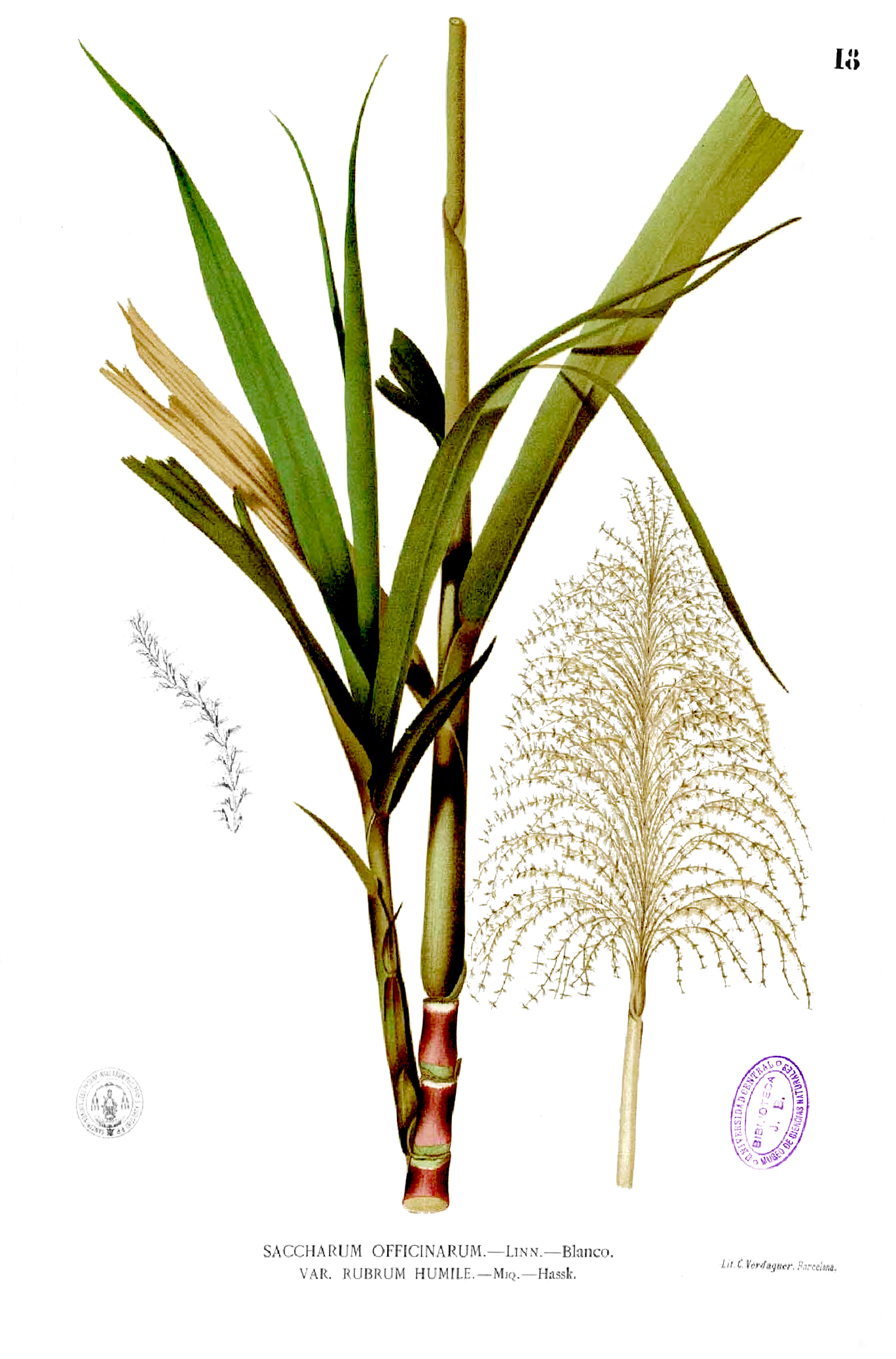
Botanical plate (c.1880) of sugarcane, Saccharum officinarum

I begin the book looking at the lengths early man went to just to get its hands on honey – the purest natural source of sugar. You see, Homo sapiens adapted to spend a great deal of its time thinking about sugar and how to get hold of it. We evolved bigger brains with the ability to problem solve that feed on glucose only – no other sugar will do – and we evolved pleasure centres that are never sated and stomachs we can stuff with sweet foods well after we are full.

This evolved adaptation is advantageous if there is little sugar about, but when it’s available any time we want in any amount we want, our brains go into overdrive and out pleasure centres spin like Catherine wheels, reinforcing our behaviours, training us up to eat more and more of it. At any cost. As I say in the book:

We take sugar for granted, but now we are paying the price, and have been for some time. With cheap and plentiful sugar came centuries of exploitation, slavery, racism, diabetes, obesity, rotten teeth, and mistreatment of an exhausted planet.

But sugar and sweetness are seen as pretty favourable: sugar is good, heavenly even; little girls are made of ‘sugar and spice and all things nice’ Somebody who is described as ‘sweet’ is cute, friendly, kind, and your romantic partner is your ‘sweetheart’. We look at sugar with dewy-eyed nostalgia: baking cakes with Grandma, chocolate coins at Christmas, buying sweets in the corner shop.

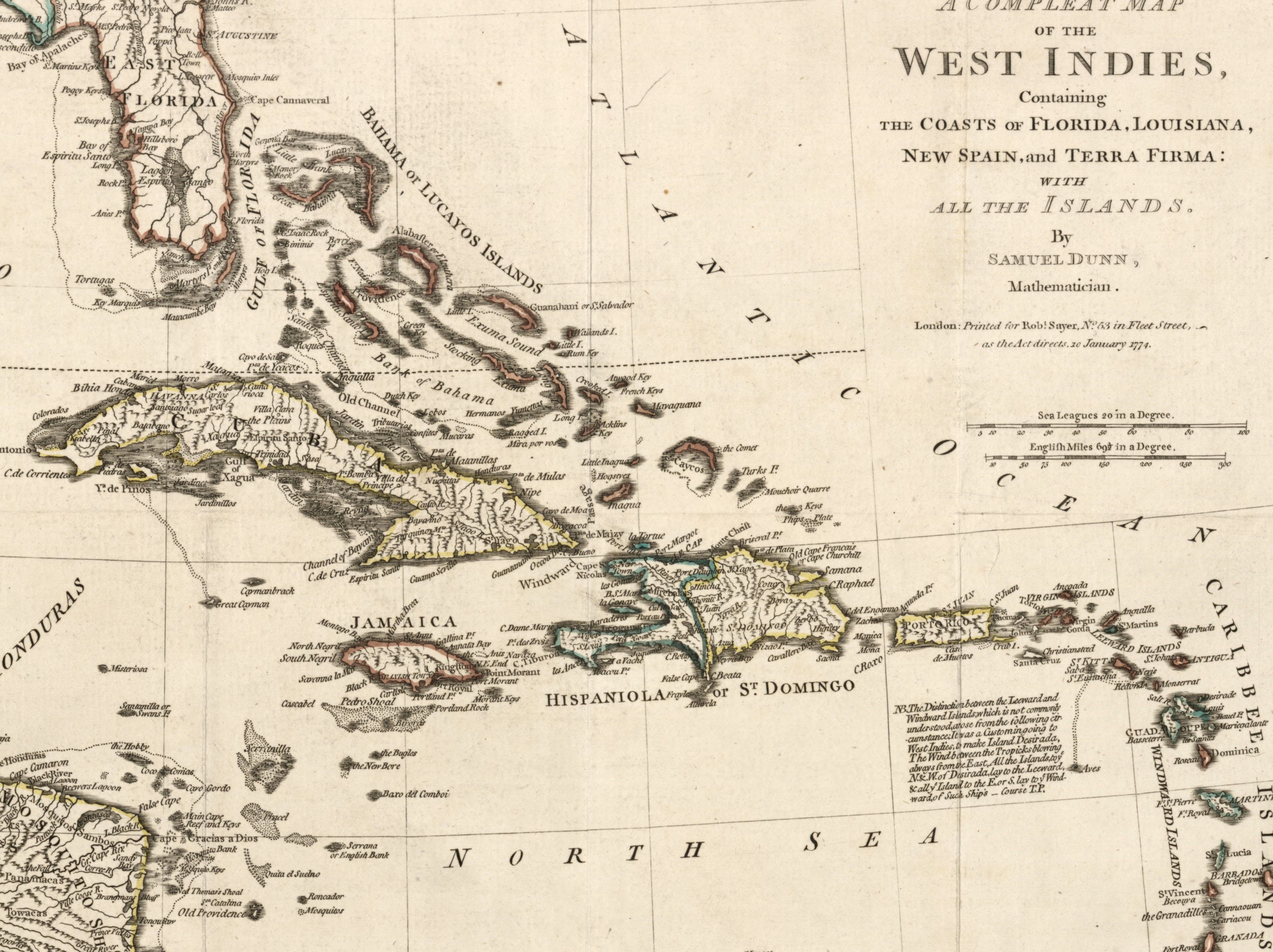
Detail from A compleat map of the West Indies (1774). The tiny islands of the Lesser Antilles are dwarfed by the greater islands, Cuba and Hispaniola.

The reality is different, for we are a world of sugar junkies, and as consumers we have had the wool pulled over our eyes for centuries. Of course, sugar manufacturers, confectioners and fizzy drinks companies much preferred it when we knew nothing about how sugar was made and what its effects are upon the human body.

Just how did we in Europe go from returning crusading knights bringing back a few sugar samples to pass around at court, to a transatlantic trade in African slaves that displaced 12 million African men, women and children to the sugar colonies via the horrific Middle Passage?1 The slave and sugar trade made many people rich; not just investors and merchants, but also those in Britain selling fancy goods, food, tools and furniture to the colonies. This intricate web of commerce reached into almost every aspect of trade is called the ‘sugar-slave complex’.2

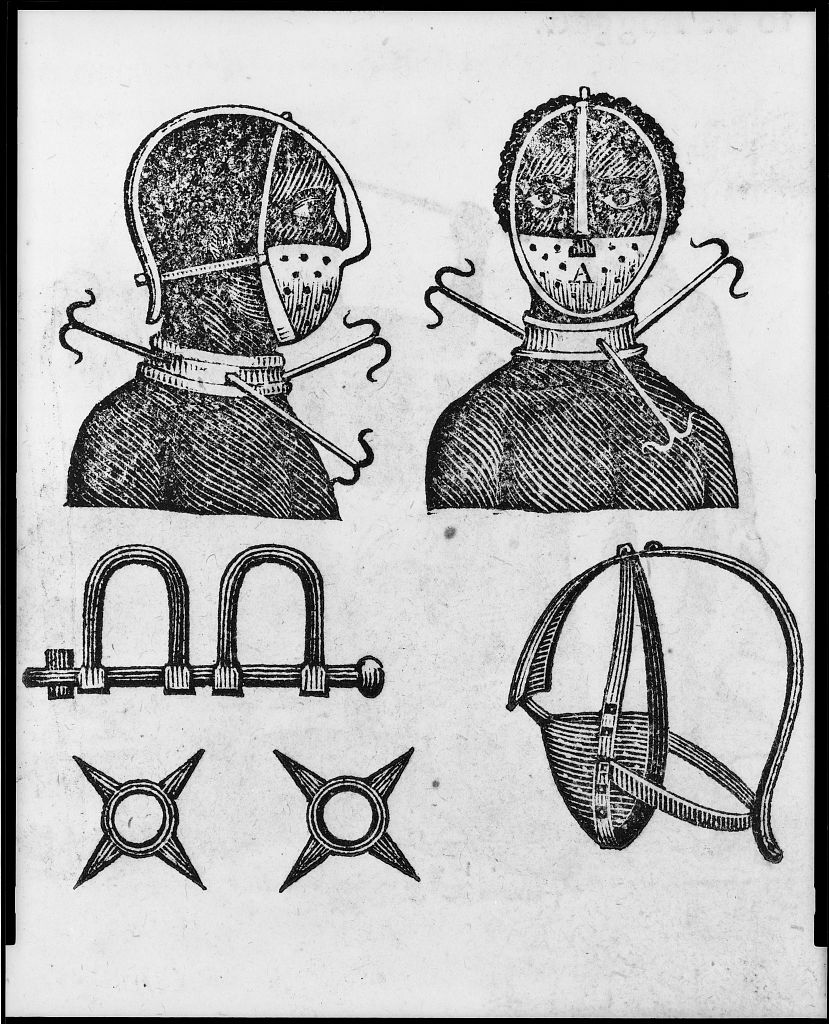
Iron mask, collar, leg shackles and spurs used to restrict slaves on the sugar colonies. From the 1807 book The Penitential Tyrant by Thomas Branagan.

When the slave trade, and then slavery itself, was abolished, one might think that working conditions might have improved. Sadly they did not: new World sugar plantation owners simply swapped one type of exploitation for another, making it nigh-on impossible for freed slaves to leave them.

As the British Empire grew, so did the British sugar manufacturing industry, with sugar plantations cropping up wherever it was viable to do so. At this point, the association of sugar manufacture with exploitation could have been decoupled, but sadly this was not the case, and the indigenous people who had become suddenly, and usually violently, subjects of the empire were worked to death, and many were displaced to work on plantations thousands of miles away from home. Indian workers, for example, were forced to work on the West Indies, South Africa and Mauritius as well as India itself.

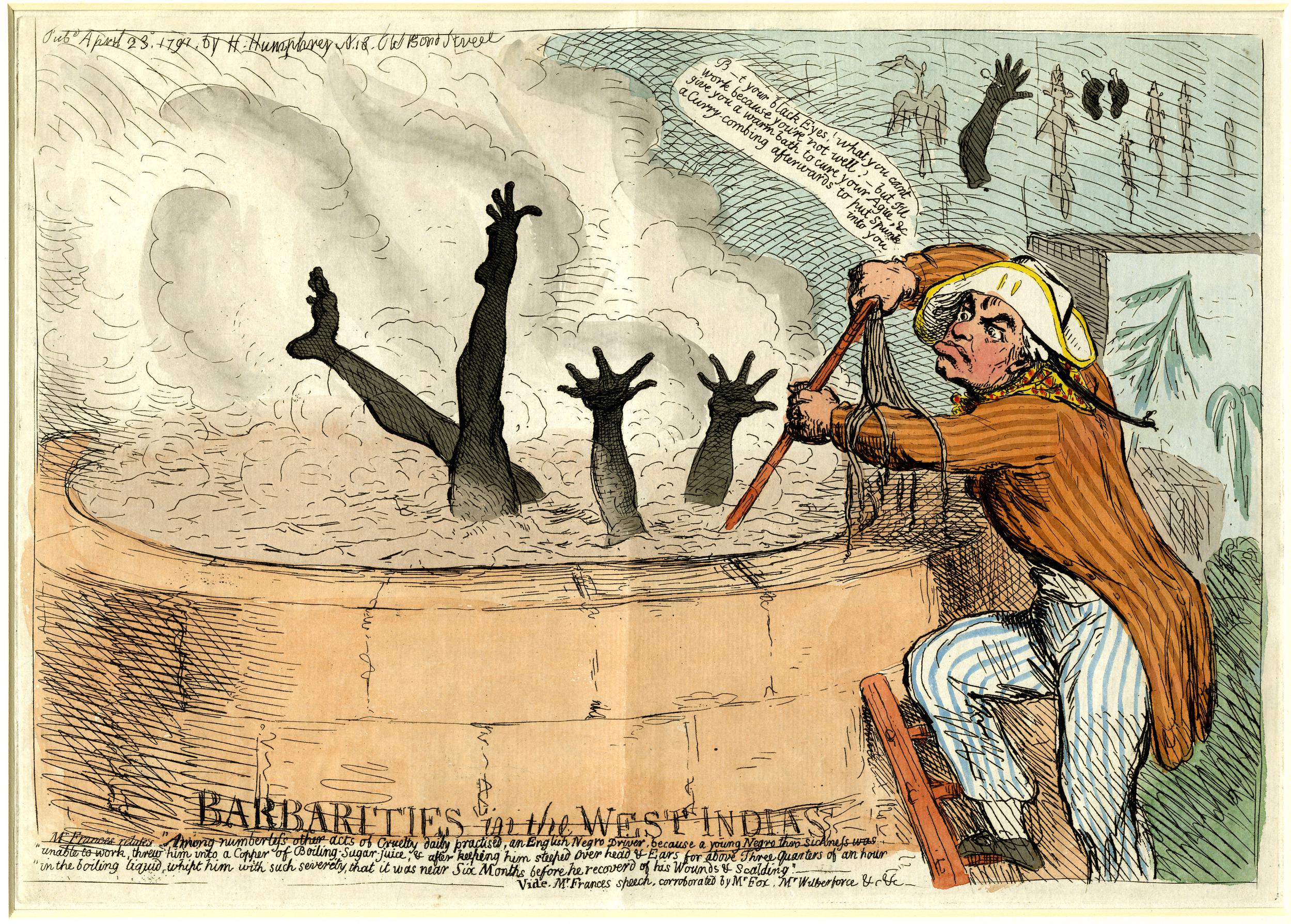
A political cartoon from 1791 titled Barbarities of the West Indias showing a cruel overseer plunge a slave into a kettleful of boiling sugar syrup to ‘warm’ them up.

And it still goes on today: people across the world are still being exploited to make sugar, even children.

There is not enough space on the blog to go through everything discussed in the book: sugar as (useless) medicine, the Coca Cola Company, Cadbury and Queen Victoria, environmental disasters, the horrors of the sugar making processes and squalor of the slaves, rotting teeth, diabetes, Big Sugar, Christopher Columbus, the Haitian Revolution and the fact that every English monarch from Elizabeth I to George III had a stake in the sugar-slave trade. The list goes on…

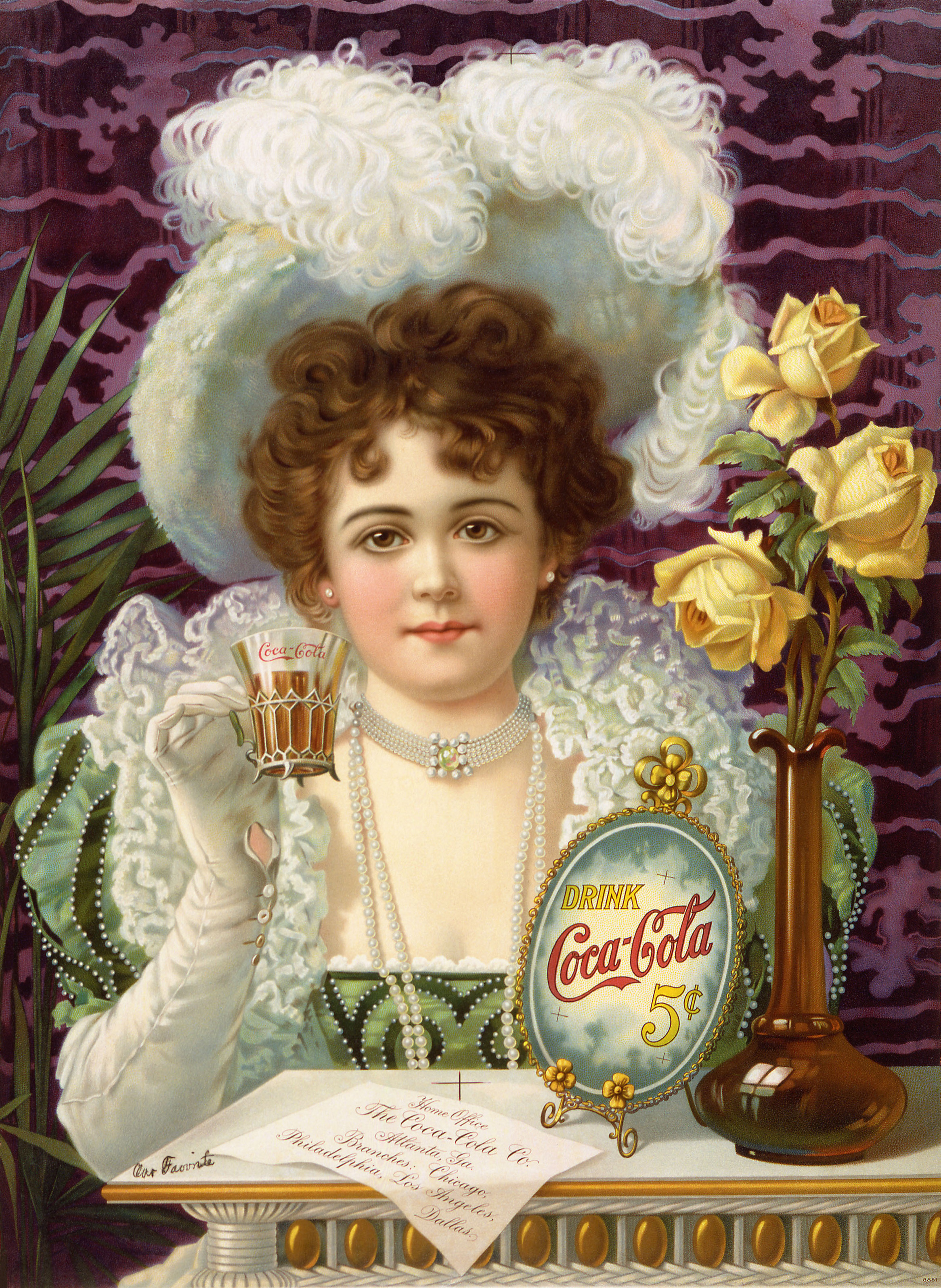
An 1890s Coca Cola advertisement. Coca Cola managed to keep its price set at five cents a bottle until the close of the Second World War.

I hope you find A Dark History of Sugar interesting and informative, and that I achieve my aim: to connect the dots between the first time sugar was made in Asia to the mess we are in now…and some thoughts upon how we can get out of it.

References

  1. Curtin, P. D. The Atlantic Slave Trade: A Census. (Madison: The University of Wisconsin Press, 1969).
  2. Abbot, E. Sugar: a Bittersweet History. (Penguin, 2008).

6 Comments

Filed under Books, food, history, Uncategorized

Happy New Year!

Enjoying an NYE Smoking Bishop

Well I didn’t think I would be starting my New Year post in the same way as last year’s, but hey:

2020 2021 is finally over, and 2021 2022 is here. I hope the blog has been a bit of escapism from all turmoil the last 12 months 2 years have brought us; I’ve tried not to mention it too much.”

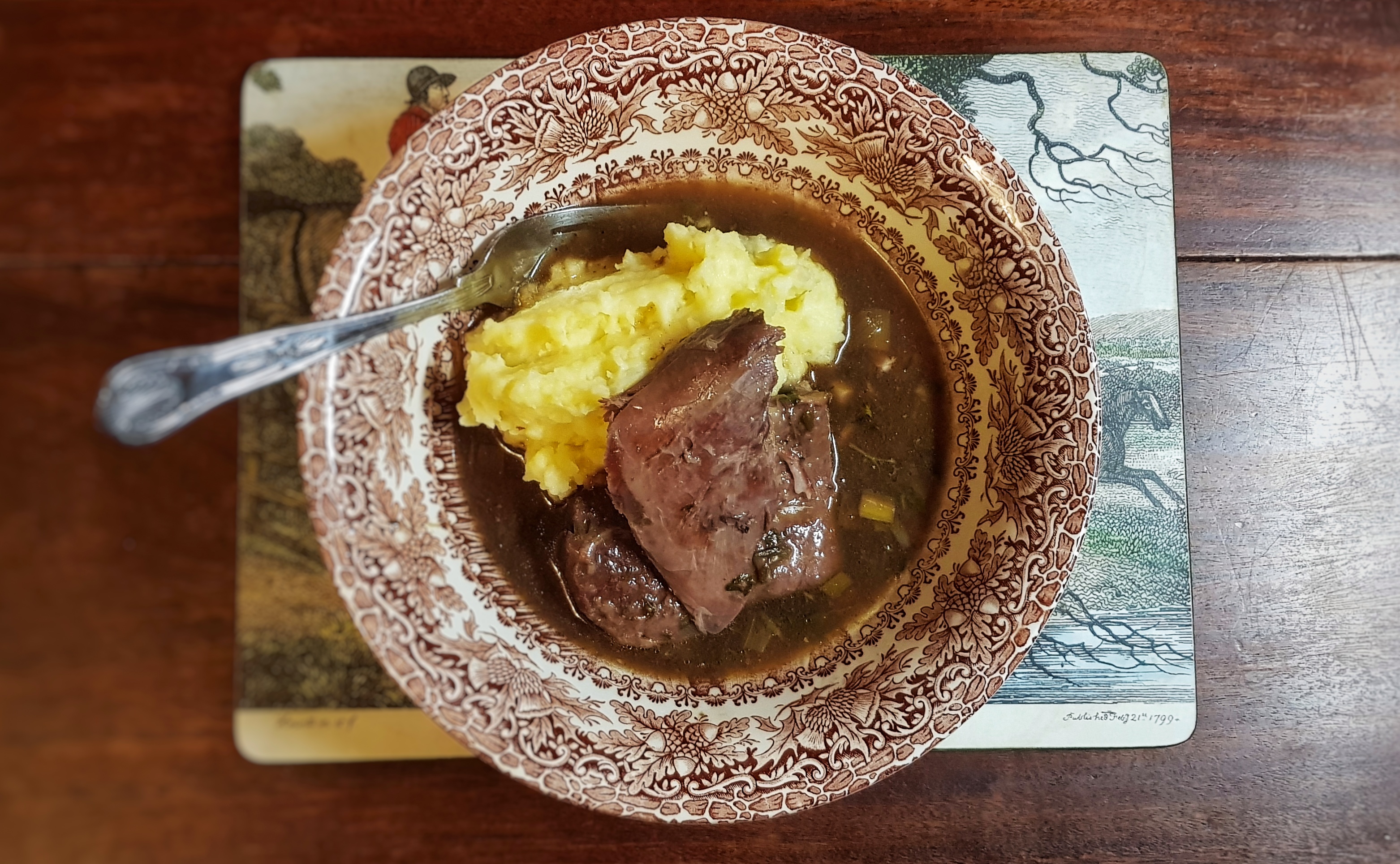
It has been surprisingly busy year: I handed in the manuscript of my first book A Dark History of Sugar, and am currently working through a draft of my second, plus I contributed to some food and cookery shows: I made Christmas Pottage and Christmas Cakes on Amazing Christmas Cakes & Bakes, plus some Wassail! On Our Victorian Christmas both on Channel 5. Then there has been the return of the podcast as well!

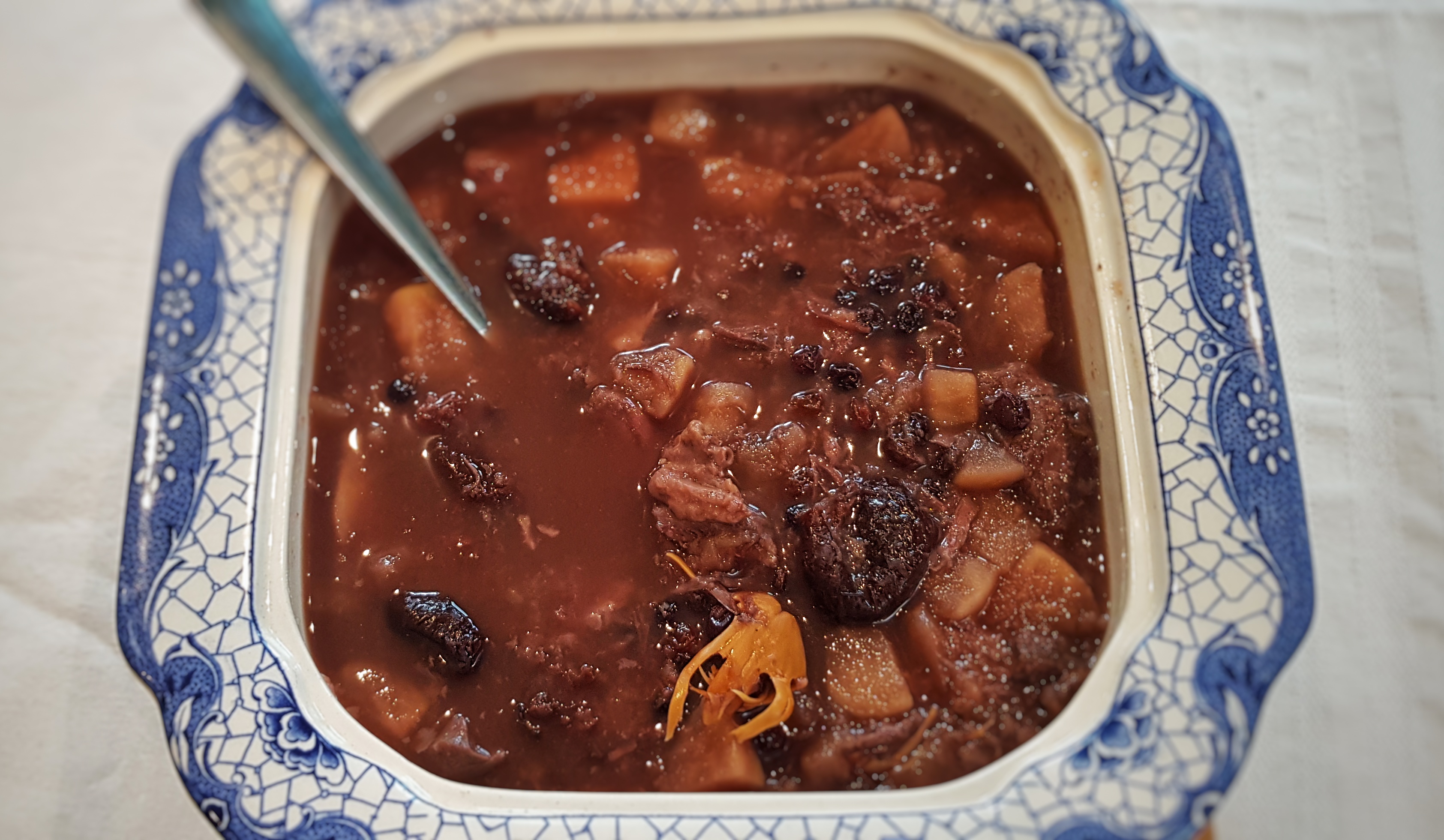
The Christmas pottage I made for Amazing Christmas Cakes & Bakes

I mention this only because none of it would have happened without you, dear reader: it’s the followers, and the comments and shares that make the blog popular, and makes me want to write year after year…

…and what a year! 2021 saw the blog’s 10th birthday and a record number of views! Gosh.

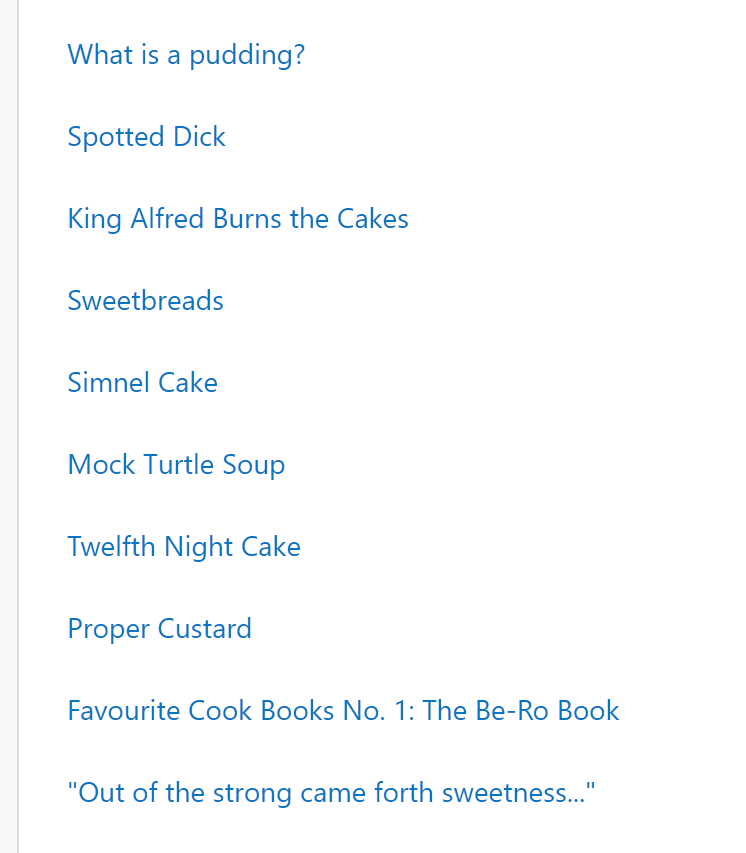
The top 10 posts are below; it is nice to see two seasonal posts getting high views – simnel cake and Twelfth Night cake have never made it into the top 10 before. It is, of course, very good to see puddings and offal represented there too.

So thanks for reading, liking, listening and watching; it really does mean a lot. Also: a massive thank you to anyone who had pledged me a virtual coffee or pint, or become a regular subscriber. It is getting increasingly expensive just to have a blog and podcast. It really does help, and it means that I can make more online content.
I’m gonna stop gushing now: I’m a Yorkshireman for goodness sake.

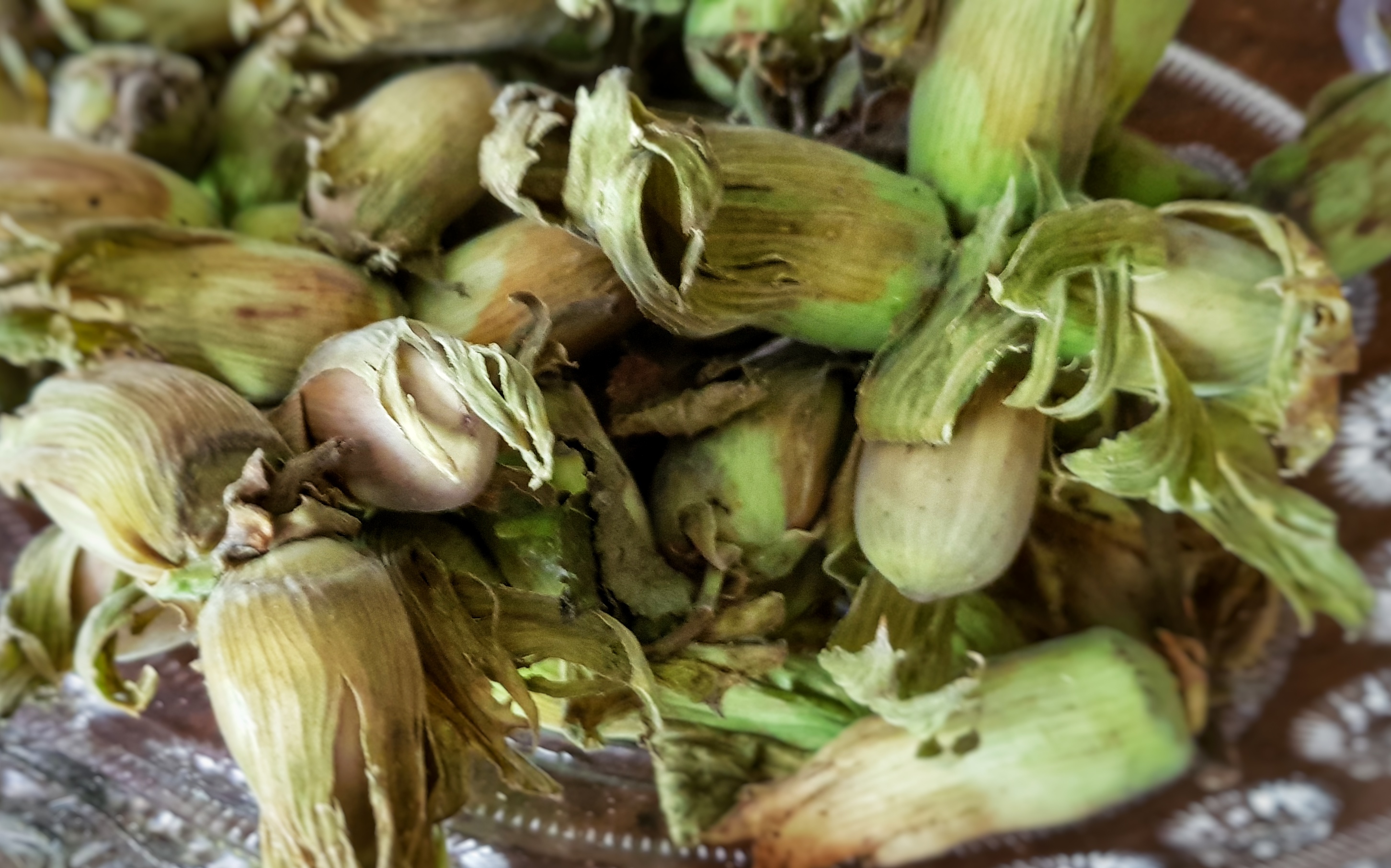
This year the blog covered a wide range of topics including: the surprising history of the pressure cooker, the problem with saltpetre and other nitrates in meat preservation, why Samuel Pepys buried his round of Parmesan in the garden, as well as the difference between a cobnut, filbert and hazelnut. There were recipes, and the histories behind them, too for frumenty, seed cake, Glamorgan sausages and the humble hot toddy.

Cobnuts (or are they hazelnuts?)

The other blog (Neil Cooks Grigson) saw me cook probably the craziest recipe in there, Hannah Glasse’s Yorkshire Christmas Pye for the TV (which was then subsequently cut out of the show), smoking my own meat, including a cold-smoked chicken. There was too an inedible three gourd garnish, plus two chapter reviews: Poultry and Saltwater Fish. I have only five recipes to cook to complete the book!

My home-made cold-smoked bacon

The second and half the third season of the podcast was published this year, and it is doing much better than I expected. If you have any suggestions of topics for the podcast, by the way, please let me know. Topics this year have included: food in gothic literature, savouries (with recipe for Scotch woodcock), gingerbread, Christmas pudding, the dark history of chocolate, Forme of Cury and, of course, the trilogy of eel episodes!

The first part of the new year ahead looks pretty busy: A Dark History of Sugar will be out at Eastertime and my second book will be handed to publisher at the end of January. I’m going to take a few months off from writing books after that – two in two years has been pretty full-on – and concentrate on the blogs and podcast. I have a large backlog of posts, and I really want to get those final Jane Grigson recipes cooked!

I really do hope that by the time we are approaching wintertime 2022 there will be a better looking – dare I say normal? – year ahead of us. But for now, we shall soldier on, eat plenty of puddings, and read more cookery books.

Take care and be safe,

Neil x

7 Comments

Filed under Blogs, Britain, food, history, Uncategorized

A Hot Toddy

Merry Christmas! I hope you are all able to have some fun in yet another strange Yuletide.

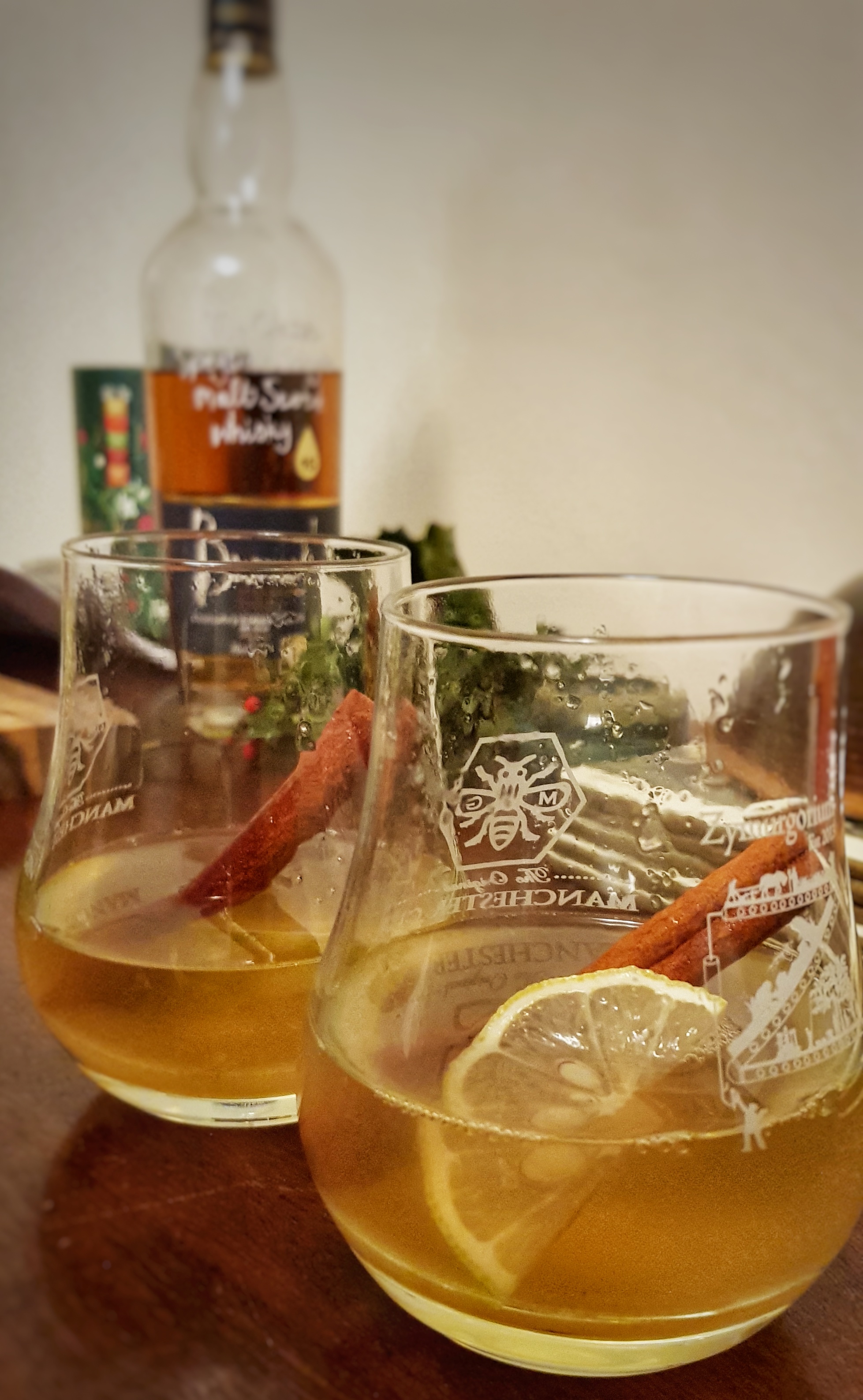
At Christmas we often receive bottles of booze we don’t really like as gifts. My most hated alcoholic drink is whisky, but it is delicious in a hot toddy. Well I was recently gifted some and that’s why it is this year’s Christmas boozy drink post.

What do you think of when imagine a toddy? I think of Scotland, whisky. I think of lemons and spices, and its warming effects on those who have just come in from the cold.

There is a popular myth that the drink was invented in the early 18th century at Tod’s Well Tavern, Edinburgh, to warm up the very cold patrons1, but I found that the hot toddy’s history is a little more complicated. The trouble is, toddies were not created in Scotland, not were they hot, and nor were they laced with whisky.

Whenever I am researching the vintage of a recipe, I always visit The Foods of England website – even if the recipe is Welsh, Scots, or Irish. It’s definition is I would say standard: ‘Spirit such as whisky with hot water, sugar, lemon and sometimes spices such as cloves.’ On the webpage is a quote from the 1788 book Grose Classical Dictionary of the Vulgar Tongue which states: ‘Toddy, originally the juice of the cocoa tree, and afterwards rum, water, sugar, and nutmeg.’2

Going by that quote, the drink looks like it has its origins in the West Indian plantations. Note it is not a hot drink.

It turns out, however, to have its roots in the East, rather than the West, Indies, or rather the British Raj. There was a Hindi drink known as taddy, which was made from slightly fermented palm sap since at least the early 17th century. During the British occupation of the country in the 18th century, the fermented juice was used to ‘water down’ expensive beer3: expensive because at the time it was difficult to make in hot climates, and therefore had to be imported (this is before the invention of Indian pale ale, or IPA).

By 1820 the drink had evolved into a mixture of alcohol, sugar, ginger and lime.4 It wasn’t hot, but the delicious drink spread through the British Empire, changing depending upon what was available. The palm sap swapped for ‘the juice of the cocoa tree’ in the West Indies, and perhaps the Scots were the first to think of warming it up? Who knows?

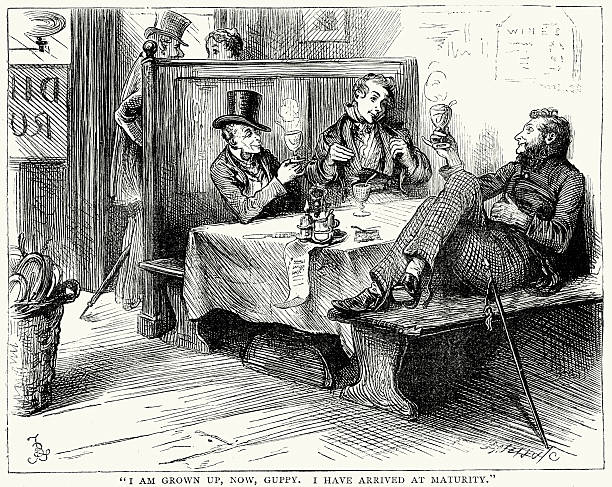
Drinking hot toddies in Charles Dickens’s Bleak House

However it became the classic whisky-based drink, it certainly became popular as a cure-all for colds and flu. And why not? There’s the lemon with its vitamin C, honey or sugar making the drink viscous and soothing, and hard liquor – nature’s anaesthetic. There may be an element of practical truth to this; those who drink a moderate amount of alcohol are able – on average – to fend off colds better than those who drink heavily, and those who do not drink at all.5

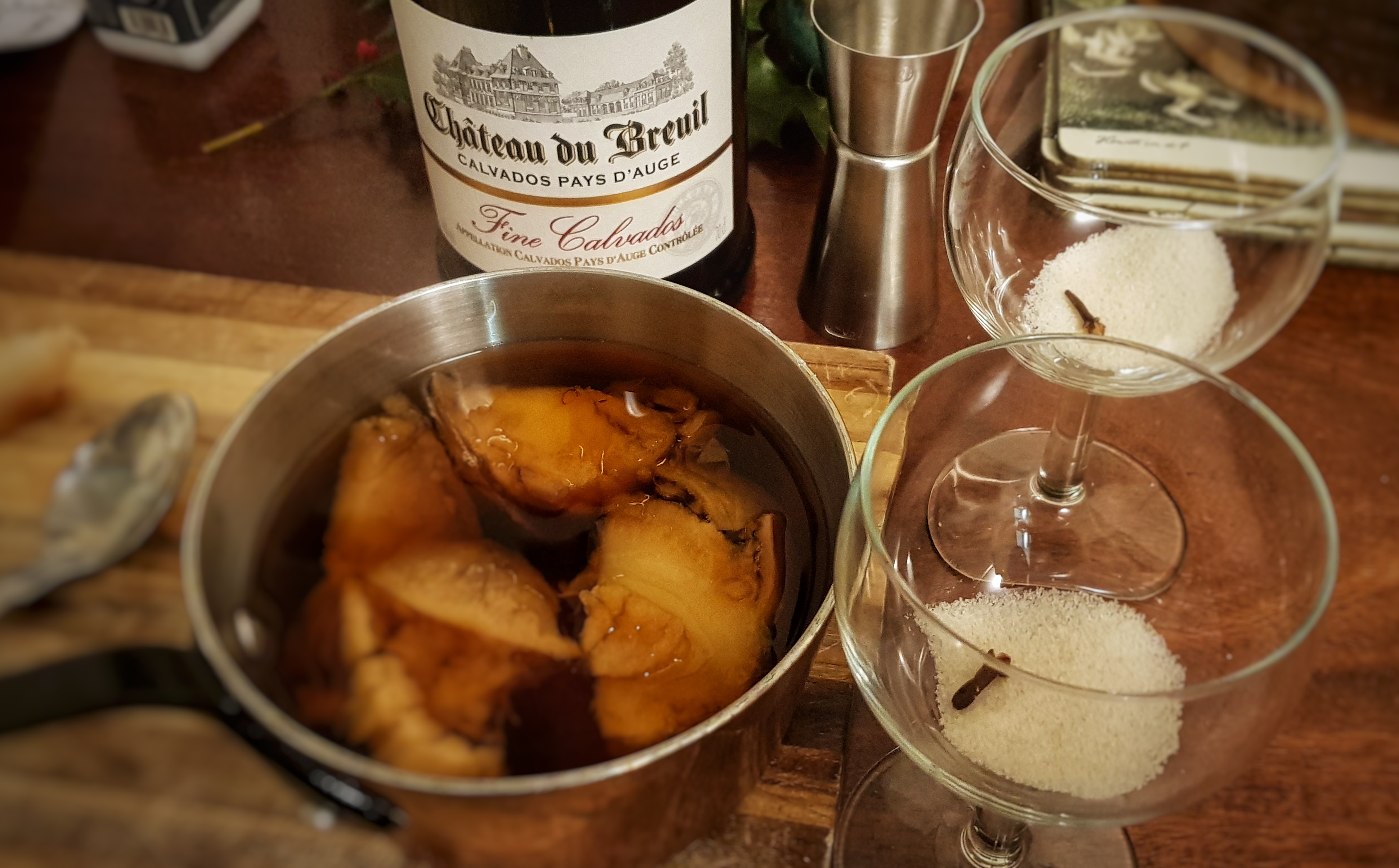
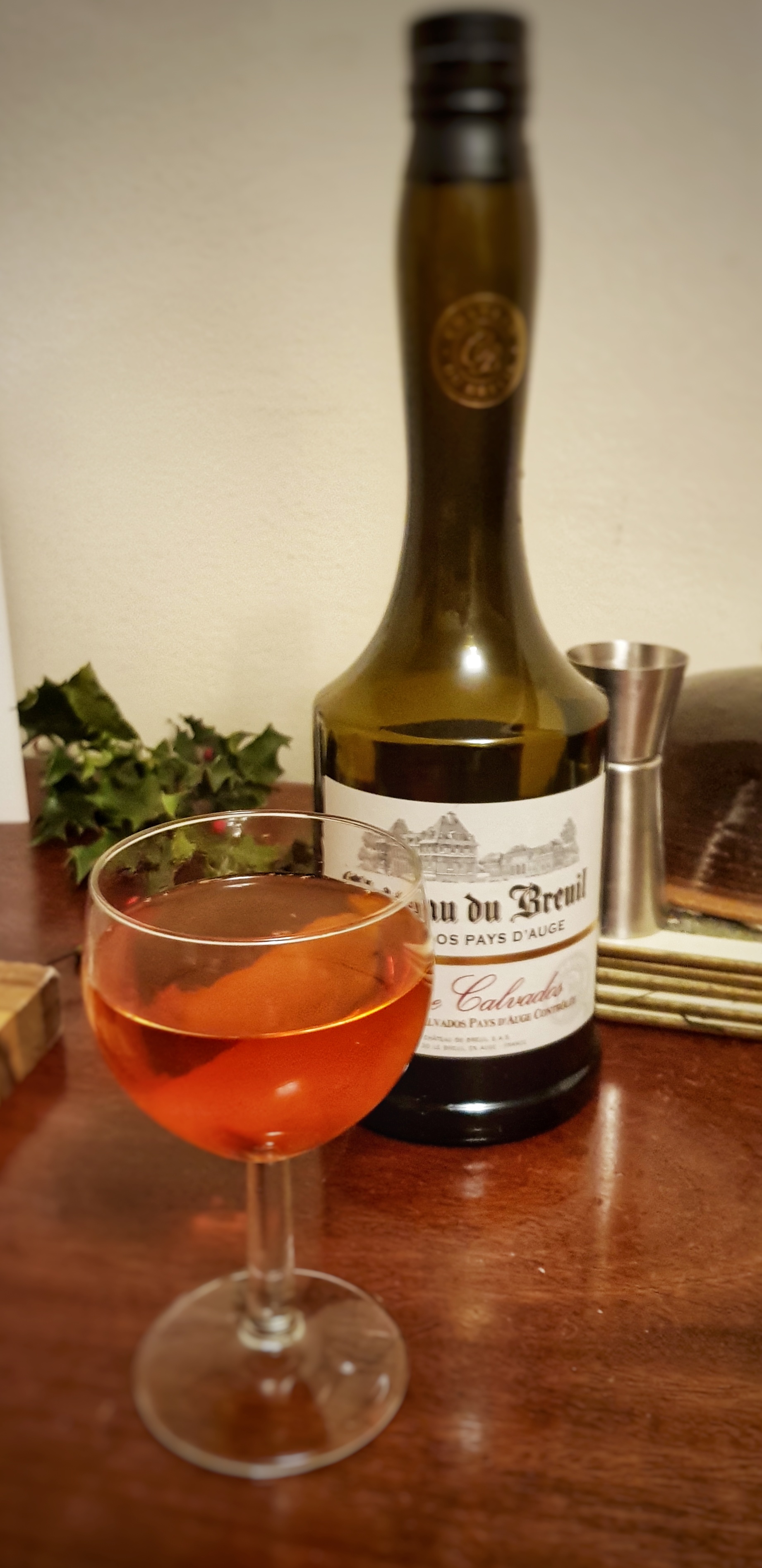
So what should I put in my recipe? I turned to another favourite of mine: the classic and comprehensive Savoy Cocktail Book (1930). Disappointingly, there are just three toddy recipes, and of those only one is hot and contains no whisky (Calvados is the booze of choice) and uses roasted apples. The cold toddies contain whisky only as an option.6 In the end I came up with my own, I had a play around and I think I have the proportions of ingredients just right. I also tried the Calvados toddy, which was also a great success.

Here are my recipes for both cocktails. Let me know if you give them a go.

Whatever you do, be safe, eat and drink plenty, and do as little as possible this Christmas. Thanks for reading my posts, trying the recipes, leaving comments, listening to the podcast, and for supporting me this year. I have the best followers! I’ll be back on 1 Jan 2022 with my usual review of the year.

If you like the blogs and podcast I produce, please consider treating me to a virtual coffee or pint, or even a £3 monthly subscription: follow this link for more information.


A classic hot toddy

Per person:

1 shot (25-30 ml) whisky (or rum or brandy)

2 tsp honey or sugar

Juice of quarter of a lemon

75-100 ml hot water (or tea)

1 cinnamon stick (optional)

1 slice of lemon

Freshly grated nutmeg (optional)

Put whiskey, honey or sugar, lemon juice and most of the hot water, or tea, into a small glass or coffee cup. Stir with a cinnamon stick, or a spoon, to dissolve the honey.

Taste and see if you need to add more water (I go with the full 100 ml).

Garnish with a lemon slice, the cinnamon stick and a few rasps of freshly-grated nutmeg.

Calvados hot toddy

This is adapted from the entry in The Savoy Cocktail Book. I always buy a bottle of Calvados at Christmastime, but I think rum or brandy would be good substitutes.

For four:

1 dessert apple

400 ml hot water or tea

2 tbs sugar

4 cloves

4 shots (100-120 ml Calvados)

Freshly grated nutmeg

Preheat your oven to 180°C. Take your apple and make an incision around the apple two-thirds of the way up, cutting just the skin. Place on a baking sheet and roast until, pale brown and the juices have begun to caramelise, around 40 minutes.

In a small saucepan add the hot water, sugar and cloves. Slice the apple in half, roughly chop one half and place in the pan. Keeping the heat very low, allow the flavours to steep in the hot water for around 10 minutes.

Place a shot of calvados in four small glasses, and divide the hot steeped liquid between the four cups, passing through a tea strainer or small sieve.

Garnish each with a clove and a neat piece of roasted apple cut from the reserved piece. Grate a little nutmeg over the top and serve.

References:

  1. Schofield, J. & Schofield, D. Schofield’s Fine and Classic Cocktails: Celebrated Libations & Other Fancy Drinks. (Octopus, 2019).
  2. Toddy. Foods of England http://www.foodsofengland.co.uk/toddy.htm.
  3. M., N. Warding Off Jack Frost: The History of the Hot Toddy. Arcadia Publishing https://www.arcadiapublishing.com/Navigation/Community/Arcadia-and-THP-Blog/November-2018/Warding-Off-Jack-Frost-The-History-of-the-Hot-Tod.
  4. Burton, D. The Raj at the Table: A Culinary History of the British in India. (Faber & Faber, 1993).
  5. Barrett, B. Viral Upper Respiratory Tract. in Integrative Medicine (ed. Rakel, D.) (Saunders Elsevier, 2007).
  6. The Savoy Cocktail Book. (Constable & Co., 1930).

5 Comments

Filed under Britain, Christmas, Festivals, history, Recipes, Uncategorized

Rum Butter & Brandy Butter

This post complements the episode ‘Christmas Special 2021: Christmas Pudding’ on The British Food History Podcast.

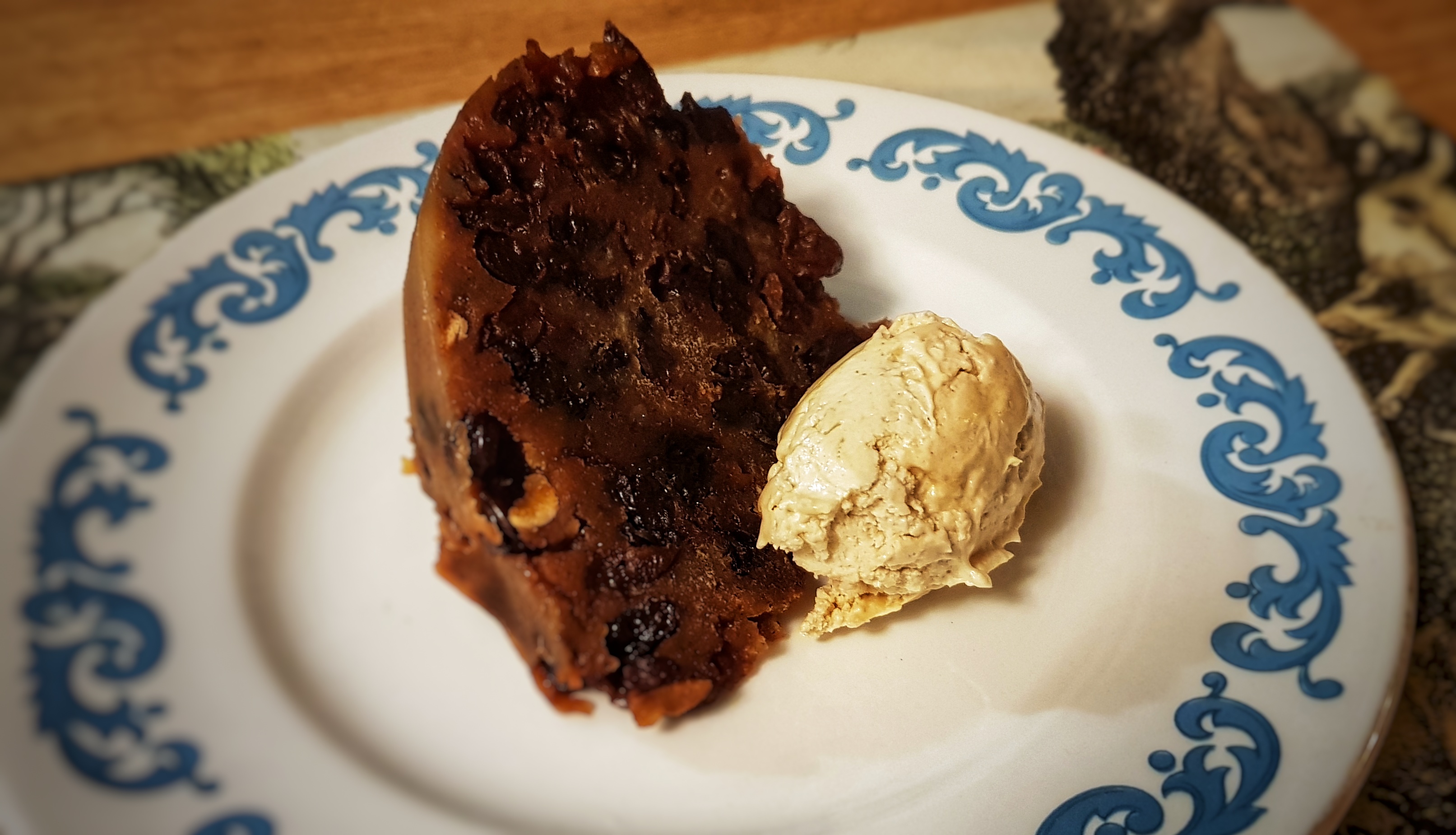
I used to believe that brandy butter – that infamous accompaniment to Christmas pudding and mince pies – was far too rich and sweet, and always preferred custard. I made a traditional Christmas pudding from a 19th century recipe and because it wasn’t as rich as modern day puds, I found the buttery sauce complemented the dessert perfectly – though I still prefer the rum butter.

Subscribe to get access

Read more of this content when you subscribe today.

To subscribe please visit the Support the Blog & Podcast tab.

7 Comments

Filed under Blogs, Britain, Christmas, cooking, Festivals, food, General, history, Puddings, Recipes, Uncategorized

To Make a Christmas Pudding Part 1: Stir Up Sunday

This post complements the episode ‘Christmas Special 2021: Christmas Pudding’ on The British Food History Podcast.

Today is Stir Up Sunday, traditionally the day Christmas pudding is made. The day was also a cue to local grocers to begin to make their orders and get ready for the 12-day long Christmastide feast.1 As they mixed, the children would sing:

Stir up, we beseech thee

The Pudding in the pot,

And when we get home,

We’ll it it all hot!

Stir Up Sunday is always the Sunday before Advent; which isn’t 1 December despite what manufacturers of Advent calendars would have you believe. Advent actually begins on the sixth day before Christmas, so this year (2021) Advent begins on 28 November. The day has a deeper meaning beyond reminding us to prep our puds; the children’sl song was sung on the day comes from a hymn: Stir up, we beseech thee O Lord the wills of my faithful people… and is call for everyone to stir up their pious and spiritual feelings in preparation for Advent – a period of fasting and reflection before the festivities begin.

When you make your Christmas pudding (whichever day you make it on) there are various superstitions which should be held. First, each member of the family should add at least one ingredient to the mix, give it a good stir and make a wish. The stirring must either go from east to west (like the Sun).2 The pudding should be made up of 13 ingredients to represent Jesus and his 12 disciples.

There are trinkets too of course: a sixpence to represent financial success or good luck in the New Year, a ring to represent romance or marriage, or a thimble – bad luck! No romance for you, spinster!


If you like the blogs and podcast I produce, please consider treating me to a virtual coffee or pint, or even a £3 monthly subscription: follow this link for more information.


Great Aunt Eliza’s Christmas Pudding

I love Christmas pudding, but whenever I’ve made my own (I have used Delia Smith’s and Jane Grigson’s recipes in the past) I’ve always been rather disappointed. I reached out to Twitter for inspiration and food historian (and podcast alumnus) Sam Bilton very kindly let me use her Great Aunt Eliza’s recipe taken from her handwritten recipe book. Sam has cooked it for a demonstration at Petworth House, West Sussex.3 Click here to find out more about Sam’s Great Aunt, and how she adapted and recreated the recipe. Here’s the original:

Note there are indeed 13 ingredients!

I decided to adapt the recipe myself, only later looking at Sam’s interpretation and we took a similar approach, which is pleasing.

I took the recipe and converted it into metric and then divided everything by 3, making a huge pudding with a 15 hour boiling would have been craziness. I could have made one good-sized pudding from my one-third mix, but decided to make 2 smaller ones. I used vegan suet because I already had that in. Fresh beef suet would have been best, but there’s no point buying more if there’s some already in the cupboard.

I hedged my bets on the plums and used half prunes and half raisins, and swapped out almond extract for the bitter almonds. Feel free to toss in some slivered almonds for texture though.

Makes 2 x 800 g puddings:

150 g plain flour

150 g breadcrumbs from a stale loaf

120 g suet

300 g currants

225 g raisins

225 g prunes, roughly chopped

40 g candied peel

2 tsp mixed spice

75 g soft dark brown sugar

½ tsp almond extract

60 ml milk

40 ml brandy

40 ml rum

2 eggs

Making a Christmas pudding batter couldn’t be easier: mix all of the dry ingredients in a large bowl, i.e. everything on the list from plain flour down to the soft dark brown sugar, then add all of the remaining wet ingredients to a jug and give them a good whisk.

Make a well in the centre and pour in the eggy mixture then stir until combined. If after a few minutes’ mixing things still seem a little bit dry, add an extra slug of milk, brandy or rum. Mine needed a bit more rum.

Cover the mixture and leave it somewhere cool overnight to let the flavours develop – if you’re in a rush, leave for an hour.

Next day (or next hour) make you puddings. First get a large pot of water on the boil; deep enough for two puddings to cook without touching the base of the pot. Next, cut two pieces of muslin (cheesecloth) into rectangles of around 30 x 60 cm, place in a bowl and pour boiling water over them. When cool enough to handle, remove one and squeeze out excess water. Fold it in half to make a square shape, then lay it in a bowl.

Dust the muslin very well with plain flour, leaving no bare patches, then spoon in half the mixture, then gather up the corners and twist to tighten. Use some good quality string to tie the pudding tight. If there are folds in the cloth, they can be easily smoothed out. Repeat with the other piece of cloth.

Tie a longer piece of string to your puddings, drop them in the boiling water, and tie them so that they are nicely bobbing about in the water and not touching the bottom. Cover, bring the water back to a boil, and let things cook on a simmer for 2½ hours.

Remove and cool on a cooling rack and keep in a tub or tin. You can feed the puddings a few times if you like with more brandy or rum by untying the top and pouring some in, or by rolling them in a few tablespoons – they quickly absorb it!

Then it’s just a case of giving it a second boil on the big day…I’ll post that a few days before Christmas Day, along with a recipe for brandy or – even better – rum butter to go with.

References

1.           Simpson, J. & Roud, S. A Dictionary of English folklore. (Oxford University Press, 2000).

2.           Kerensa, P. Hark: The Biography of Christmas. (Lion Hudson Ltd., 2017).

3.           Bilton, S. A Proper Plum Pudding. Comfortably Hungry http://www.sambilton.com/plum-pudding/ (2019).

5 Comments

Filed under baking, Britain, Christmas, food, General, history, Podcast, Puddings, Recipes, Uncategorized

Samuel Pepys Buries His Parmesan

Samuel Pepys

Early in the morning of Tuesday 4 September 1666 the great diarist and raconteur Samuel Pepys was rudely woken by a servant telling him to get up and get out of his house because a fire, which had started two days prior on Pudding Lane* in the City of London, was fast approaching his home on Tower Hill. The Great Fire of London was well underway. What would you do in this situation? Well Pepys told his servant to go away (or words to that effect), turned over, farted (probably) and went straight back to sleep.1

Things obviously took a while to sink in and he realised later a catastrophe was afoot. According to his diary entry for the day he was ‘[u]p by break of day [we can that with a pinch of salt] to get away the remainder of my things; which I did by a lighter at the Iron gate and my hands so few, that it was the afternoon before we could get them all away.’2

Pepys lived on Seething Lane and was a naval administrator and lived close to several other navy chums near to the Tower of London, so they really were in the thick of it. He tells us in detail what he saw and what he and his friends did:

Sir W. Pen [this is Admiral William Pen, Commissioner of the Navy Board] and I to Tower-streete, and there met the fire burning three or four doors beyond Mr. [Richard] Howell’s, whose goods, poor man, his trayes, and dishes, shovells, &c., were flung all along Tower-street in the kennels, and people working therewith from one end to the other…’2

He managed to get the majority of his belongings to Bethnal Green and safety, but not everything.1 Left with little time, and perhaps no horses and carts either, snap decisions had to be made:

the fire [was] coming on…both sides, with infinite fury. Sir W. Batten [Master of Trinity House which specialised in all things naval] not knowing how to remove his wine, did dig a pit in the garden, and laid it in there; and I took the opportunity of laying all the papers of my office that I could not otherwise dispose of. And in the evening Sir W. Pen and I did dig another, and put our wine in it; and I my Parmazan cheese, as well as my wine and some other things.2

Parmesan cheese has medieval origins

But – you may be thinking – if he was taking plenty of belongings, surely he could make room for some wine and cheese? One issue was size: the wine would have been in barrels, not bottles, and the Parmesan cheese – if a full round – could have weighed 40 kilos or more. But – you may also be thinking – these are just food items, why risk hanging about the inferno just to save them? Was he that greedy!? Well, in part, yes – he certainly liked his food, and he relished writing about the food he ate, and the booze, coffee, tea and chocolate he drank. His diaries are essential reading for the food historian for this very reason. Mainly it was because they were very expensive and a great status symbol, so it wasn’t all about not wasting good food. No doubt he shed a tear as he shovelled it over with clods of earth.

A young Henry VIII

Parmesan cheese was a particularly sought after food and was commonly part of diplomatic gifts. For example, in 1511 Pope Julius II gave Henry VIII 100 rounds of Parmesan cheese for helping him fight the French3 (yes, there was a time the English Crown and the Catholic Church got on!). Parmesan, then, was perfect for the greedy aristocrat or great gourmand in your life.

Detail from a 19th century map of 1660s London showing where Pepys lived (ringed in red) and Bethnal Green. Almost everything west of Bethnal Green and the Tower was destroyed.

He dined that evening with friends in Woolwich, and from their house he could see the blaze rampaging through the city:

Only now and then walking into the garden, and saw how horridly the sky looks, all on a fire in the night, was enough to put us out of our wits; and, indeed, it was extremely dreadful, for it looks just as if it was at us; and the whole heaven on fire. I after supper walked in the darke down to Tower-streete, and there saw it all on fire… the fire is got so far that way, and all the Old Bayly, and was running down to Fleete-streete; and [Saint] Paul’s is burned, and all Cheapside. I wrote to my father this night, but the post-house being burned, the letter could not go.2

The Great Fire would go on to decimate four-fifths of the city, destroying over 13 200 homes, 87 parish churches, as well as several important and iconic buildings such as the Royal Exchange.1 Pepys’ home wasn’t destroyed in the end.

The Parmesan cheese was never recovered and who knows, it could still be there, waiting to be found…


If you like the blogs and podcast I produce, please consider treating me to a virtual coffee or pint, or even a £3 monthly subscription: follow this link for more information.


*There is currently some debate as to whether this actually was the source of the fire.

1.         Martin, K. ‘London’s Burning’: Samuel Pepys and the Great Fire of London. Royal Museums Greenwich https://www.rmg.co.uk/stories/blog/curatorial/londons-burning-samuel-pepys-great-fire-london (2015).

2.         Pepys, S. Tuesday 4 September 1666. The Diary of Samuel Pepys https://www.pepysdiary.com/diary/1666/09/04/ (1666).

3.         Wooding, L. Henry VIII. (Taylor & Francis Group, 2015).

10 Comments

Filed under Britain, Dairy, food, General, history, Seventeenth Century, Uncategorized

To Make Frumenty/Furmenty

This post complements the episode ‘Forme of Cury with Christopher Monk’ on The British Food History Podcast.

This post is for subscribers only. Subscribers get access to my Easter Eggs tab – full of extra interviews, outtakes and other bits and bobs, as well as subscriber-only blog posts and recipe

Subscribe to get access

Read more of this content when you subscribe today. Follow this link for more details.

13 Comments

Filed under Britain, cooking, food, Mediaeval Age, Podcast, Recipes, Uncategorized

Ten Years of British Food: a History!

Well, I never expected to reach this milestone, and I certainly did not foresee what would happen in the years after I started up British Food: a History. In fact, I only set it up because my other blog – Neil Cooks Grigson – a blog created only to help me practise my writing skills after starting a PhD at Manchester University in evolutionary biology. The idea behind the blog is that I cook and blog about every recipe in Jane Grigson’s book English Food; cooking and reading her work had got me so enthusiastic about the history and tradition of British food I felt I needed a second blog! Cooking was still intended/expected only be a hobby and an escape from the laboratory, however I had started to find NCG a little restrictive: I was interested in dishes and ingredients that were not included in her book (there are no jam roly-poly, fish and chips or custard recipes for example). I had also become interested in the food and traditions of the other nations of Great Britain as well as Ireland. I was no longer tied to basing every post around a recipe either, I could write essays too.

Another reason for creating the blog was the yearning I had for all things British at the time – by now I had completed my PhD and had started a Post-Doc position in the lab of Joan Strassmann and David Queller in St Louis, Missouri, USA. I loved American culture, but being away from home focussed my own identity as a Brit, fuelling my enthusiasm for the hobby even further.

I can’t remember when the idea dawned on me that I should try and turn the cooking skills I had unwittingly gained into a food business, but off I went, back to the UK and to Manchester, with good wishes from Joan and David, and support from my friends and family – if there were nay-sayers in the camp, they were keeping their ideas to themselves. I returned to Manchester at the start of August 2012 and by the end of it I had set up The Buttery as a market stall. Under a year later I graduated up to pop up restaurant and then eventually restaurant-bar with Mr Brian Mulhearn. Busy as I was, I did try to blog, but it was tricky and I came close to stopping altogether.

The Buttery existed as a bricks-and-mortar affair for two years, but when it closed I decided to write more: it was therapeutic if nothing else, and I was at a very low ebb, so needed any help I could get. How I had missed it! Unfortunately blogging does not pay the bills, so I kept my toe in as a chef, baker and caterer.

A pop-up restaurant highlight: the Titanic’s last meal inside Victoria Baths!

Over the last couple of years, the blog has become much more popular and seems to be getting recognised more, leading on to a bit of TV and radio work, and I was even approached by publishing house Pen & Sword History to write my first book A Dark History of Sugar which has led to a second book, this time on a subject of my own choosing (I will let you know more about this when I can!).

The British Food History Podcast

The other project that has been borne of the blog was the Lent podcast I made with Sonder Radio and Beena Khetani. What great fun it was. I learned a lot and really wanted to get a second season made…and here it is! It’s taken me almost 18 months to organise myself, but I spotted the anniversary in my diary and thought it a good day to kick season 2 off.

I’m doing all of the writing, presenting and producing myself this time and I’ve come up with a format (I think) of separate seasons of 6 episodes. Each episode will be a standalone subject, but then use the last 2 or 3 episodes to look at a meatier subject in more depth. Kicking off season 2 today is an episode about gingerbread and my guest is the excellent writer, chef and food historian Sam Bilton, author of the cookbook First Catch Your Gingerbread.

To subscribe simply search for ‘The British Food History Podcast’ wherever you usually find your podcasts, or follow this feed to the Captivate website. Please follow, like, subscribe, rate and leave comments: I would be most grateful.

Food historian Sam Bilton helps me kick off season 2

Here’s to another 10 years

What will the next decade bring I wonder? I have no idea, but one thing I do know is that I shall still be writing blog posts and putting together podcast episodes. I just love creating them, and I certainly would have given up years ago if I didn’t have such great, supportive followers on here commenting and telling me about their own memories and experiences – good and bad – on British food. So here’s a big thank you to all of you who have followed the blogs and cooked up my recipes; if I were a religious chap, I would be saying that I feel blessed right now.

I really want to carry on producing more content with more variety, but it is getting increasingly more expensive to produce online content, so if you can please support the blogs and podcast and treat me (should you think I deserve it) to a virtual coffee or pint.

If you like, for £3 per month you can also become a subscriber. If you do, you get access to premium content: extra blog posts and recipes, as well as access to my Easter Eggs tab which will soon start to fill with podcast extras: full interviews, deleted scenes and outtakes. I’m also planning to make some ‘how to’ videos demonstrating some techniques that are best taught by showing rather than by writing a long-winded method.

Right, off I go, this was only supposed to be a quick post and I’ve wittered on for ages. Here’s to the next 10 years!


If you like the blogs and podcast I produce, please consider treating me to a virtual coffee or pint, or even a £3 monthly subscription: follow this post for more information.


3 Comments

Filed under Blogs, food, General, Uncategorized

Season 2 of ‘The British Food History Podcast’ coming soon…

Some exciting news! The second series of my podcast will drop from Sunday 25th of July, which is also the tenth birthday of the blog; it seemed appropriate somehow. Craziness. It’s had a slight name change and it now has the less clumsy title of The British Food History Podcast. I would love it if you subscribed to it via your favourite provider. It’s taking a little time to appear on Apple and Google podcasts but is all ready to go on the others: Spotify, Amazon, Deezer etc.

I’ve chosen Captivate to be my host and if you don’t have a podcast provider, you can listen to it there: https://the-british-food-histor.captivate.fm/listen

If you look on the episode list you’ll see I have added the episodes of the Lent special I made last year with Sonder Radio. Sorry it’s taken so long to do a second series: in lockdown everyone else made a podcast, but I had such a bee in my bonnet about going on location for interviews etc., I thought I’d wait for enough normality to resume before I started again. Anyway, I got bored of waiting for that obviously. (That said, I did manage to do some real life interviews and jaunts.)

I’m going to produce the podcast in packets of six episodes – life often gets I the way and as much as I’d like to make an episode every single week, the day job rather gets in the way of that.

One final thing – and I flush red as I type – I love making content and hope to be able to spend more time making it so if you like my blog posts and podcast episodes, please consider a monthly subscription or buying me a virtual coffee or a pint?

You can pay a one off donation or start up a monthly £3 subscription. The great thing about being a subscriber is that you get some extra bonus Easter eggs (deleted podcast scenes, bonus episodes, cookery videos) as well as extra blog posts. As more subscribe, the more content I can add for everyone. To find out more visit the Support the Blog and Podcast tab on the blog. I thank you in advance xxx

1 Comment

Filed under Britain, food, history, Podcast, Uncategorized

Saltpetre and Salt Prunella

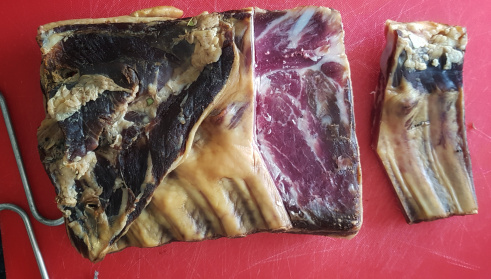
On my Jane Grigson blog I recently completed a recipe, the 441st, Smoking Meat. It wasn’t so much a recipe, more a bit of advice, and the advice was: don’t bother. However, I wanted to have a go at curing and smoking my own bacon, so took this as an opportunity, and because there was no recipe in English Food, I could do my own thing with respect to the recipe (see The Premise). All of Jane’s cured meats contain a combination of salt and saltpetre – also known as potassium nitrate – which has a bad rep these days because it has been implicated as a causative agent in diseases associated with eating processed meat products (more on that later). So, with my bacon, I thought it a good opportunity to see if leaving out the saltpetre would have any observable detrimental effects. SPOILER ALERT! My bacon is still completely fine three months after making it, stored at room temperature – there isn’t the merest trace of mould – and it got me thinking about its use in meat curing and processing and whether it needs to be included.

Pure Potassium chloride

Just what is the function of saltpetre? Everyone does agree that the pink colour saltpetre gives the meat is attractive. However, there is certainly disagreement out there as to its efficacy in preservation. According to Jane Grigson saltpetre ‘no preservative value’1 and Elizabeth David is of the belief that it is simply ‘the cosmetic of the preserved meat industry.’2

On the other side of the argument Larousse Gastronomique reckons it a ‘powerful bactericide [that] has been used since ancient times to preserve food.’3 Harold McGee concurs, adding that it is particularly effective against the bacteria that causes botulism.4

In conclusion: I don’t know what to think.

It seems that it hasn’t been used since ‘ancient times’ either; according to Peter Brears, ‘there appears to be no evidence for the use of saltpetre, sugar or smoking in medieval meat preparation, only salt.’5

Natural deposits of saltpetre pic: William Haun

Saltpetre can be found deposited naturally as veins in rocks – indeed, saltpetre literally means salt stone. Houses built on foundations dug into rocks containing the mineral sometimes find saltpetre can be found in crystalline forms in damp cellars. It is relatively rare, but it was in demand in the Middle Ages, not for its preserving powers but as an ingredient in gunpowder. In the sixteenth century a method of production was devised after an alchemist found that after boiling the water from urine the crystalline material left behind was highly flammable.6 With further refining of the process, urine was combined with faeces and lime on an industrial scale. It was said that the best urine for the job was ‘Bishops’ piss’; not because it was the urine of a holy man, but because of the large volume of wine that Bishops drank. The process even makes an appearance in the Canterbury Tales:

Chalk, quicklime, ashes and the white of eggs,

Various powders, clay, piss, dung and dregs,

Waxed bags, saltpetre, vitriol and a whole

Variety of fires of wood and coal.7

Everyone was well aware how saltpetre was made, and people – as you might expect – did not want to use a product derived from human waste in their food and continued to use saltpetre from natural sources at great expense. Today it is made from ammonium nitrate and potassium chloride.

An engraving showing equipment used to extract saltpetrefrom ‘soil’. From The Laws of Art and Nature, in Knowing, Judging, Assaying, Fining, Refining and Inlarging Bodies of Confin’d Metals (1683) by Lazarus Erckern (pic: science photo library)

When saltpetre comes into contact with meat, the nitrate part of the molecule reacts with haemoglobin (in the blood) and myoglobin (in the muscle) to form a nitrite, which reacts further to form nitric oxide. It is the nitrite and globin molecules reacting that form the pink colour. The products of reduction are stable away from oxygen in the air, however if one takes a slice from the meat to reveal the pink meat within, the nitrites oxidise back into nitrates and the meat loses its rosy tinge.

Some recipes ask for salt prunella, which is simply saltpetre that’s been formed into little balls and dissolve at a slower rate that regular saltpetre. It also contains a small proportion of potassium nitrite to help kick-start the chemical processes in the meat. Again sources disagree as to the truth of this.

Saltpetre is used in very small amounts – when I used it in the past, I used approximately a teaspoon or two to every 500 g salt. You can purchase it on the internet, but it is much better to buy salt mixes for curing that contain salt and nitrates already mixed and measured.

Pre-mixed pink curing salt

This brings us to health – this chemical which is added in small amounts is getting the blame for causing heart disease and bowel cancer in those who eat processed meat products. Well, there is certainly a correlation between consumption of processed meats and cancer. But let’s not jump on nitrates as the causative agent: correlation is not causation, after all. Remember when red wine was supposedly good for your heart? It wasn’t true – there was a correlation, sure, but only because folk who drink red wine tend to be middle class, and therefore tend to also exercise regularly and eat a heathier diet. Nothing to do with wine.* I suspect there is something similar going on with nitrates: they are used in processed meats, which are cheap and much more likely to be consumed by poorer families, who in turn, are less likely to eat fewer fresh fruit and vegetables, and less likely to own a gym membership. As it turns out, nitrates may actually be beneficial in that they help lower blood pressure.

The jury then is still out. And in the case of my own homemade, nitrate-free bacon, leaving out the nitrates hasn’t caused the meat to go bad, and it stayed relatively pink too. Removing it might not improve the nation’s health, but at least it removes a chemical that’s been produced from nasty chemicals which can only be good for the environment.

Do you have any thoughts on the matter? Let me know them in the comments.


If you like the blogs and podcast I produce, please consider treating me to a virtual coffee or pint, or even a £3 monthly subscription: follow this post for more information.


My home-made bacon

*In fact it has been demonstrated that there is no safe minimum alcohol levels – it’s all bad, sorry!

References

1.           Grigson, J. Charcuterie and French Pork Cookery. (Grub Street, 1969).

2.           David, E. Spices, Salt and Aromatics in the English Kitchen. (Penguin, 1970).

3.           Larousse Gastronomique. (Hamlyn, 2001 edition).

4.           McGee, H. On Food and Cooking: The Science and Lore of the Kitchen. (Allen and Unwin, 1984).

5.           Brears, P. Cooking & Dining in Medieval England. (Prospect Books, 2012).

6.           Beach, H. By the Sword Sundered. (Authorhouse, 2014).

7.           Chaucer, G. The Canterbury Tales. (Translated by Nevill Coghill, Penguin, 1951).

15 Comments

Filed under Britain, food, General, history, Meat, Uncategorized