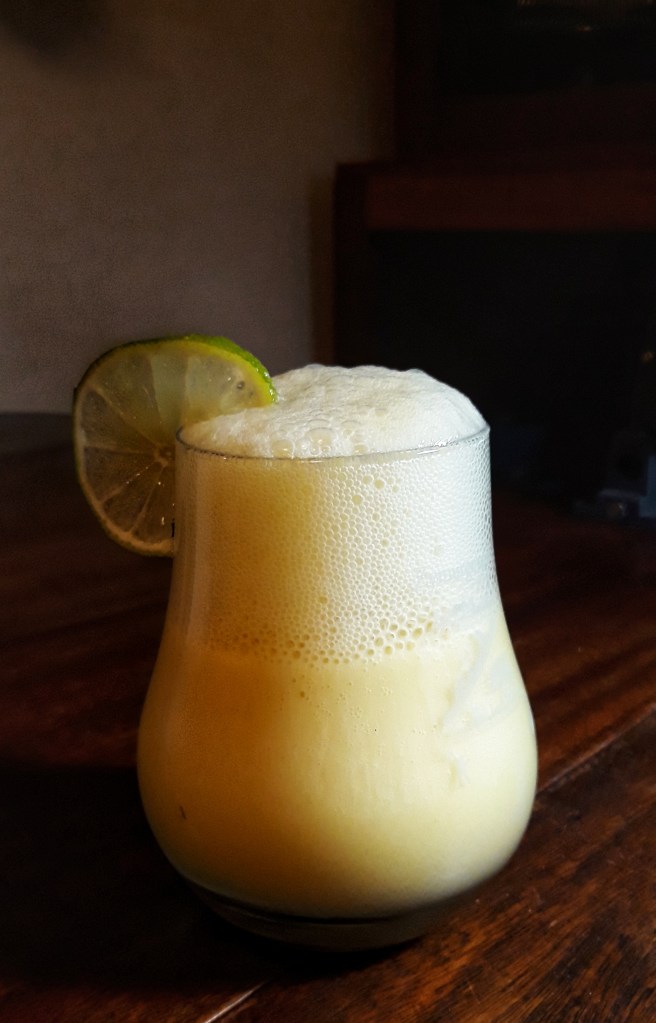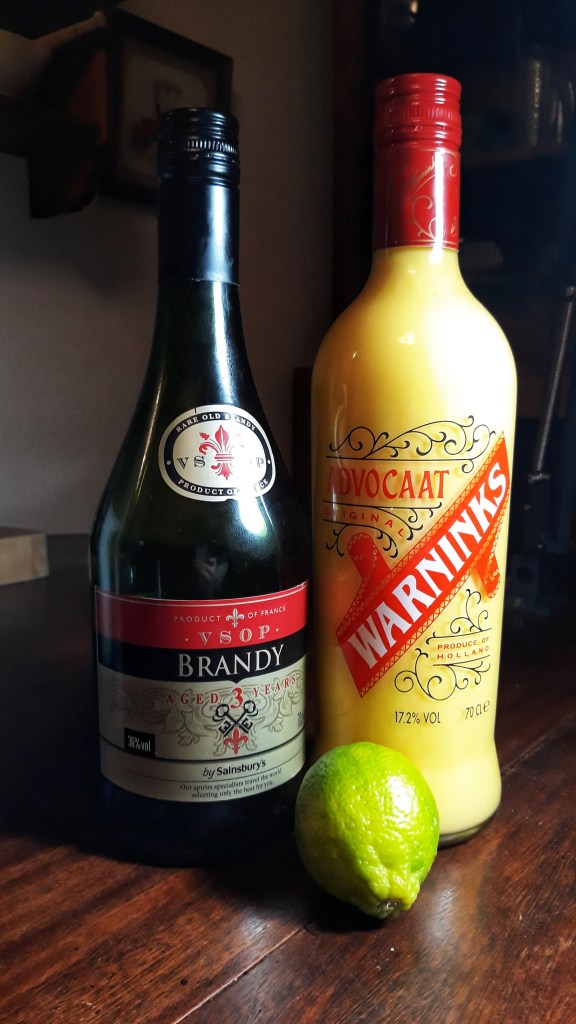
As you may know, I like to write a boozy post at this time of year and this year’s is small but perfectly formed: the Christmassy and rather kitsch classic, the Snowball, a blend of the Dutch egg yolk-based liqueur Advocaat and lemonade.
A lot of people think Snowballs are a bit naff, but I love them. The problem is that they can be too sweet and cloying, but that’s because folk don’t realise that there are two other very important ingredients – brandy and fresh lime juice. They both cut through the custardy sweet Advocaat and subtly transform it. I recommend you go out and buy the ingredients right now!
The Snowball cocktail was invented in the 1940s but didn’t become popular until the 1970s, where it was stripped of all sophistication by those who used only Advocaat and lemonade, missing out the ingredients they supposed to be superfluous producing the sickly cocktail we all know today.
Advocaat is a Dutch liqueur. Its name is a bit of a mystery; most reckon it comes from the Dutch word for advocate or lawyer. The 1882 edition of the Dictionary of the Dutch Language says it is ‘…a good lubricant for the throat and thus considered especially useful for a lawyer, who must speak in public.’
There is another theory that it was originally made by 17th-Century Dutch settlers in the Americas using creamy avocados, sugar and rum. I am assuming that because this is the most exciting story of the two that it is the apocryphal one. Occam’s Razor and all that…

Anyway, I hope you have a great Christmas – and a good few PROPER Snowballs.
xxx
~
Per person:
25 ml (1 shot) Advocaat
12.5 ml (a ½ shot) brandy
Juice ¼ of a lime
Ice
Around 75 ml lemonade
To garnish: a thin slice of lime
Pour the Advocaat, brandy and lime juice in a cocktail shaker and add plenty of ice.
Shake well and strain into glasses. Add a single ice cube per glass and top up with a little lemon (it will fizz up!).
Stir and garnish with the slice of lime.
~
If you like the blogs and podcast I produce, please consider treating me to a virtual coffee or pint, or even a £3 monthly subscription: follow this link for more information.
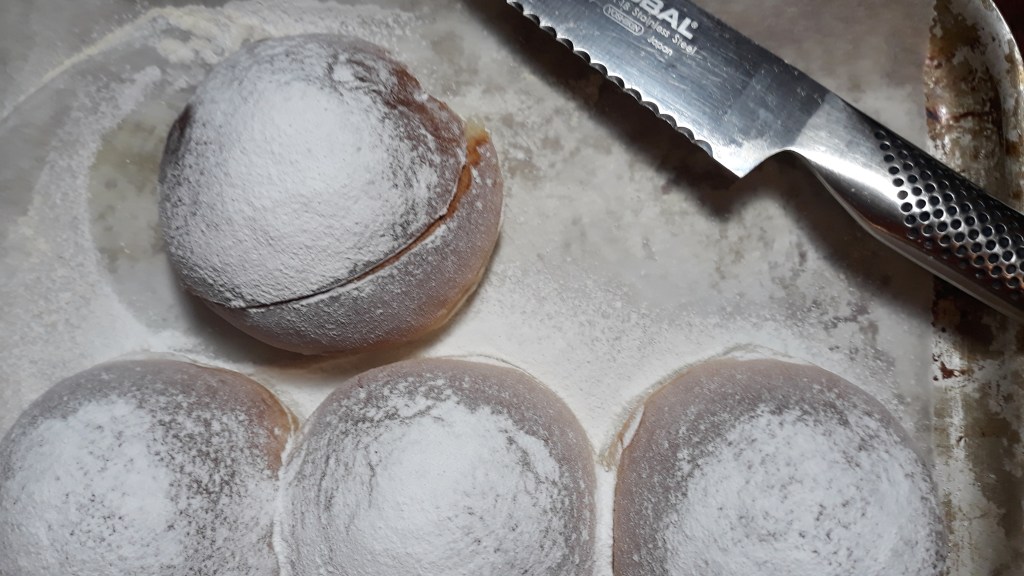
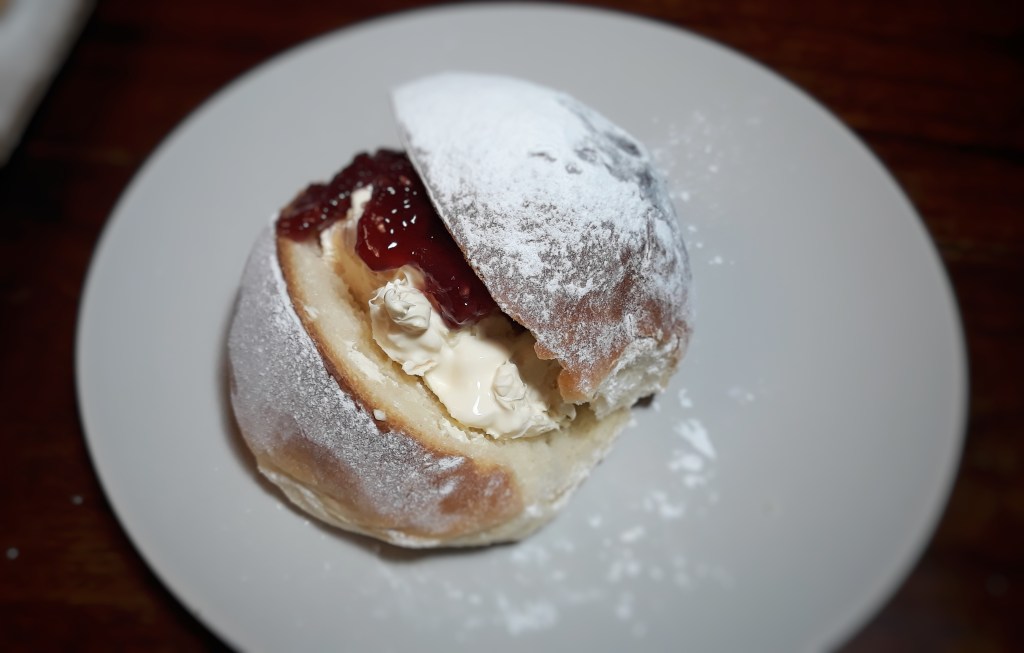
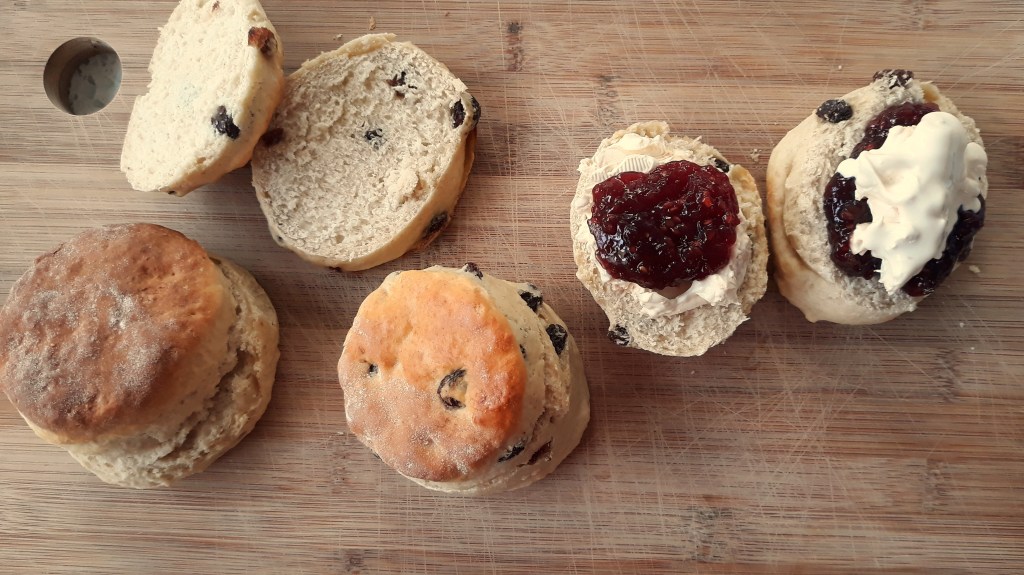
Cornish splits are soft and pillowy enriched bread rolls and were the original cakey element of the Cornish cream tea. Bread rolls such as these were – and indeed are– eaten all around the country. There were Devonshire chudleighs, Yorkshire cakes and Guernsey biscuits, for example. But it was the people of Devon and Cornwall who combined them with clotted cream and jam.
These light, fluffy rolls are enriched with butter and are
made extra soft by being made with milk rather than water and are covered with
a tea towel as soon as they come out of the oven – the captured steam softening
the exterior crust. Once cooled – or better, just warm – the rolls are not cut
open, but split open with the fingers, hence their name.
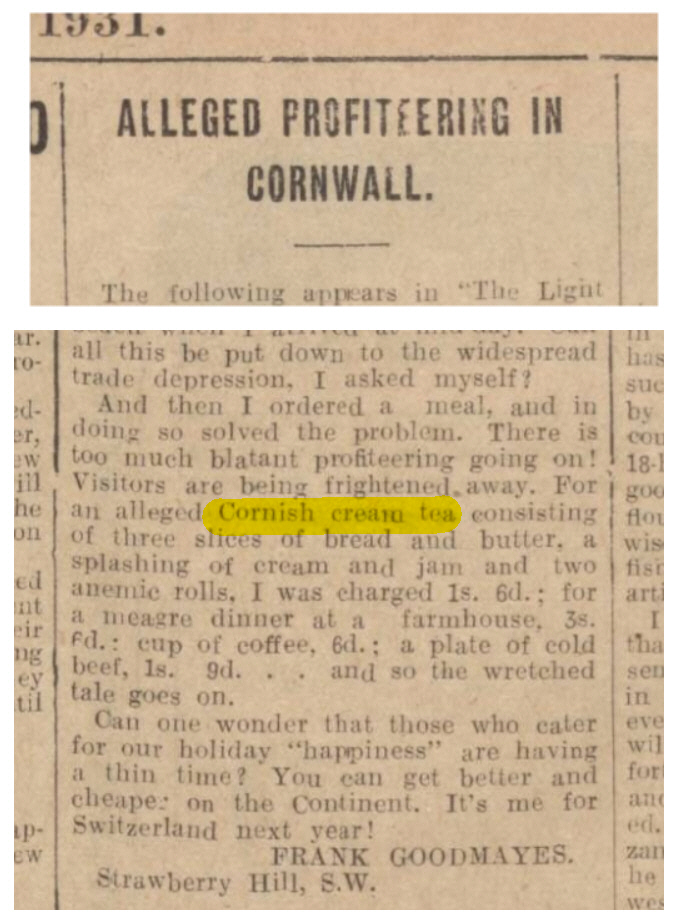
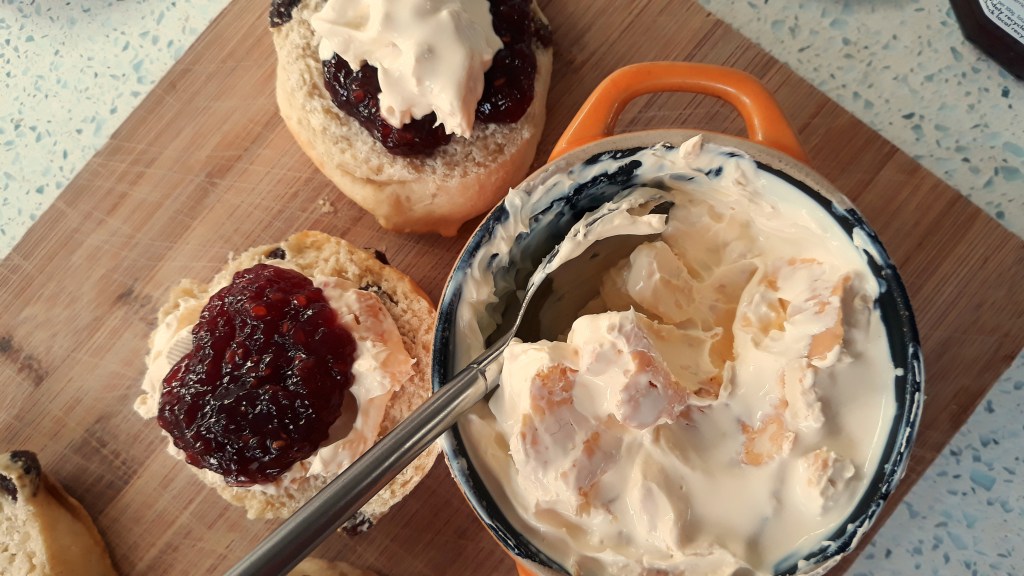
Of course, the cream tea as we know today it is made up a scone, clotted cream and jam. Some places sell them made with whipped cream, but that will not do. The phrase ‘cream tea’ meaning a scone/split with jam and cream (as opposed to tea with cream in) seems to be relatively modern – the earliest printed reference of one coming from a 1932 article in The Cornishman newspaper (see foodsofengland.com). The earliest mention of a combination of jam, cream and bread eaten together pops up in the Devon town Tavistock’s accounts dating from the tenth century!
Cutting from The Cornishman, Thursday 3rd September 1931 (foodsofengland.com)
Some establishments in Cornwall still serve a split instead
of a scone in their cream teas, but they are few and far between. Many folk
reckon that the split is superior to the scone in a cream tea, the scone winning
out by virtue of it being much quicker and easier to make. The Devonians apparently
turned to scones before the Cornish, presumably because Cornwall is more
cut-off. So, we have a situation where the rivalry between the two lands can be
stoked. The Cornish can claim they invented the cream tea because they invented
the split, but the Devonians can claim they invented it because they came up
with the cream tea we think of today.
The bakery where I grew up in Pudsey, West Yorkshire sold Cornish
splits filled with whipped cream, thin seedless raspberry jam and lots of icing
sugar. I used to love them, so I was keen to make them myself and have a proper
Cornish cream tea.
This enriched dough is a little trickier to work with than regular white bread dough, but you can make it by hand without things becoming too much of a horrible sticky mess. I prefer to use the dough hook these days I must admit. I use strong bread flour to gain a nice rise, but older recipes use regular plain flour; feel free to use it too, but whilst your splits will be more historically authentic, they will be less light for it: your choice!
Makes 12 splits:
500 g white strong bread flour
8 g instant yeast
10 g salt
60g caster sugar
75 g softened butter
280 g warm milk
I’ve written before about making and forming bun dough in more detail before, so if there’s too much brevity here, click this link.
Mix the flour, yeast, salt, sugar in a bowl. Make a well and
add the butter and then the milk. If you have a food mixer with a dough hook, mix
slowly to combine, then turn up to speed 4 and knead for around 6 minutes or
until the dough has become tight and smooth and no longer sticky.
You can of course do all of this by hand, using a little
flour for kneading at first until the dough loses its stickiness.
Using your hand, form the dough into a tight ball, pop in a
lightly oiled bowl and cover with cling film or a damp tea towel. Leave
somewhere warm until it doubles in size, which could take 90 minutes depending
upon the ambient temperature.
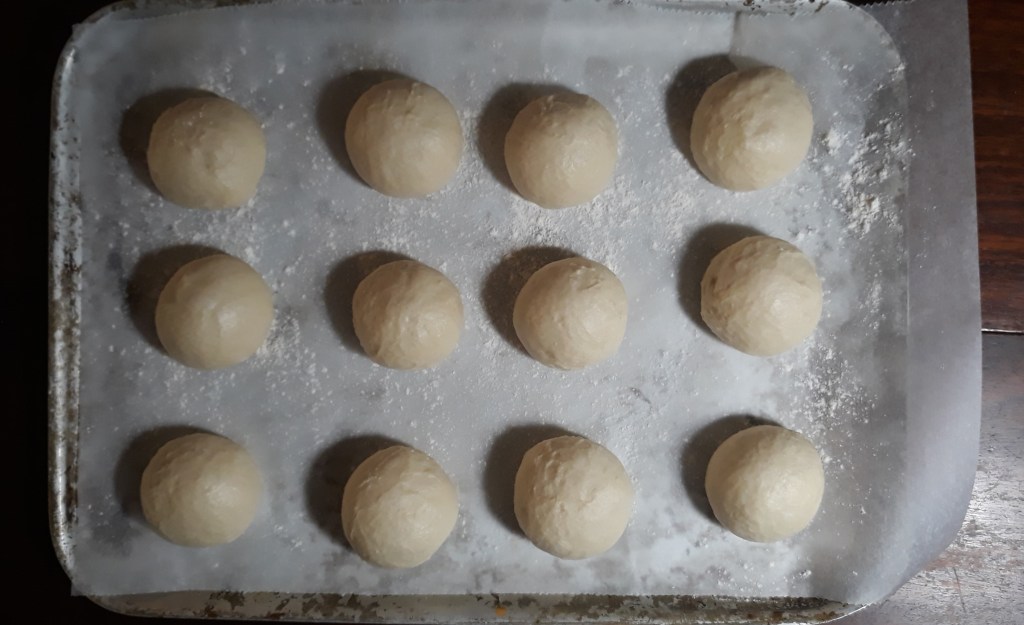
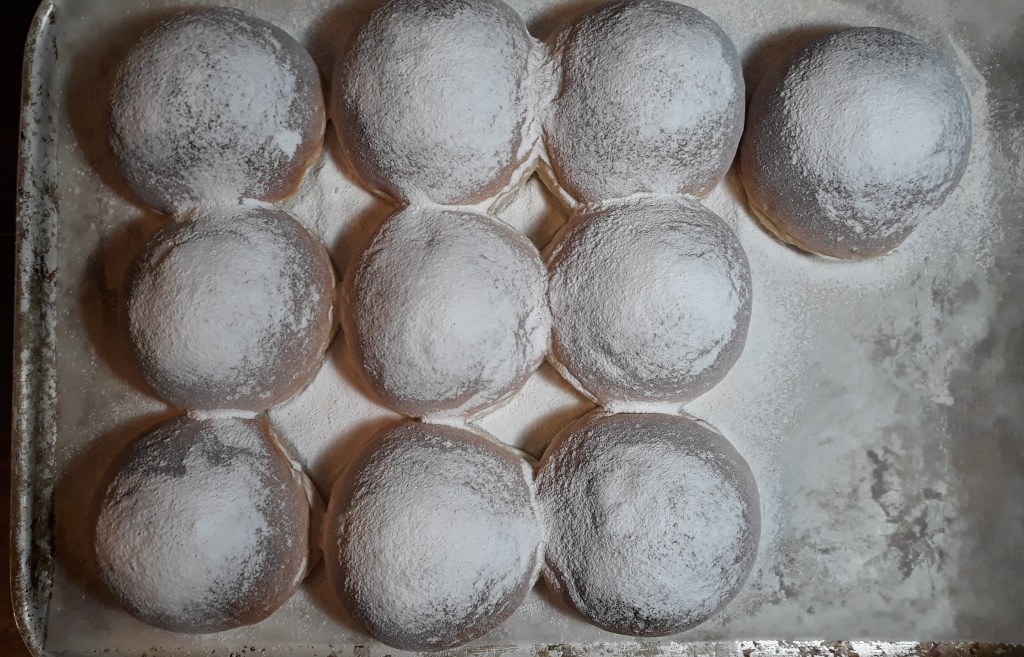
When ready, divide into 12 equal sized pieces, form them
into balls and arrange on a baking sheet. Cover with a large plastic bag or tub
and wait for them to prove. Once doubled in size again – it should take much
less time than the first rising – place in a cold oven and turn it to 200°C.
Bake for 25 minutes, but if at any point, the splits look like they getting too
brown, turn the temperature down to 175°C.
When ready, remove from the oven to cooling tray and quickly
place clean tea towels over the buns to prevent them crisping up.
When cold, you can sprinkle with sugar if you like, then slice
or split and fill with jam and cream.
If you like the blogs and podcast I produce, please consider treating me to a virtual coffee or pint, or even a £3 monthly subscription: follow this link for more information.
There’s nothing more Cornish than a good blob of clotted
cream on a lovely cream tea. Unless you are from Devon of course, then there’s
nothing more Devonian than a good blob of clotted cream on a lovely cream tea.
For those not in the know, clotted cream is a very thick
cream with a much higher butterfat content than double (heavy) cream; weighing
in at 64% and 48% respectively (for comparison, single cream is 18% fat, and
full-fat milk is around 4%).
Clotted cream has a long history in Devon and Cornwall, and
it is reckoned that it was first introduced to England by Phoenician settlers around
2000 years ago. Phoenicia was on the eastern Mediterranean coast in, what is
now Syria, Lebanon and northern Isreal. The clotting of cream was a way of
preserving buffalo milk. By removing the watery liquid, leaving mainly
butterfat, the growth of spoilage organisms is retarded. The folk of Devonshire
knew of its efficacy in this area; it was said that not even a witch’s breath
could turn it sour.
If you have ever tried it, you will know that clotted cream
– aka clouted cream or scalded cream in older books – is absolutely delicious
and is well worth buying. It is possible to make your own and there is a recipe
at the end of the post of you would to try your hand at it.
The best thing about it is the buttery, nutty crust that
forms on the top as part of the manufacturing process. It is made by gently
heating rich milk or cream in large shallow pans to a temperature of 80 to 90°C,
the heat traditionally coming from cinders or charcoal. Once the buttery crust
had formed, it was carefully but quickly moved to a cool place and sat upon
some slate so make the cooling process as rapid as possible; the cold shocking
the thin skimmed milk into sinking quickly and making a layer underneath the
thick cream. These days, it’s all done with centrifuges, which is rather less
romantic.
Once completely cooled, the clotted cream was lifted away
with cold, wet hands and mixed in cold, wet wooden bowls to remove the last of
the watery milk. It was then layered up in pots. I found a 1755 home recipe
from an Elizabeth Cleland who recommended sprinkling rose water and sugar
between the layers – the result must have been delicious!
The left-over skimmed milk, by the way, was taken away and
either drank or used to make scones or Devonshire splits.
From the point of view of butterfat extraction, clotted
cream is a much more efficient method than basic skimming techniques. The
reason it is not the standard technique, I assume, is that double skimming requires
no heating or centrifuges, tipping the balance of economy in double cream’s
favour. Couple this with the fact that modern refrigeration and pasteurisation
is doing the lion’s share of the preserving today means that the process of
clotting cream is no longer required for that purpose. We eat it for the sheer
love of it (ditto smoked fish and meat).
Mrs Beeton’s Book of Household Management says that
there are two types of clotted cream: Devonshire and Dutch. She goes on to
explain the difference – Dutch clotted cream is thick enough to stand a spoon
up in. Now, in my (humble) opinion, it ain’t clotted cream unless you
can stand a spoon up in it, so I can only conclude that English clotted cream –
at least from a Victorian Londoner’s point of view – was relatively runny
compared to that of today’s
Clotted cream is used to make ice cream, some biscuits and as a topping to the old-fashioned pudding Devonshire junket, a sweetened milk dessert set with rennet, producing curds and whey. It can be used to enrich sauces and soups too but use with caution – things can end up too rich.
Rodda’s is the largest producer of clotted cream and is based in Cornwall. There is much debate between the folk of Devon and Cornwall as to whether the cream should be added before or after the jam. Nick Rodda reckons his grandfather knew why:
We always put our cream on top because we are proud of it, Devonians are slightly ashamed of theirs, so they cover it up with their jam.
I must confess to siding with the Devonians on this one.
It’s all down to what you think the buttery cream’s role is. The argument goes
something like this:
The Cornish: it is the cream, and you wouldn’t put cream under
your fruit salad/trifle/fruit tart etc, now would you?
The Devonians: it is the butter, and you wouldn’t spread
butter over the jam on your toast/crumpet/muffin etc, now would you?
Your choice.
If you like the blogs and podcast I produce, please consider treating me to a virtual coffee or pint, or even a £3 monthly subscription: follow this link for more information.
Home-Made Clotted Cream
All you need to make your own is some double cream, an oven
and patience.
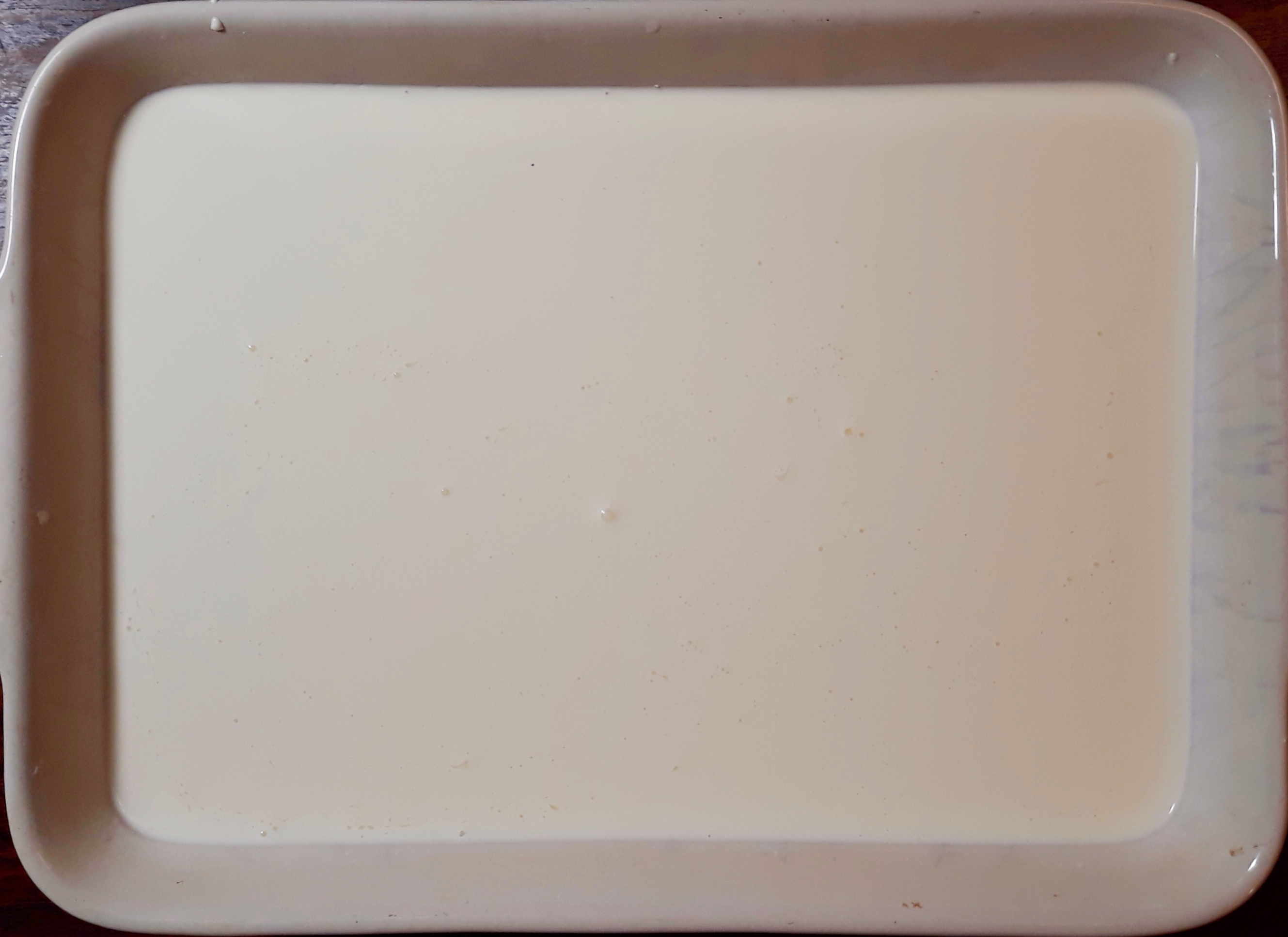
Before…
Preheat your oven to 80°C. Pour around 1 litre of
double cream into a wide, shallow ovenproof dish, place it in the oven and
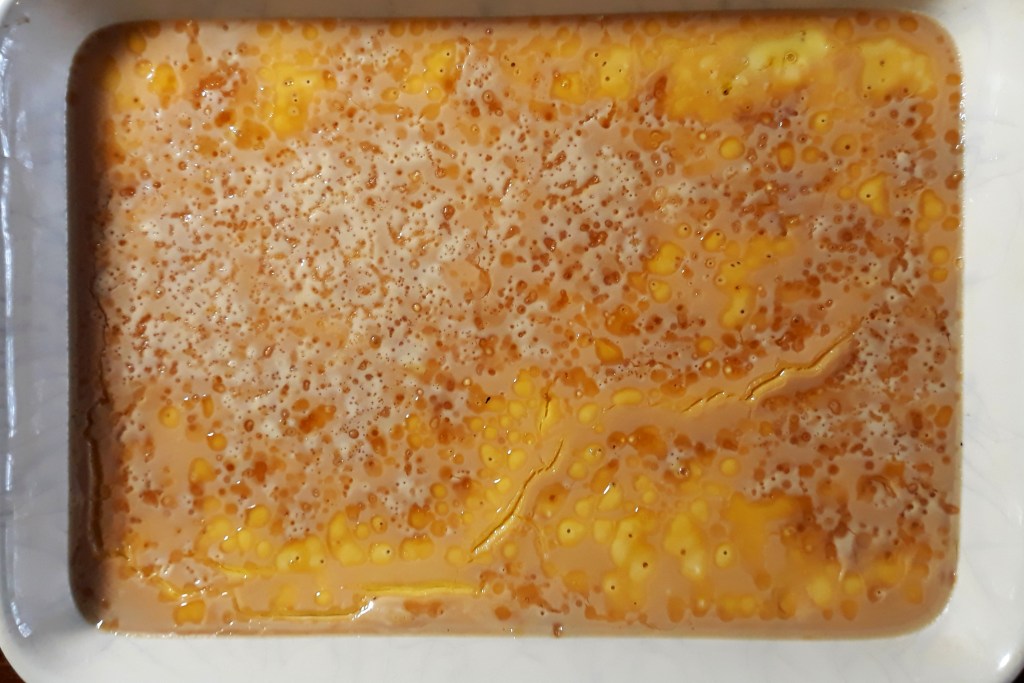
leave in there for 12 hours. If you are really patient, leave for 18 hours to
achieve a darker, more delicious caramel-flavoured crust.
…after
Carefully remove from the oven, cover with kitchen foil and
pop straight into the fridge to cool quickly and undisturbed.
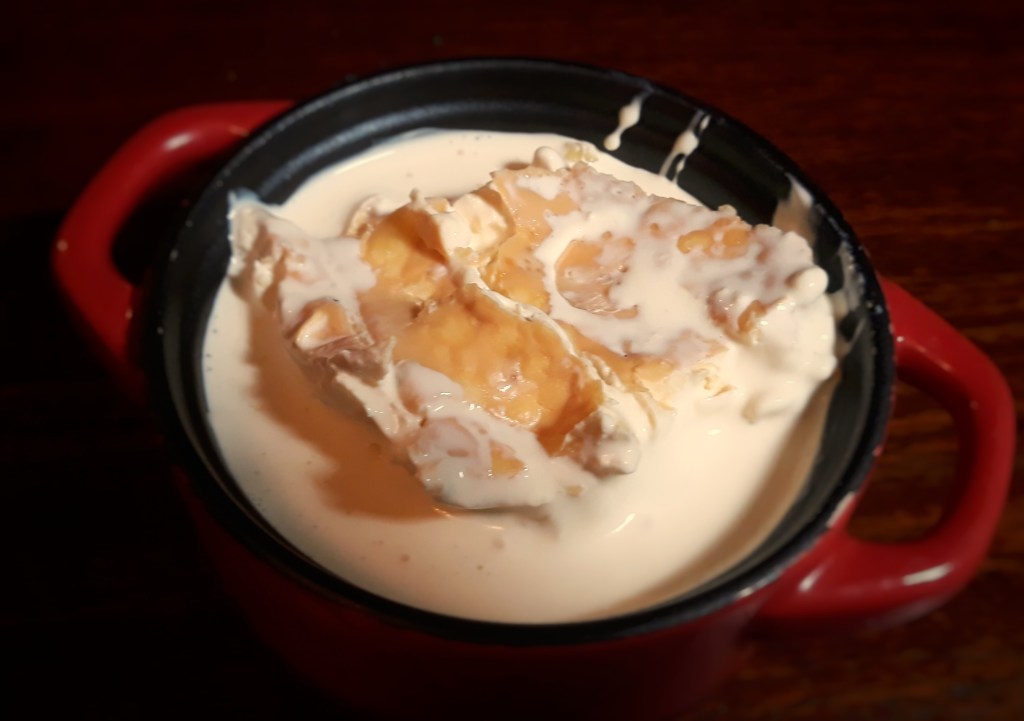
Once fully chilled, lift the clotted cream from the dish and
layer up in pots. I filled three good-sized ramekins with mine. The amount of
skimmed milk at the bottom will vary depending upon how long you left the cream
in the oven for.
The cream keeps for 7 days in the fridge.
References:
Clotted Cream, RS Chavan, A Kumar & S Bhatt,
2016, In Encyclopedia of Food and Health
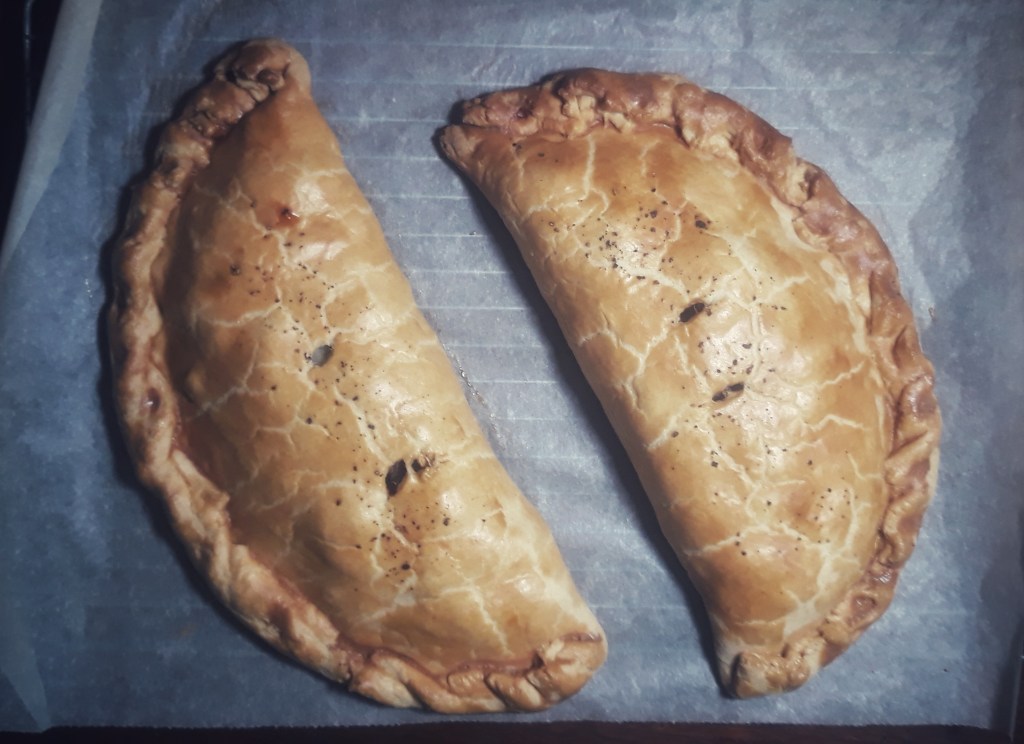
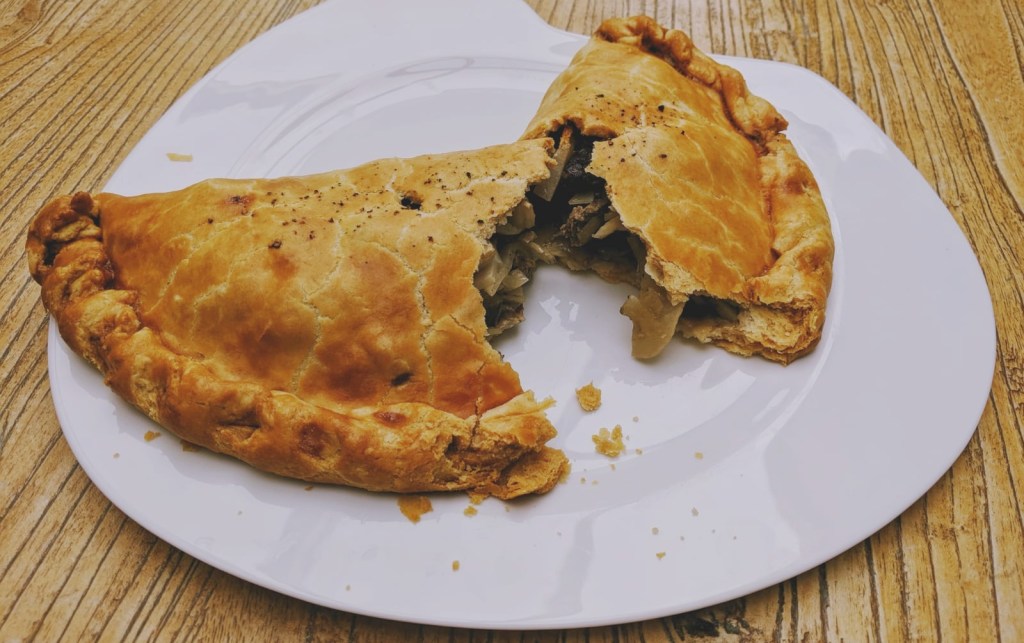
As promised, some Cornish recipes and I start with a classic. Cornish pasties are a simple combination of chopped (not minced) beef, potatoes, turnips and onions. It’s seasoned well – especially with black pepper and baked in shortcrust pastry. You can moisten it with a bit beef stock and season it further with some thyme leaves if there’s some hanging around, but you really don’t need to. Sometimes you may find some carrot in your pasty, if you do, thrown it back the face of the person who gave you it, because there is no place for carrot a Cornish pasty.
Cornish pasties were given to Cornish tin miners or field-workers so they could slip one into their pockets and eat them for lunch, the thick crimp being a useful handle protecting it from dirty fingers. The meat-to-vegetable ratio varied depending upon what folk could afford at the time. It don’t think it should be too meaty, but if you disagree simply alter my proportions in the recipe below.
Cornish tin miners, pasties in hand
Also, for a Cornish pasty the crimp must go down the side,
not over the top, as you might see in some bakeries. That is a Devonshire
pasty, I believe.
As discussed in the comments in my previous post, these pasties did not have a sweet filling at one end and a savoury one at the other. What you have there is Bedfordshire clanger, but I’m sure you knew that.
One final thing, some advice from Jane Grigson: “Cornish
pasties are pronounced with a long a”. We use a short a Up North,
and I refuse to change.
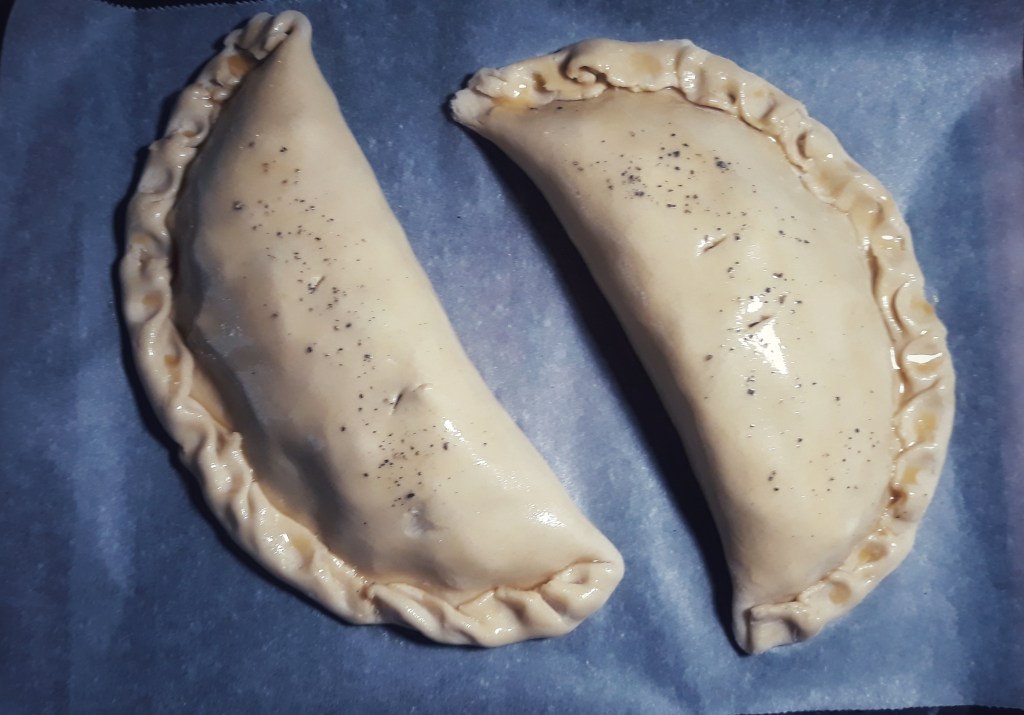
Pasties ready for the oven
If you’ve never made a pasty in your life, this is the one
to start with; the ingredients are raw so there is no messy gravy and juices
getting everywhere and making things difficult. It seems too simple to be delicious,
but it is. The secret is in the seasoning. I use a rounded teaspoon of salt,
but you can use less; be warned though, use no or little salt, and you will
have a bland stodge-fest before you, my friend.
On the subject of salt, notice the crazy amount of salt in
the egg wash – a good half-teaspoon of salt in your beaten egg provides a
strong and appetising shine to the final product. I believe that is, as the
kids say, a kitchen hack.
For 2 large or 4 medium-sized pasties:
For the shortcrust pastry:
400g plain flour
100g each salted butter and lard, diced
around 80g water
For the filling:
300g chuck, skirt or braising steak, gristle and fat removed
125g onion (a medium-sized one), chopped
125g turnip, peeled and thinly sliced
250g potato, peeled and thinly sliced
salt and freshy-ground black pepper
thyme, fresh or dried (optional)
4 tbs beef stock or water
Egg wash:
1 egg beaten with ½ tsp salt
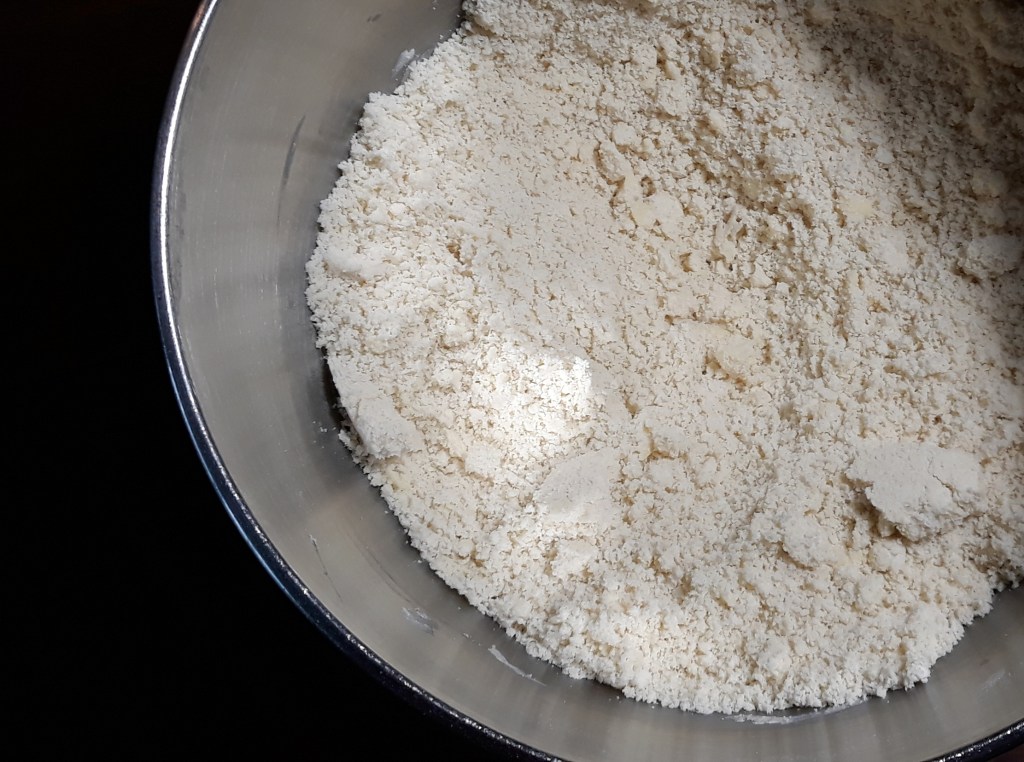
Begin with the pastry. Place the flour, butter and lard in a
mixing bowl. If you have an electric mixer, use the flat beater and turn on to
a low speed until the mixture resembles breadcrumbs. If you are doing this by
hand, rub the fat into the flour with the tips of fingers. It shouldn’t take
longer than five minutes.
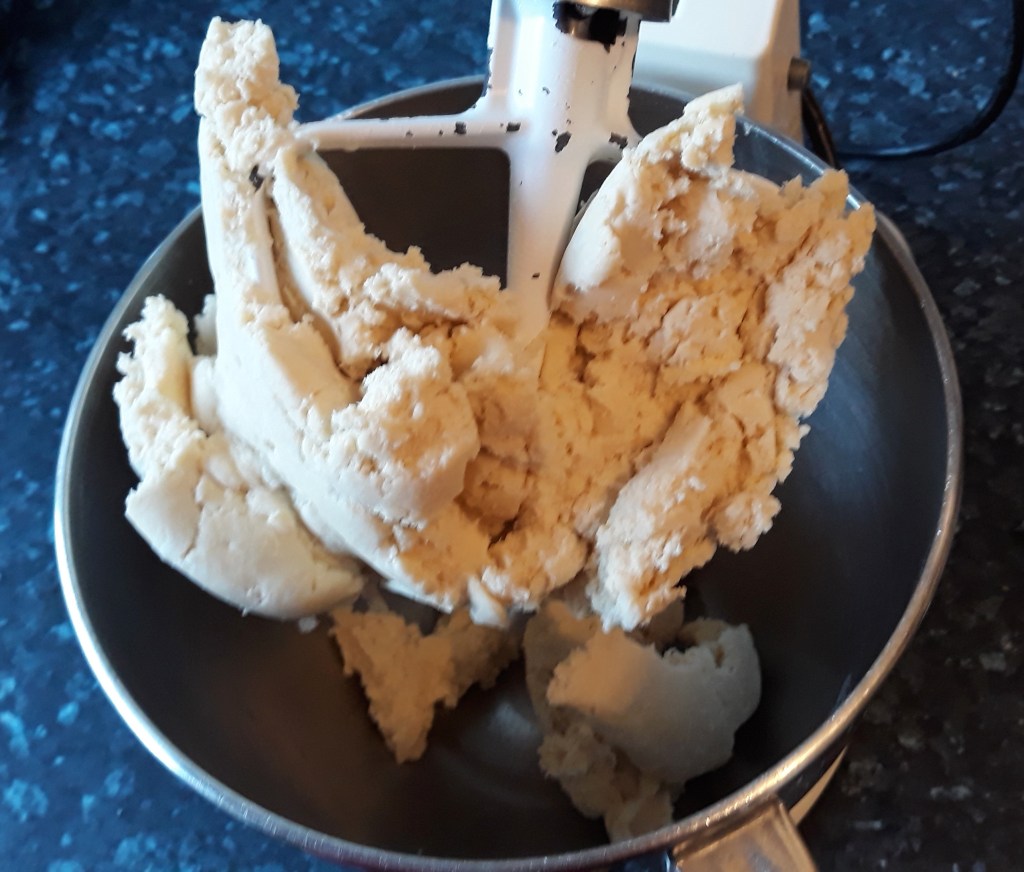
Trickle in the water with the mixer on its slowest speed and
stop it as soon as the dough comes together. If doing by hand, add half the
water and mix in with one hand, trickling in the rest of the water as you mix.
Either way the dough should some together and not feel
sticky – it shouldn’t stick to your worktop, but it will feel a little tacky.
Lightly flour your work surface and knead the pastry briefly.
This is where you may go wrong – over-kneading results in tough, shrinking
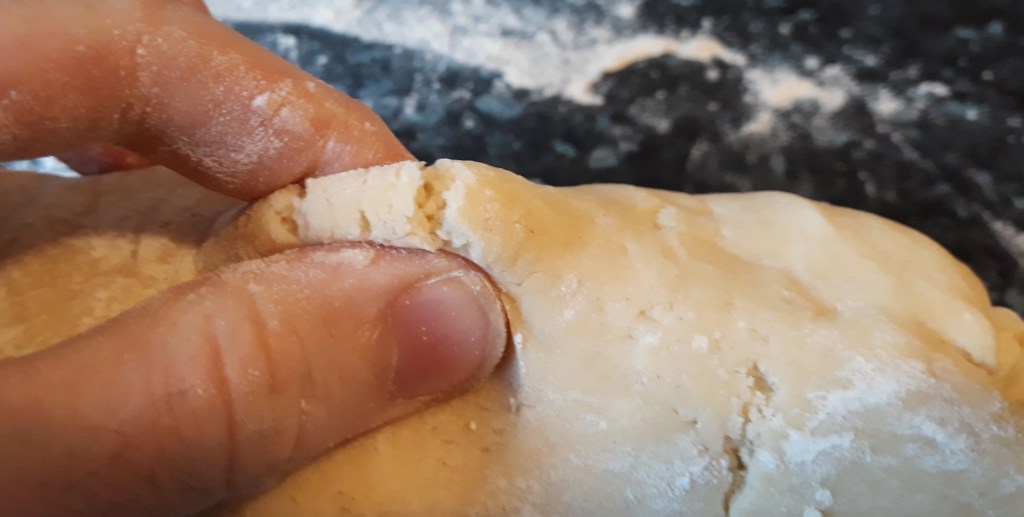
pastry. The way to tell you are done kneading is to pinch some of the dough
between your thumb and forefinger – it should just split around the edges when
you pinch it hard (see pic).
Cover the dough and pop in the fridge to rest for 30 minutes.*
Meanwhile, get the filling ready. Place all the vegetables
and a good pinch of thyme if using in a large mixing bowl. Season and mix with
your hand, then add the meat, season that and then mix in. Remember to be generous
with the black pepper – add what you think is sufficient, then do a couple more
twists of the milk.
Remove the pastry from the fridge and split into two or four
equal pieces. Form into balls and roll each out on a lightly floured surface,
using a lightly floured rolling pin. I rolled out two large dinner plate sized
circles of dough to around 3mm thickness – that of a pound coin. Don’t worry if
they are a little wonky, they get tidied up as we go. That said, if it’s
looking more like a map of the Isle of Wight than a circle, you might want to
neaten up a little.
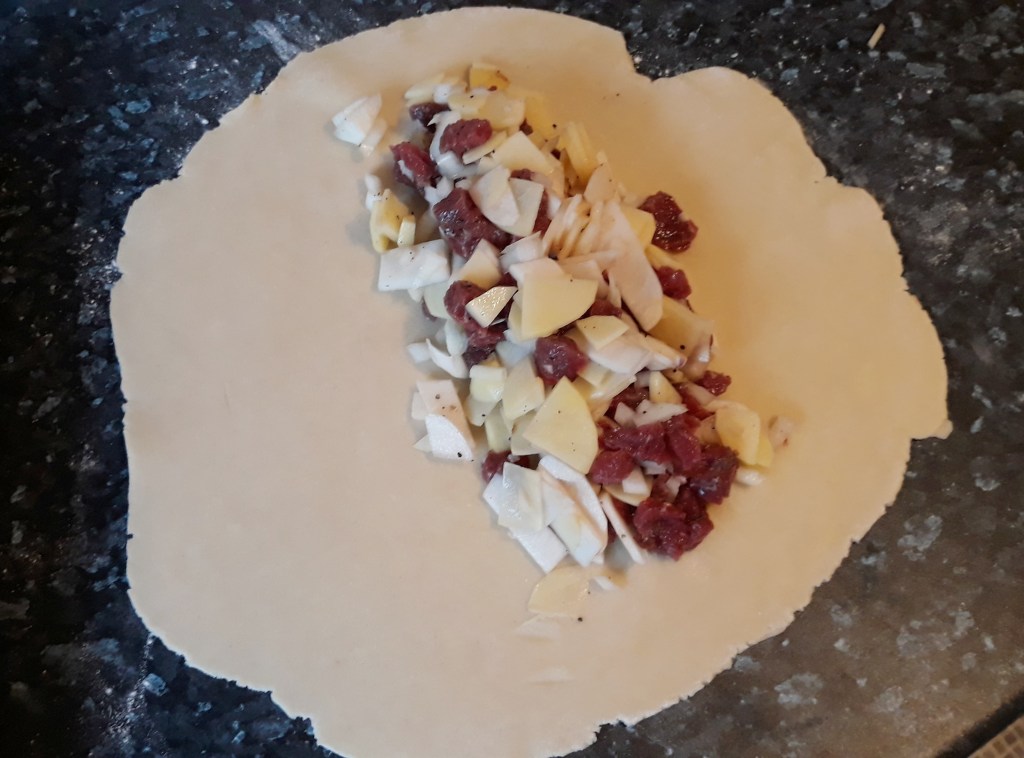
Now heap up the filling in a line just slightly off centre,
dividing equally between the circles of dough. Sprinkle with the beef stock or
water. Brush a semi-circle of egg wash down the edge nearest to the filling and
then fold the dough over leaving the dough beneath poking out by 5 or 10mm.
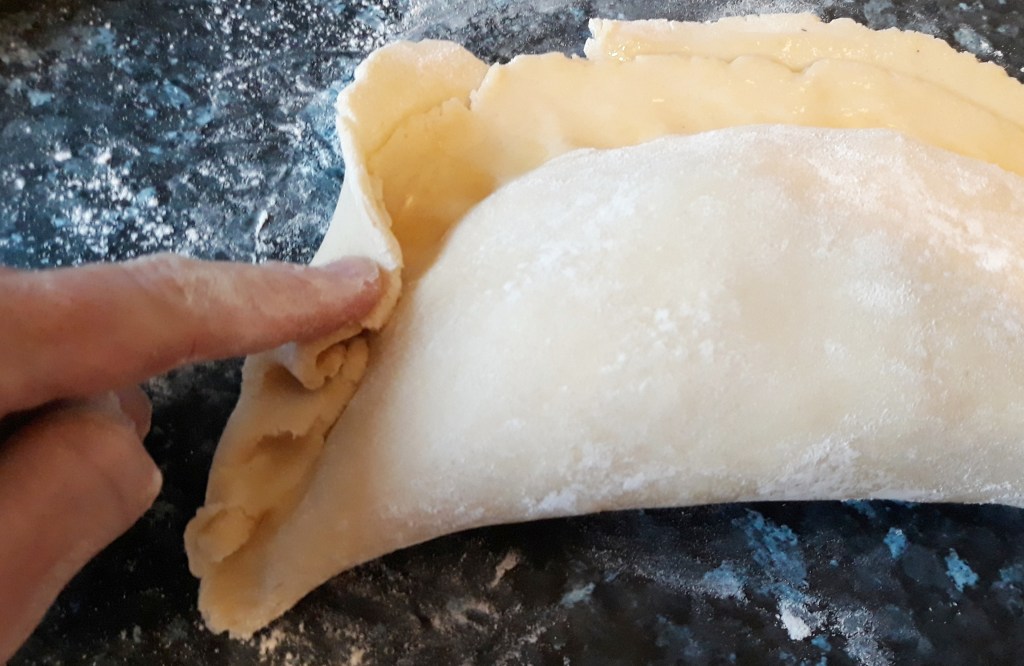
Next egg wash the side again and crimp down the edge – this makes things extra-secure as the filling
expands in the oven. To crimp, fold over one corner inwards with a finger, squidge
down the next section of pastry and repeat until you have worked all your way
around the pasty.
Place on a lined baking tray, egg wash the tops and poke in
a couple of holes with a sharp knife. Bake for 1 hour at 200°C,
turning down the temperature to 180°C once the pastry is golden brown,
around 20-30 minutes into the bake.
Remove and eat hot or cold.
*I will write a more in-depth method for pastry at some
point, honest!
If you like the blogs and podcast I produce, please consider treating me to a virtual coffee or pint, or even a £3 monthly subscription: follow this link for more information.
The last in a quartet of gooseberry posts – I promise I will change the subject next post.
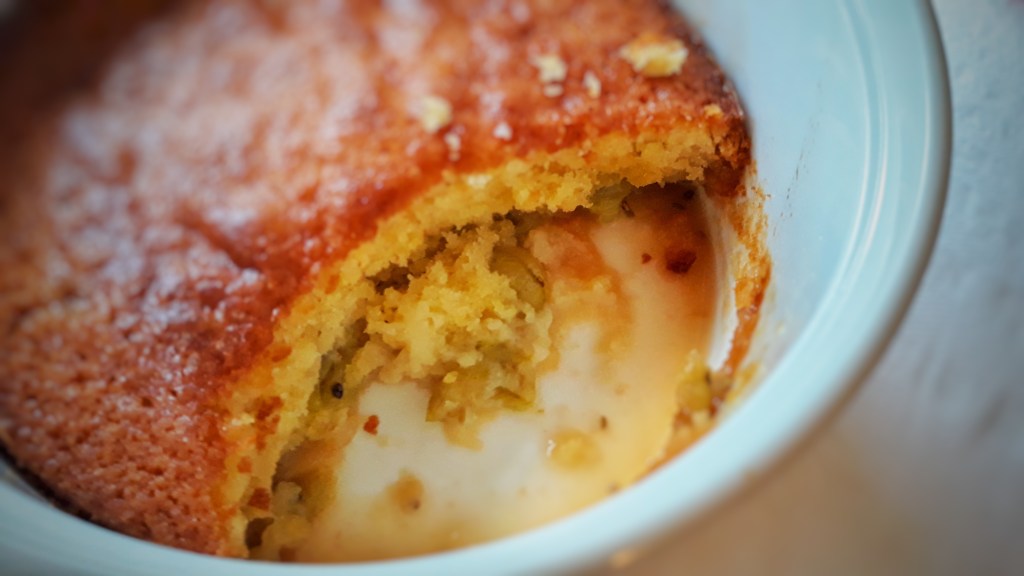
In my honest, humble opinion this is the best
gooseberry dessert recipe. It’s old-fashioned and simple to make – gooseberries
are baked with a little brown sugar and a knob or two of butter, all covered in
cake sponge. The berries are still very sharp and are perfectly balanced with
the warm, sweet sponge. This is much more superior to the better-known Eve’s
pudding – stewed cooking apples covered in sponge cake. I suspect this would work
excellently with blackcurrants.
This recipe crops up in my traditional English or British cookery books, but I first heard of it from Jane Grigson (as I have many dishes) in her book English Food.
For the pudding, you can make any amount of topping, it’s
dependent upon whether you like a thin or thick layer of sponge and the
dimensions of your baking dish. I used a soufflé dish of diameter around 7
inches/18 centimetres. I think this is a good amount for this size, and for
most family-sized dishes.
The sponge is made using the all-in-one method, so make sure
your butter is extremely soft to ensure a light topping.
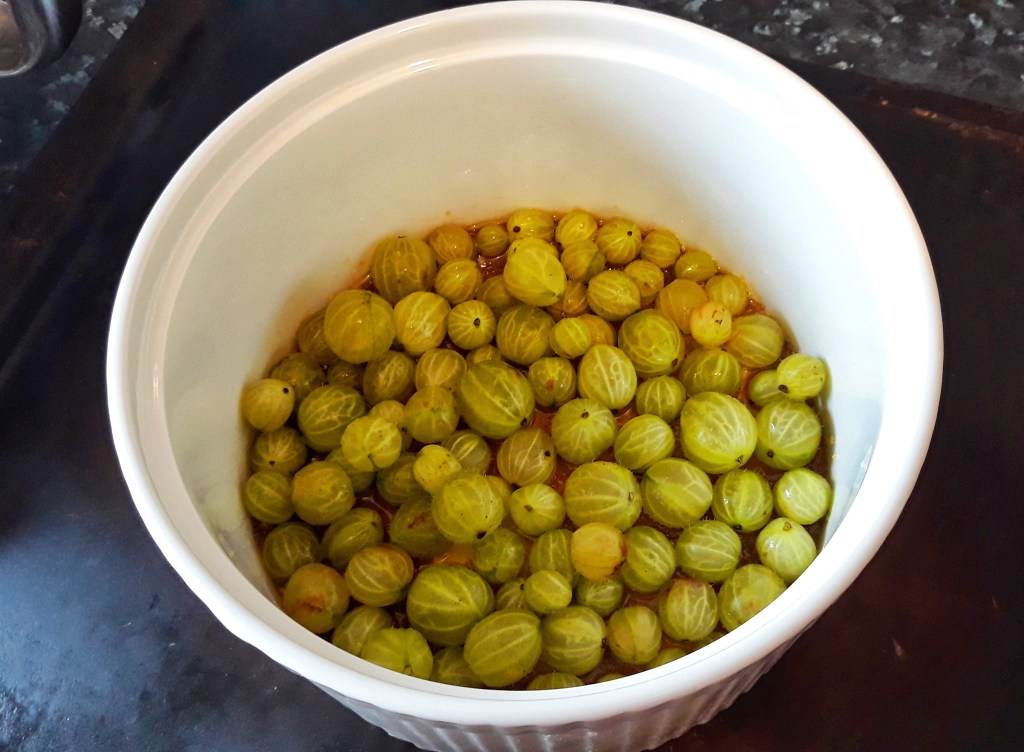
Scatter the sugar and dot the butter on the bottom of your
baking dish and cover with the gooseberries; you are aiming for a generous
single layer of them.
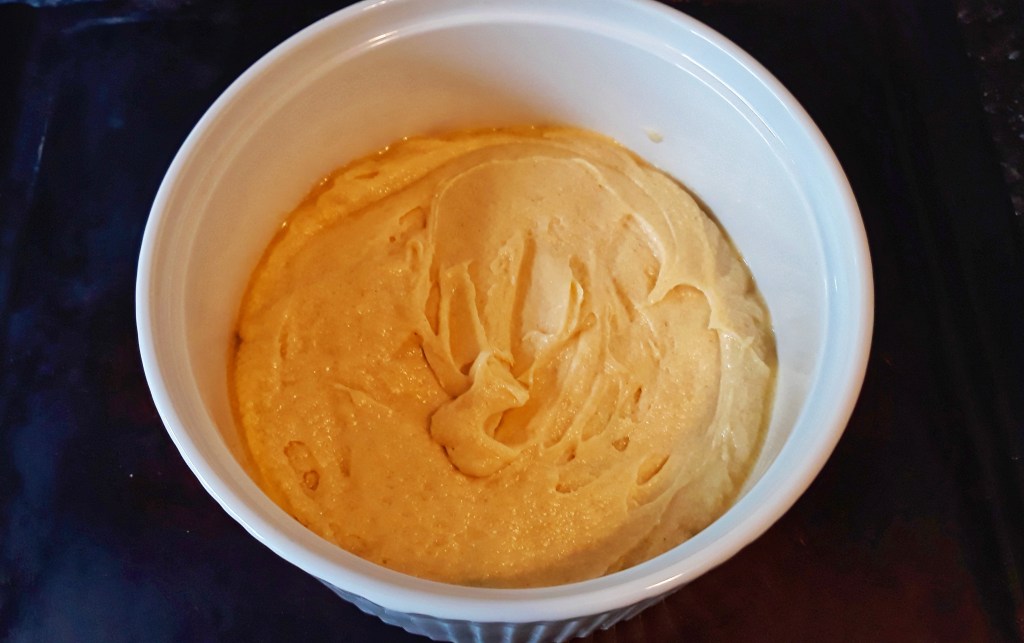
Place the butter, flour, caster sugar and eggs in a bowl and
beat together with an electric mixer until the mixture is smooth and
well-combined. Using a large spoon or spatula, add the cake batter in big
spoonfuls over the gooseberries and level it, you don’t have to be very neat
here, the baking batter will flatted itself out.
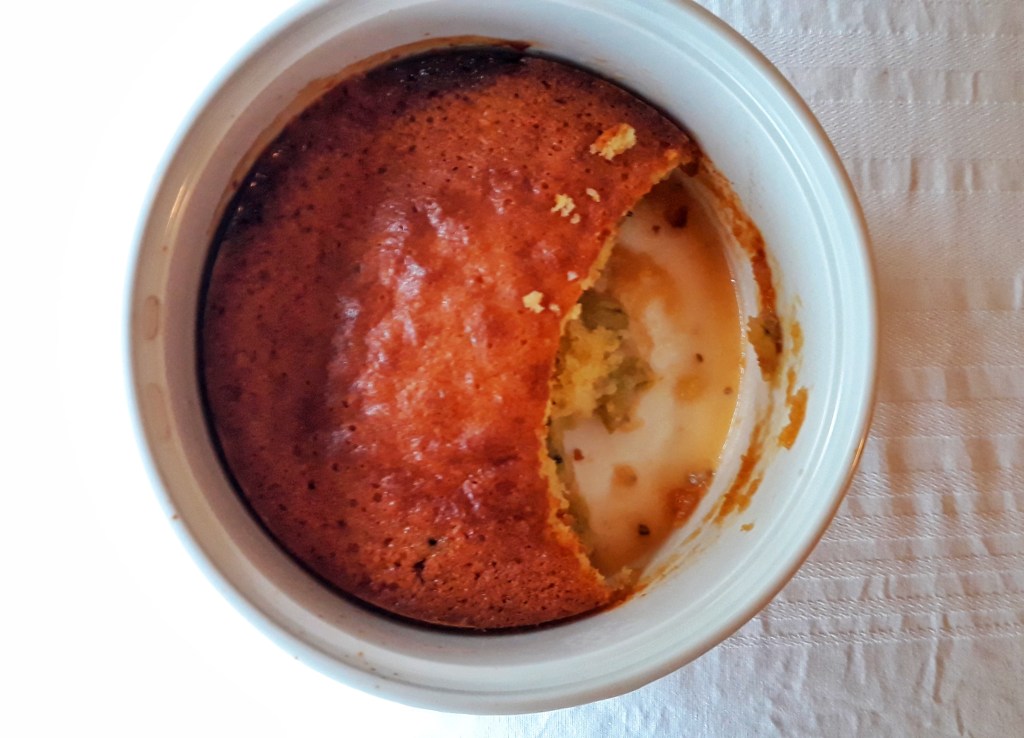
Place in the oven and bake for around an hour until the top
is a deep golden-brown colour.
Serve immediately with custard or lightly-whipped cream sweetened with a little icing sugar.
If you like the blogs and podcast I produce, please consider treating me to a virtual coffee or pint, or even a £3 monthly subscription: follow this link for more information.
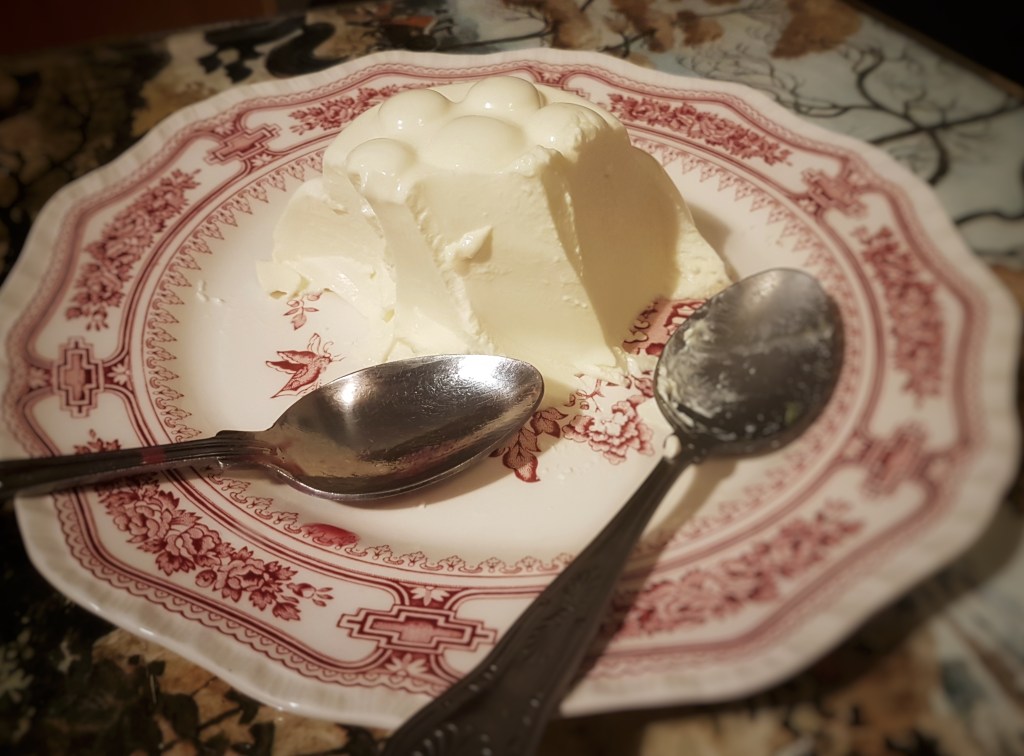
Last post I wrote all about the mediaeval dish Blanc Mange, an almond and rice stew served with chicken or fish. Obviously, I couldn’t let the opportunity pass to give you a recipe for the dessert blancmange we know and love (or hate).
Blancmange went from a savoury to a sweet dish somewhere
around 1600 – 1604 is the earliest recipe for it I can find that sounds like
the pudding we eat today.
When one thinks of blancmange, a shuddering over-sweet pale
pink mass doused with cloying raspberry flavouring is imagined. This is not a
proper blancmange. When I make one, I go back to basics.
photo: unknown
Blancmange should be a simple affair: cream, milk, sugar and
almond extract set with gelatine. In the recipes from earlier than the 20th
Century, the gelatine would have been prepared in house from calves’ feet or
pigs’ trotters. There was an alternative setting agent called isinglass which
is made from the dried swim bladders of fish.
By the way, the pronounced almond flavour of almond extract is not supposed to emulate that of regular almonds, but of bitter almonds which were high in cyanide and therefore used in small, highly aromatic doses. Other things were sometimes added to this basic mixture: lemon zest, cinnamon, brandy and rose water all crop up in recipes through the centuries.
If you like the blogs and podcast I produce, please consider treating me to a virtual coffee or pint, or even a £3 monthly subscription: follow this link for more information.
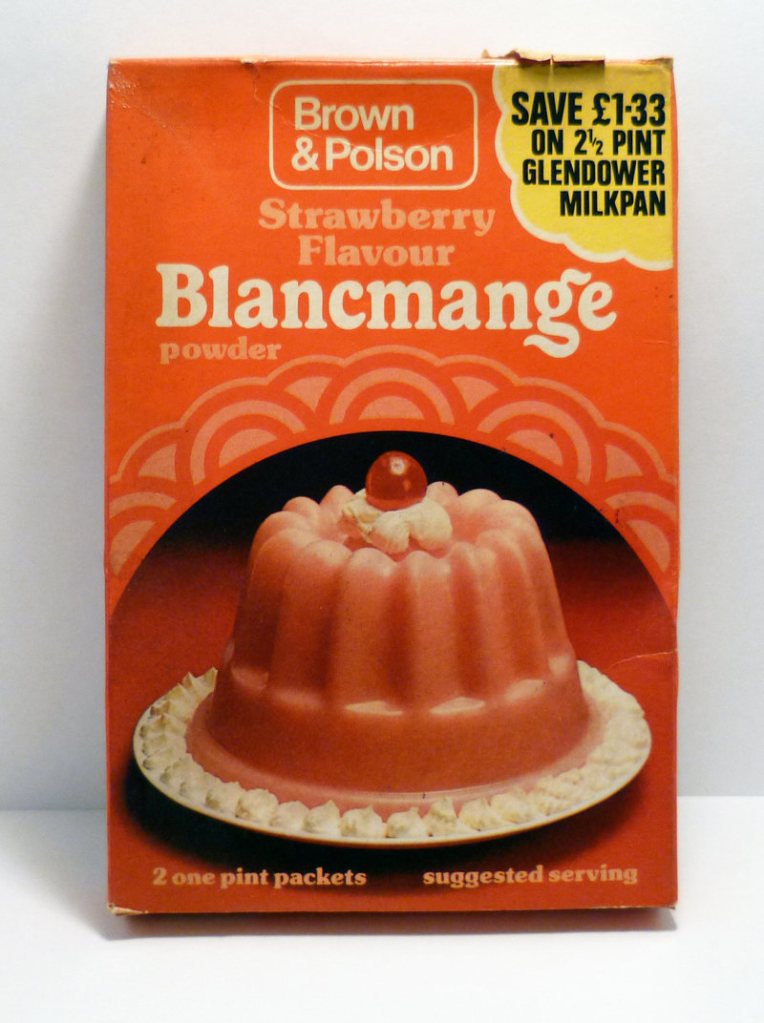
The blancmange went rather downhill once you could buy it in packet form. The almond extract or bitter almonds replaced with almond flavouring and instead of gelatine, cornflour was used. This is the dessert that many people hate. I must confess to quite liking the preparatory blancmange, but then, I’ll eat anything. It shouldn’t be called blancmange though, as it is quite a different beast; fake flavour and thick cornflour base making the final pud less jiggly and delicate. I suppose that after the realisation you could set custard with cornflour instead of egg yolks, the ‘magic’ formula was applied to blancmange.
I like to serve blancmange with a compote of cherries
flavoured with a dash of kirsch and some delicate shortbread biscuits, but it
is pretty good served all on its own. Who needs panna cotta!? If you want to
turn the blancmange out of its mould, it is worth brushing the inside with a
thin layer of sunflower oil so that it is easier to turn it out.
Makes 600 ml:
250 ml whole milk
gelatine leaves (see method)
100 g caster sugar
300ml double cream
1 tsp almond extract
Heat up the milk in a saucepan and as you wait, soak the gelatine leaves in cold water – check the instructions in the packet and use the correct number to set 600 ml except use one leaf fewer than instructed – you want a good wobble.
A good wobble…
When the milk is very hot, squeeze out the excess water from
the gelatine and whisk it into the milk along with the sugar. Once dissolved,
add the double cream and almond extract. Pour into your mould or moulds, cover
with cling film or a plate and refrigerate overnight. If you like, you can whip
the cream until floppy and stir it through the milk when it is just warm. This
way you get a mousse-like consistency – good if you want to serve it at a
dinner party.
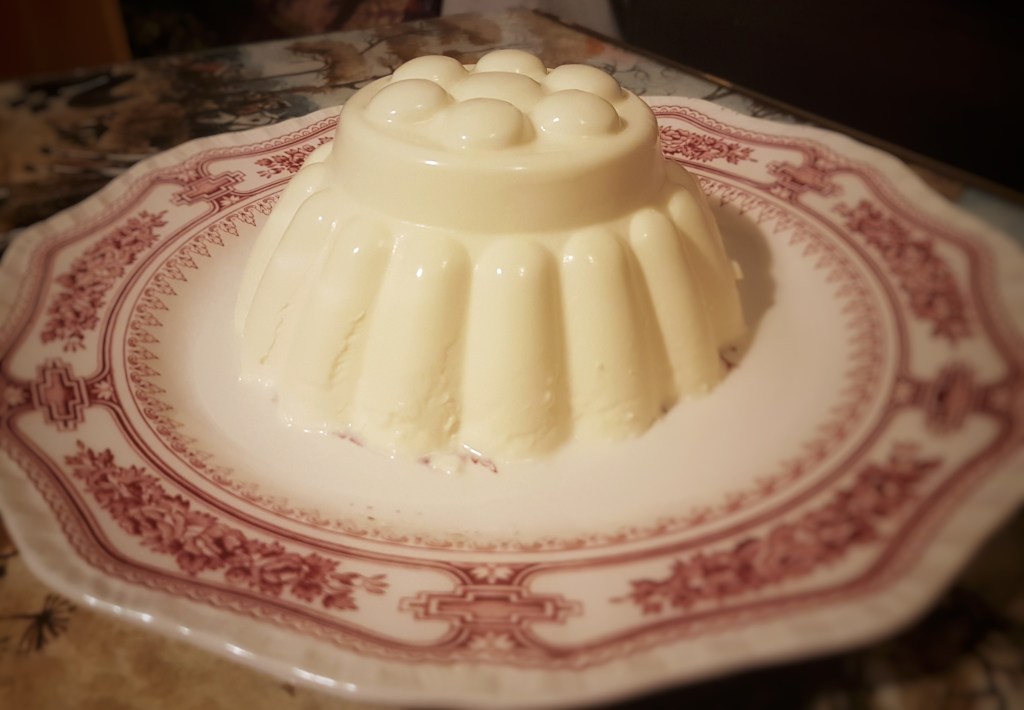
To turn out the blancmange, dip the moulds in hot water for
around 10 seconds. To make it release you may have to carefully coax the blancmange
from the inside edge of the mould with your finger; if you can move it away
easily, it should come out. Place a serving plate on top and quickly flip it
over – the blancmange should release, if not, simply dip it in the water for a
further 10 seconds.
Once turned out, you may find that some of the blancmange has
melted, so tidy up the plate with a piece of kitchen paper before serving.
Last post I wrote about my little experiment making almond milk. With my batch I decided to make a mediaeval recipe from the first cook book in English, Forme of Cury. It was written around 1390 by the cooks of King Richard II; I’ve written about it and cooked up a few recipes from it before.
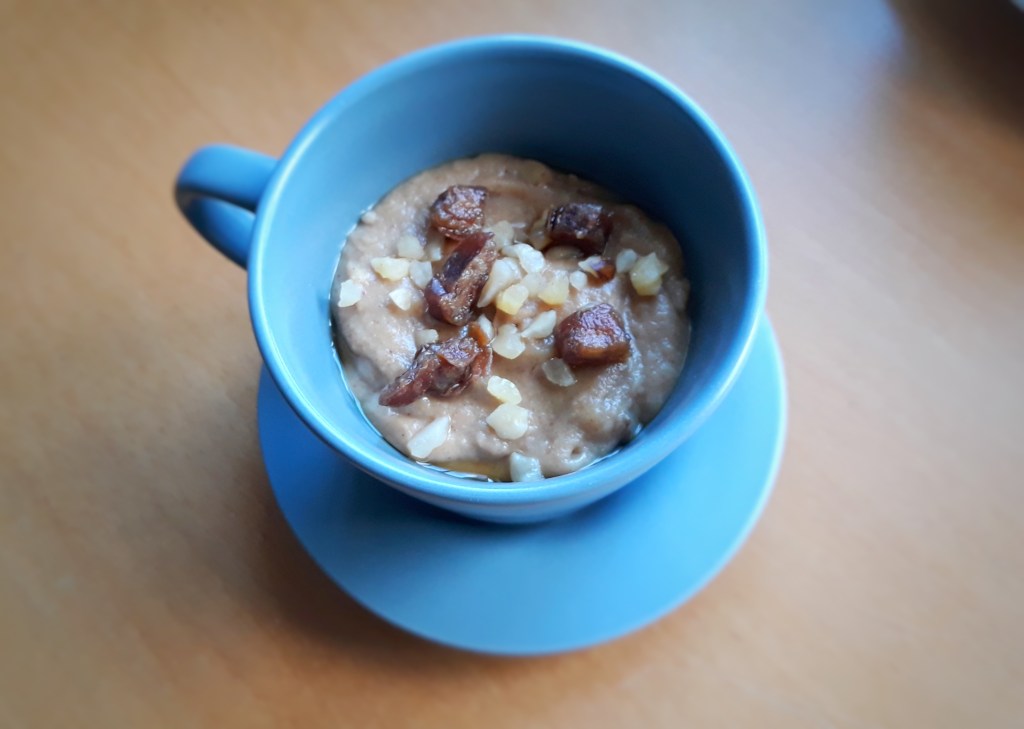
The one I chose is called Rosee, and it is like a pudding – in the American sense of the word
– i.e. a thick custardy dessert. This one is thickened with rice flour instead
of eggs like a regular custard and is flavoured with rose petals (“with flours of white rosis”) as well as
some ginger and cinnamon. It’s not the right time of year for roses, so in lieu
of the blooms, I used some rose water instead. It’s also flavoured with pine
nuts and dates, which also adds a little texture. Sugar is the sweetener –
which wasn’t refined to pure white in the 1400s, so I used soft light brown
sugar to replicate this.
You don’t have to use mediaeval almond milk, you can buy it,
or just use regular cows’ milk.
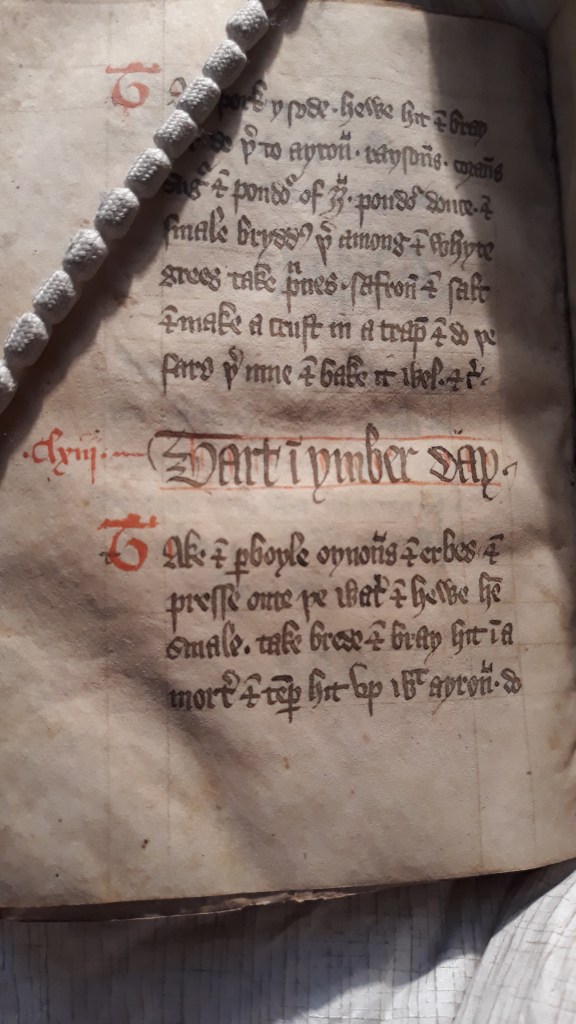
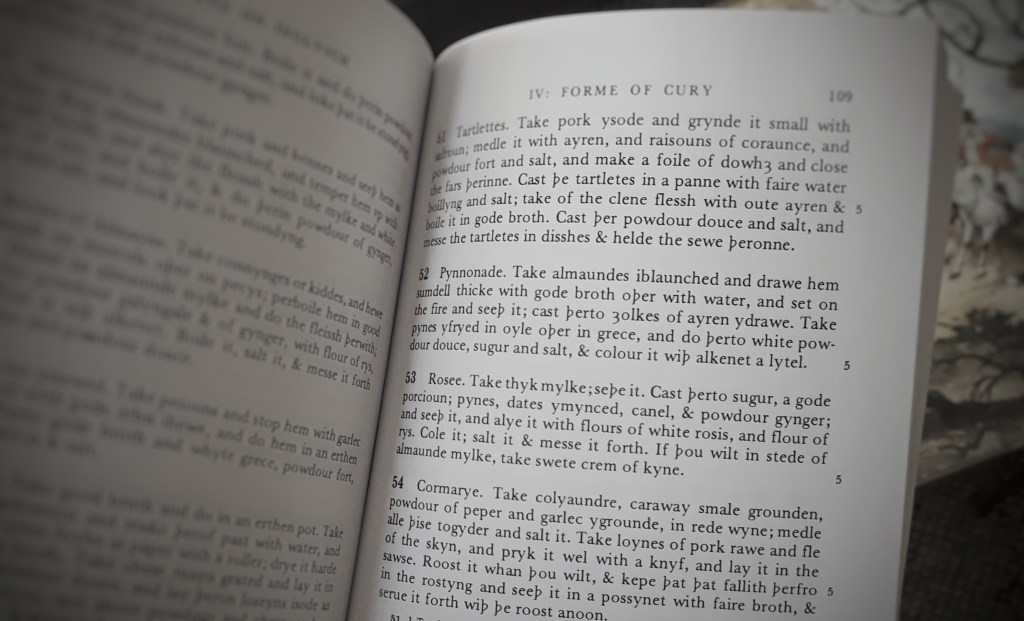
Here’s how it is written in Forme of Cury. It’s hard to decipher, but once you know the now
defunct letter thorn (þ) is makes a th sound (so seþe is pronounced seethe), it makes it a lot easier.
If you like the blogs and podcast I produce, please consider treating me to a virtual coffee or pint, or even a £3 monthly subscription: follow this link for more information.
Rose Pudding 1390:
Take thyk mylke; seþe it. Cast þerto
sugur, a gode porcioun; pynes [pine nuts], dates ymynced, canel [cinnamon], & powdour ginger; and seeþ I, and alye [mix] it with flours of white rosis, and flour of
rys. Cole it; salt it and mess it forth. If þou wilt in stede of almaunde
mylke, take swete crem of kyne [cows].
Hopefully you get the gist – it takes a while to tune in!
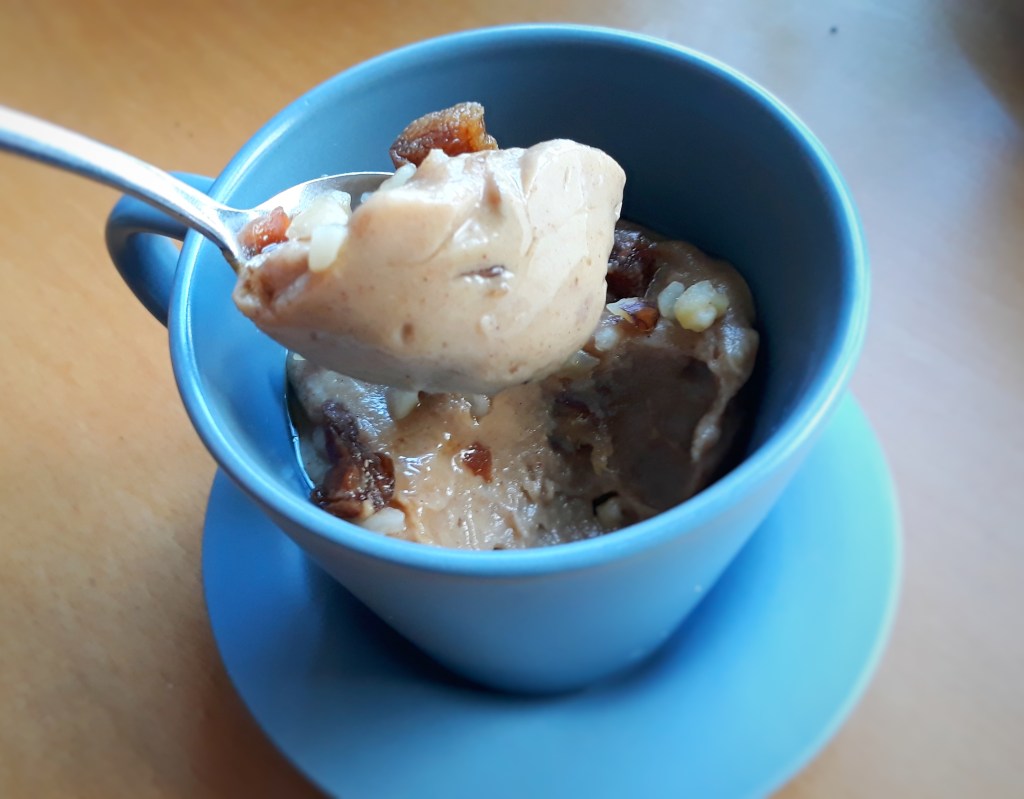
I didn’t follow the method exactly – I used my own cook’s logic to the dish – but I made quite a delicious pudding, and it didn’t feel as though it was a vegan dessert. A knob of butter or a glug of cream, goes a long way with making food satisfying, but I genuinely didn’t miss them. It really goes to show that the King and his court did not go without during Lent!
25 g pine nuts or chopped mixed nuts, plus extra for
decoration
2 to 3 tbs rose water
Put the flour and spices in a small saucepan and whisk in
the milk, starting by adding just a third of it at first to prevent lumps. When
all of the milk has been added, put the pan on the heat and bring to a simmer,
stirring well with a wooden spoon or small whisk as it begins to thicken. Add
the sugar, salt, dates and nuts. Keep it simmering very gently for around 10
minutes to cook out the flour. If it looks like it will be too thick, add more
liquid (it sets quite firm, so when it is hot, you’re looking for the
consistency of thick double cream).
Remove from the heat and add the rose water – I like quite a
lot, but it can be rather overpowering, so add enough that seems just right and
then add a shake more. By doing this you are compensating for the fact it will
be served cold, the flowery aroma less pungent.
Pour into serving cups – I went for small coffee cups – scatter
with a few more dates and nuts and cover with cling film to prevent a skin
forming. Pop them in the fridge until set.
Half an hour before you want to serve them, take them out of
the fridge to take off the chill.
At the end of last year, I finally had the opportunity to visit the United States to visit old friends – and haunts – in Houston, St Louis and Chicago, as well as discovering new cities such as Dallas, New York and New Orleans. It was a crazy whistle stop road trip and no mistake.
Having lived on both sides of the Pond, I can really appreciate the American influence on British cuisine. So much deliciousness has drifted over the Atlantic to wedge itself firmly in the psyche of British – nobody in the UK could possibly imagine a world without mouth-watering pulled pork, pillowy cinnamon buns or squidgy chocolate brownies (and blondies!).
One of the best foods of all is Mac and Cheese, and although considered very much an all-American (or perhaps the American) meal, macaroni cheese has its origins firmly planted in Britain.
Macaroni cheese emigrated to the US and Canada with the British settlers, but it wasn’t until the 1930s, during the Great Depression, that it really became part of American culture. Millions were starving, but one entrepreneurial salesman from St Louis, Missouri had the idea to combine nonperishable dried pasta with dried processed cheese. It could be mass produced and priced low. It was a huge hit, quickly establishing itself as the ‘American Housewife’s Best Friend’, feeding a family of four for just twenty cents. It literally saved a nation from starvation.
Elizabeth Raffauld
The first mention of it my side of the Pond can be found in the 1769 classic cookbook The Experienced English Housekeeper by Elizabeth Raffauld. It says To Dress Macaroni with Parmesan Cheese:
Boil four ounces of macaroni till it be quite tender and lay it on a sieve to drain. Then put it in a tossing pan with about a gill [a quarter of a pint] of good cream, a lump of butter rolled in flour, boil it five minutes. Pour it on a plate, lay all over it parmesan cheese toasted. Send it to the table on a water plate, for it soon gets cold.
All the elements of a modern macaroni cheese: the appropriate pasta, a proto-béchamel sauce, plenty of cream and lots of cheese; perhaps surprisingly, parmesan cheese.
But we can go back even further; back to the 1390s in fact, with Britain’s earliest cookbook Forme of Cury. Pasta made from breadcrumbs (I must try it sometime) cooked in a velouté sauce (like a béchamel but made with stock instead of milk), and something called chese ruayn which was a hard cheese similar in taste to brie, resulting in something half-way between macaroni cheese and a lasagne. I wonder if there’s an extant French cheese that could fit the bill if I tried to cook this dish?
Take good broth and do in an earthen pot. Take flour of payndemayn [high quality white bread] and make thereof past[e] with water, and make therof thynne foyles as paper with a roller; drye it hard and seeth [simmer] it in broth. Take chese ruayn grated and lay it in dishes with powdour douce [a mix of warm spices such as cinnamon, cloves etc], and lay on the loseyns [the pasta sheets] isode as hole as thou myst, and above powdour and chese; and so twyce or thrice [i.e. layer it up], & serve it forth.
This dish must have remained popular because macaroni and other pasta dishes using cheese and velouté sauce appear crop up again in Eliza Acton’s 1845 book Modern Cookery for Private Families. There is also the more familiar béchamel sauce version. What is interesting is that there is a variety of cheeses used in these recipes: Cheddar, Parmesan, Gruyere and blue Stilton all feature. I love blue cheese, so this one really stood out for me and I have adapted it below.
If blue cheese isn’t your thing, replace it with another. Cheddar, red Leicester or a mature Lancashire would all work. This recipe produces a rather saucy macaroni cheese, if you prefer a thicker consistency, add an extra 50 grams of pasta.
If you like the blogs and podcast I produce, please consider treating me to a virtual coffee or pint, or even a £3 monthly subscription: follow this link for more information.
Blue Stilton Macaroni Cheese
Serves four:
30 g plain flour
30 g butter
400 ml hot full-fat milk
150 ml double cream
200 g macaroni
1 slice stale bread
½ tsp chopped fresh rosemary leaves, or ¼ tsp fried rosemary (optional)
225 g Stilton cheese, grated
200 g Gruyere or Cheddar cheese, grated
Pinch Cayenne pepper
Salt and freshly-milled black pepper
First of all make a roux by melting the butter in a saucepan. As soon as it has finished foaming, tip in the flour and mix well with a small whisk or wooden spoon. Cook on a medium heat for a couple of minutes, stirring frequently. If the roux starts to brown, turn down the heat.
Beat in around a quarter of the milk with your whisk, adding another quarter once the first lot is fully incorporated. Repeat until all of the milk is used up. Add the cream and allow the béchamel sauce to simmer gently for around 10 minutes. Make sure you stir every minute or so, to stop the flour sticking to the bottom of the pan.
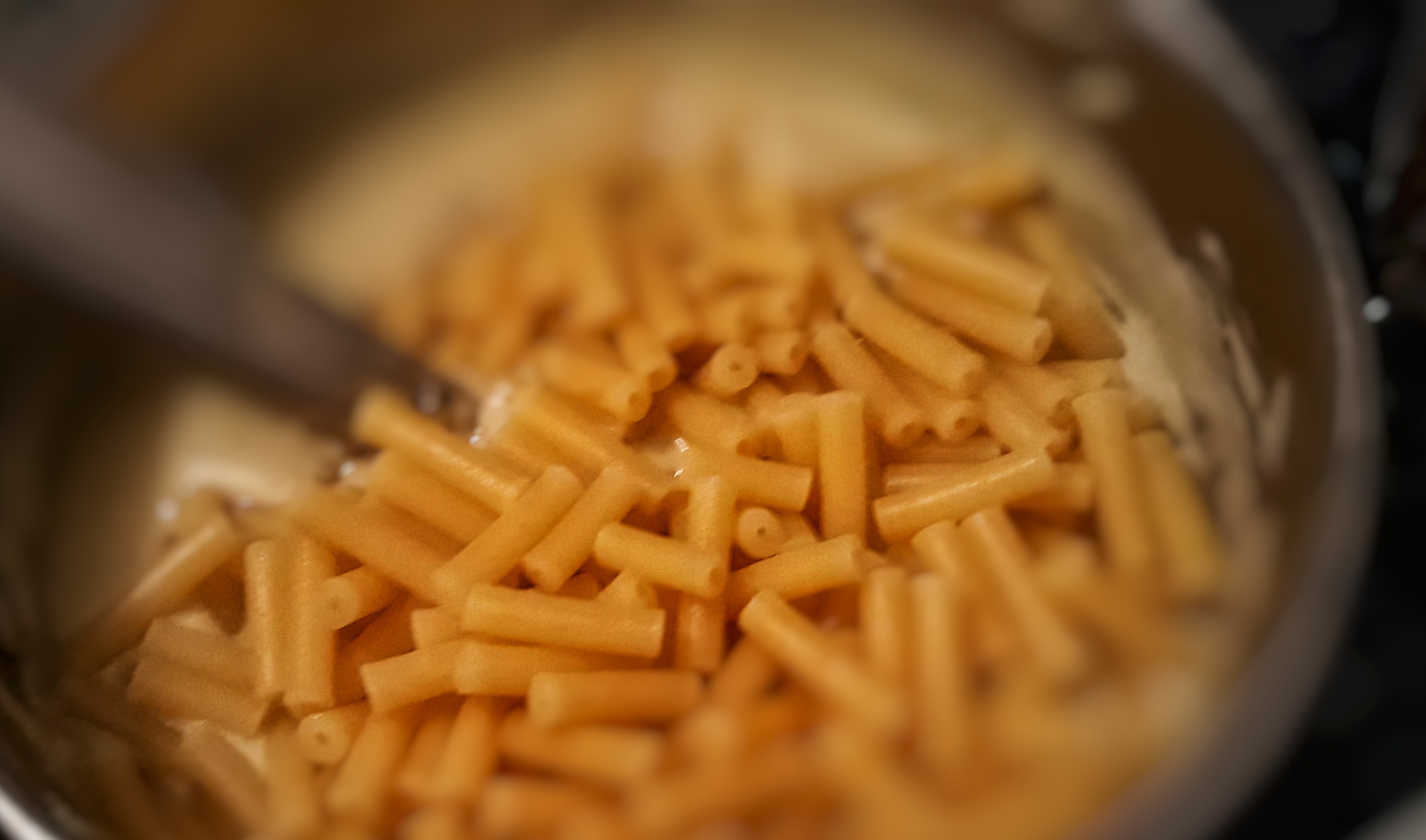
Meanwhile cook the macaroni in plenty of salted water – follow the instructions on the packet and cook for two minutes less than the instructions state.
Make the bread into breadcrumbs by pulsing in a food processor. If using, add the rosemary half way through the pulsing process.
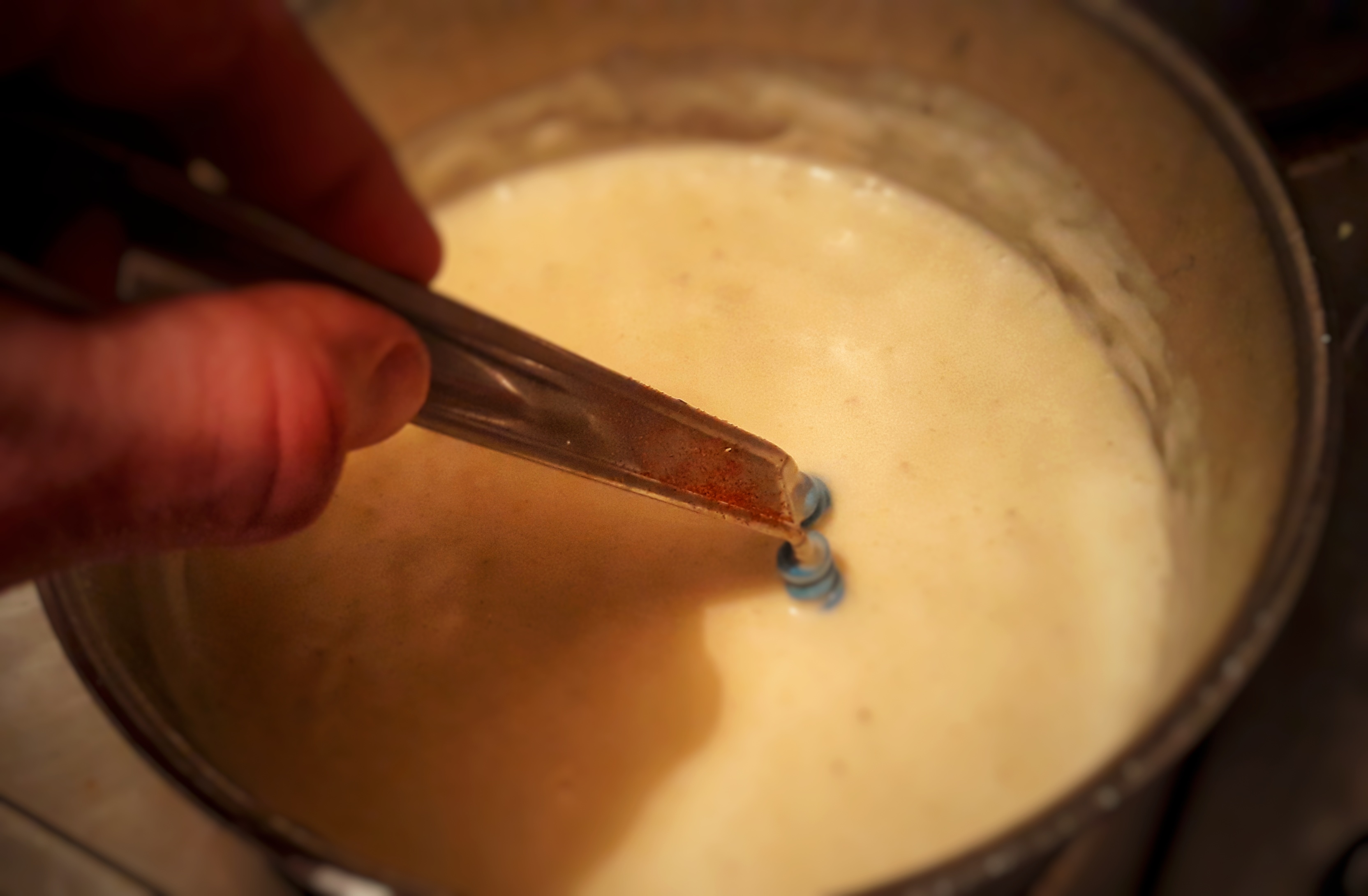
Take the sauce off the heat and drain the pasta. Stir in the cheeses, mixing until fully incorporated. Tip in the pasta and mix. Now season well with salt, black pepper and Cayenne pepper.
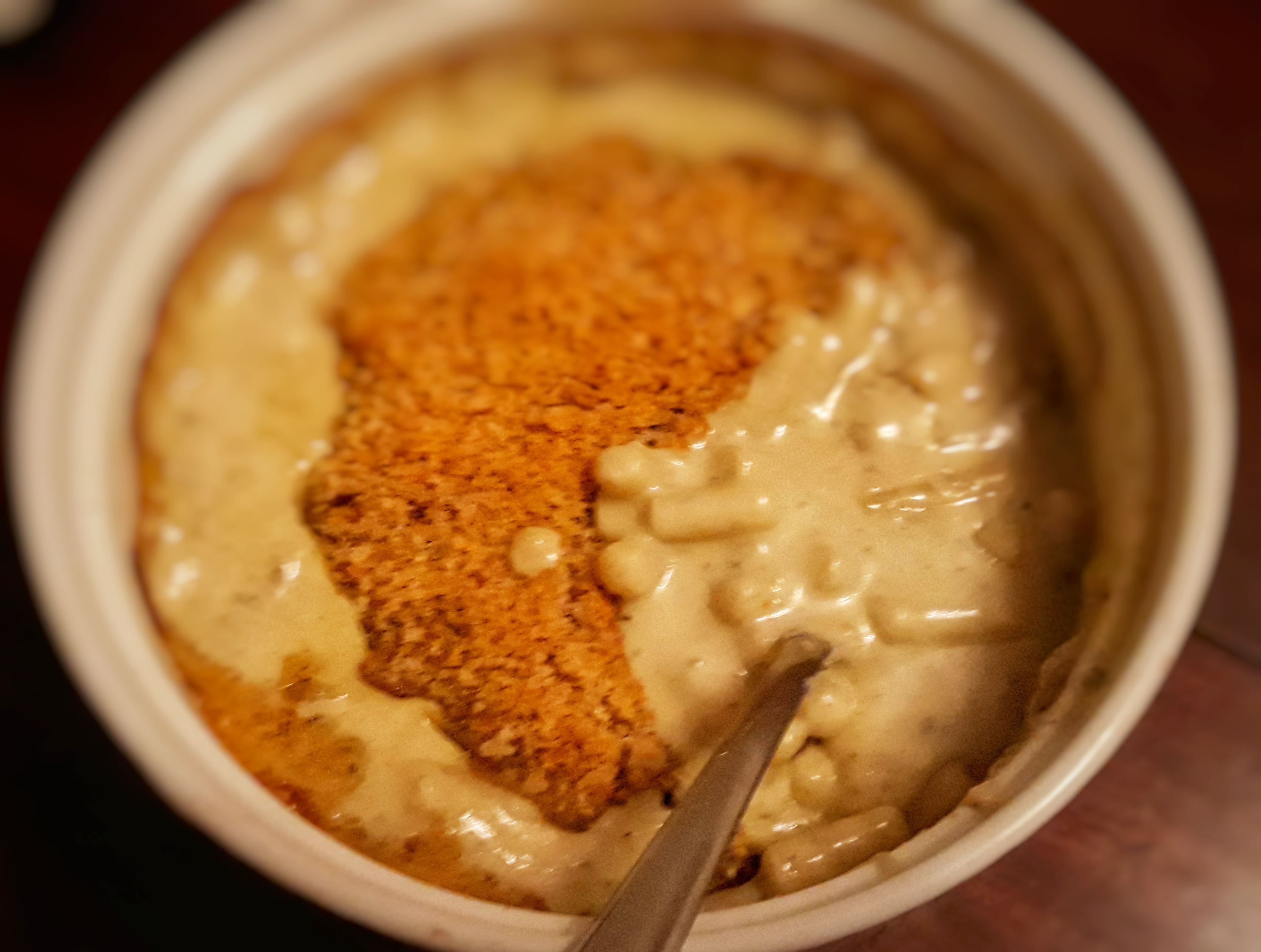
Pour the whole lot into a baking dish of a capacity of 1.5 litres, or thereabouts and bake for around 20 minutes at 180°C until brown and bubbling and the breadcrumbs are well-toasted.
Serve straight away with crusty bread or a rocket salad.
Fine oranges well roasted with sugar and wine in a cup, they’ll make a sweet Bishop when gentlefolk sup.
Jonathan Swift (1667-1745)
I spent part of the week in London this week and made sure I had a wander around the Tower Bridge area, my favourite part of the great city. The tiny roads are still so very evocative of Dickens with many of the street names and yards appearing in his writings. Much of Little Dorrit takes place in this area of London, but it was such a bitingly-cold day that it put me more in mind of the winter scenes described in Dickens’ novella A Christmas Carol.
At the very end of the story, when it dawns upon the old miser Ebenezer Scrooge that it’s nice to be nice, he offers his long-suffering clerk a well-deserved pay rise and some delicious steaming-hot smoking bishop:
“A merry Christmas, Bob!” said Scrooge, with an earnestness that could not be mistaken, as he clapped him on the back. “A merrier Christmas Bob, my good fellow, than I have given you, for many a year! I’ll raise your salary, and endeavour to assist your struggling family, and we will discuss your affairs this very afternoon, over a Christmas bowl of smoking bishop, Bob! Make up the fires, and buy another coal-scuttle before you dot another i, Bob Cratchit!”
The Christmas Bowl:
Original illustration from A Christmas Carol by John Leech
Christmas wouldn’t be Christmas without a heady hot boozy snifter and smoking bishop is the best of all, in my opinion. Everyone is sick of mulled wine these days – or at least I am – this is the way to go; a marvellous mixture of port, oranges and spices.
The drink is smoking because the oranges – preferably bitter Seville oranges – are roasted until blackened. The drink is a bishop because it is one of several drinks once known as ‘ecclesiasticals’; drinks named after various orders within the Catholic church. Indeed, if you substitute the port for claret, you have a smoking cardinal; better still, use champagne and you’ve got yourself a smoking pope! I have never tried these, but I think I might give smoking pope a go but using Prosecco instead. There was a spate of these somewhat anti-Catholic snifters during the 17th and 18th centuries, but it was just a wry dig, compared to what had happened in the past (e.g. this post). If you look up the recipe for a smoking bishop in Eliza Action’s classic 1845 book Modern Cookery for Private Families, inset is an illustration of a mitre-shaped punch bowl into which it should be served!
A mitre-shaped punchbowl, from Modern Cookery for Private Families, 1845
Many port drinks were created around this time too because France and England were tied into an out-of-control tit-for-tat game with tariffs for exports between the two countries, making French wine – the preferred drink at the time – too expensive for most people, and so eyes moved to Spain and it was soon Cheerio! Chateau Neuf de Pape and Hello! lovely port wine.
One of the reasons I don’t always like mulled wine is that it can be a little heavy on the spices. A smoking bishop uses fewer spices, in fact my recipe uses only one: cloves. The only other aromatics being the oils released from the burnt bitter orange rinds. Aside from that, just a little water and some dark brown sugar are added to taste.
It’s a delicious and easy drink to make, and you will never go back to mulled red wine again once you’ve tried it, so please give it a go; you won’t be disappointed!
Smoking bishop can be made ahead of time, strained, and reheated with great success.
One 750 ml bottle of port
3 oranges (Seville, if possible)
8 cloves
250ml water
Dark brown sugar to taste
Place the oranges on a tray and bake at 200°C for around 25 minutes until they have started to blacken and give off their delicious burnt aroma. Remove from the oven and allow to cool a little before slicing them up.
Next, pour the full bottle of port into a saucepan (very satisfying to do) along with the oranges and any orange juicy bits, as well as the cloves and water.
Bring to a bare simmer – don’t let it boil! – and let it gently tick away at a scalding temperature (around 80°C) for around 20 minutes.
Add sugar to taste – if the oranges are very bitter and black, you might need quite a bit. If you don’t want bits of orange pulp and clove floating about in the drink, strain into a clean pan before adding the sugar.
If, in the unlikely event, you do not have a mitre-shaped punch bowl, you can simply ladle straight from the saucepan into punch glasses or small mugs.
If you like the blogs and podcast I produce, please consider treating me to a virtual coffee or pint, or even a £3 monthly subscription: follow this link for more information.
As promised in my previous post, a few recipes from the Forme of Cury. I have translated them into modern English, so you can follow them a bit easier. For the hippocras drink, I have given you my interpretation of the recipe as there are some hard-to-find ingredients. All the recipes are easy to make and taste delicious.
If you like the blogs and podcast I produce, please consider treating me to a virtual coffee or pint, or even a £3 monthly subscription: follow this link for more information.
Cabbage Soup
A very simple dish – not everything Richard II ate was ostentatious. This is a very simple recipe with ingredients we use today. The addition of the saffron give it an interesting earthy flavour. Powder douce was a mixture of sweet spices – the spices we would associate with desserts like apple pie – shop-bought mixed spice is good substitute. The base of the soup is broth or stock, use any you like, though I think chicken is the best for this soup.
Caboches in Potage. Take Caboches and quarter hem and seeth hem in gode broth with Oynouns yminced and the whyte of Lekes yslyt and ycorue smale. And do þerto safroun & salt, and force it with powdour douce.
Cabbage Soup. Take cabbages and quarter them and seethe (simmer) them in good broth with chopped onions and the white of leeks, slit and diced small. Add saffron and salt, and season it with powder douce.
The Forme of Cury with stitching where a new piece of parchment was added to the scroll (British museum)
If you want to know more: this blog post complements this podcast episode.
Rabbit or Kid in a Sweet and Sour Sauce
Any kind of meat can be used here really, chicken legs or diced lamb are the best substitutes. Sweet and sour sauce was called egurdouce; -douce meaning sweet and egur- meaning sour, e.g. vin-egur was sour wine, in other words vinegar! The meat is browned in lard, removed, so the onions and dried fruit can be fried, the meat is replaced with the liquid ingredients and spices and simmered just like a modern casserole or stew.
Egurdouce. Take connynges or kydde, and smyte hem on pecys rawe, and fry hem in white grece. Take raysouns of coraunce and fry hem. Take oynouns, perboile hem and hewe them small and fry them. Take rede wyne and a lytel vynegur, sugur with powdour of pepr, of ginger, of canel, salt; and cast þerto, and lat it seeþ with a gode quantite of white grece, & serue it forth.
Take young rabbits or kid and cut them into pieces and fry them in lard. Take currants and fry them. Take onions, parboil them, and chop them small and fry them. Take red wine and red wine vinegar, sugar and powdered pepper, ginger, cinnamon, salt and add them, let it simmer gently in a good quantity of lard and serve it forth.
Hippocras
Straining hippograss through a bag
This is a really excellent recipe for spiced wine; mulled drinks were drunk throughout the year and could be served hot or cold. There are some tricky to get hold of spices, but I’ve added alternatives where appropriate. If you have to omit a spice or two, don’t worry, it will still be delicious.
Pur fait ypocras. Troys vnces de canell & iii vneces de gyngeuer; spykenard de Spayn, le pays dun denerer; garyngale, clowes gylofre, poeure long, noieȝ mugadeȝ, maȝioȝame, cardemonii, de chescun dm. vnce; de toutes soit fsait powdour &c.
To make hippocras. Three ounces of cinnamon and three ounces of ginger, spikenard of Spain, a pennysworth; galingale, cloves, long pepper, nutmeg, marjoram, cardamom, of each a quarter of an ounce; grain of paradise, flour of cinnamon, of each half an ounce; of all, powder is to be made etc.
There are a couple of tricky spices in the list: long pepper and grains of paradise are available to buy online quite easily, but are very expensive, so you can get away with regular black pepper as a substitute. Galangal is easier to find fresh than dried these days, as it is used extensively in Thai cuisine as part of their delicious red and green curries, however, seek and ye shall find the dried variety.
Spikenard of Spain is the extract of the root of a valerian plant and was used in the church as an anointing oil, it also appears very commonly in recipes. I’ve never had the opportunity to taste it.
Here’s my version of the recipe:
1 bottle of red wine
1 tsp each ground cinnamon and ground ginger
¼ tsp each ground galingale, ground black pepper, ground nutmeg, dried marjoram, ground cardamom
honey to taste
Pour the wine into a saucepan with all of the spices and bring slowly to a scalding temperature. Don’t let the wine boil as there’ll be no alcohol left in it! Let the spices steep in the hot wine for around 10 minutes.
Meanwhile spread a piece of muslin, or any other suitable cloth, over a sieve and pour the spiced wine through it into another pan or serving jug. Add honey to sweeten. Serve hot or cold.