Category Archives: General

Seville Oranges and Seville Orange Marmalade

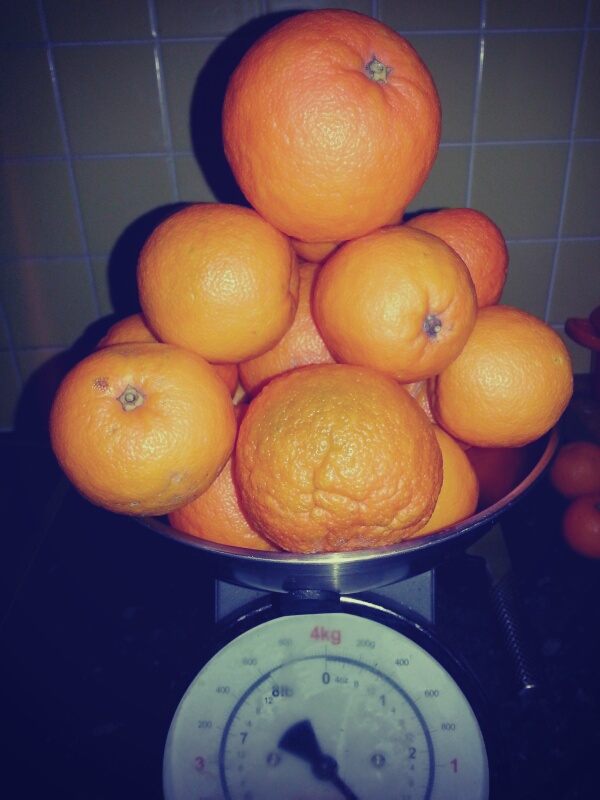
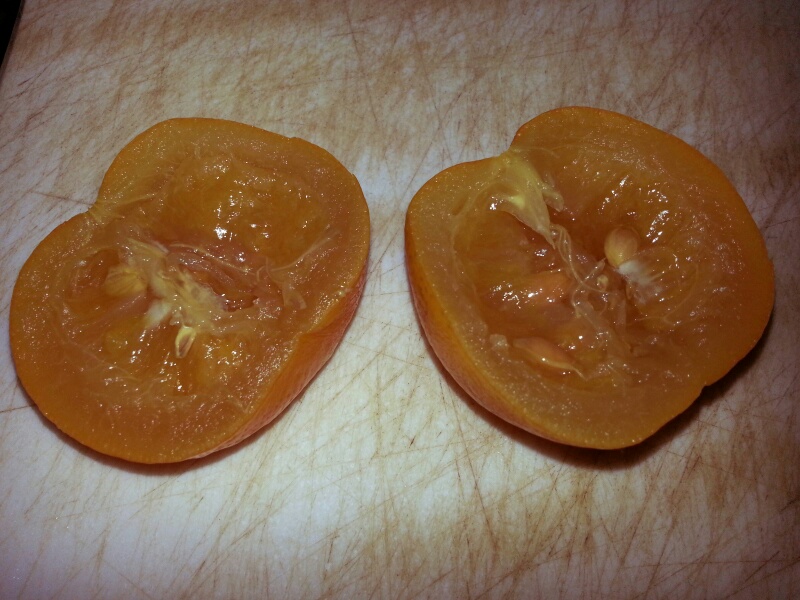
The weather outside may be miserable and the evenings still long, but luckily there is a little fleeting  sunny surprise popping up in grocers around the country that can perk us up no end; at least if you know where to find them. It is Seville orange season and a small window of just a few weeks is all we have to cook with this delicious fruit.

FxCam_1357492834789

The Seville orange is very bitter and is only really grown in Spain for us British to make our Oxford marmalade. What a treat home-made marmalade is; oranges, water and sugar that is all that are needed to produce such a delightful, very British preserve. If you have never made your own, have a go before they are all disappear again.

Like all citrus fruits, the Seville orange comes originally from China. It was imported on trade routes via Italy, to the Mediterranean countries of Europe. All of these original orange trees were bitter in flavour like the Seville. In the first half of the 17th century, sweet orange trees were delivered to the Portuguese coast by ship. These sweet oranges quickly superseded the bitter ones, that is for that small area of Spain that still grows them.

The flowers of Seville oranges are also used to make orange flower water, another of my favourite ingredients.

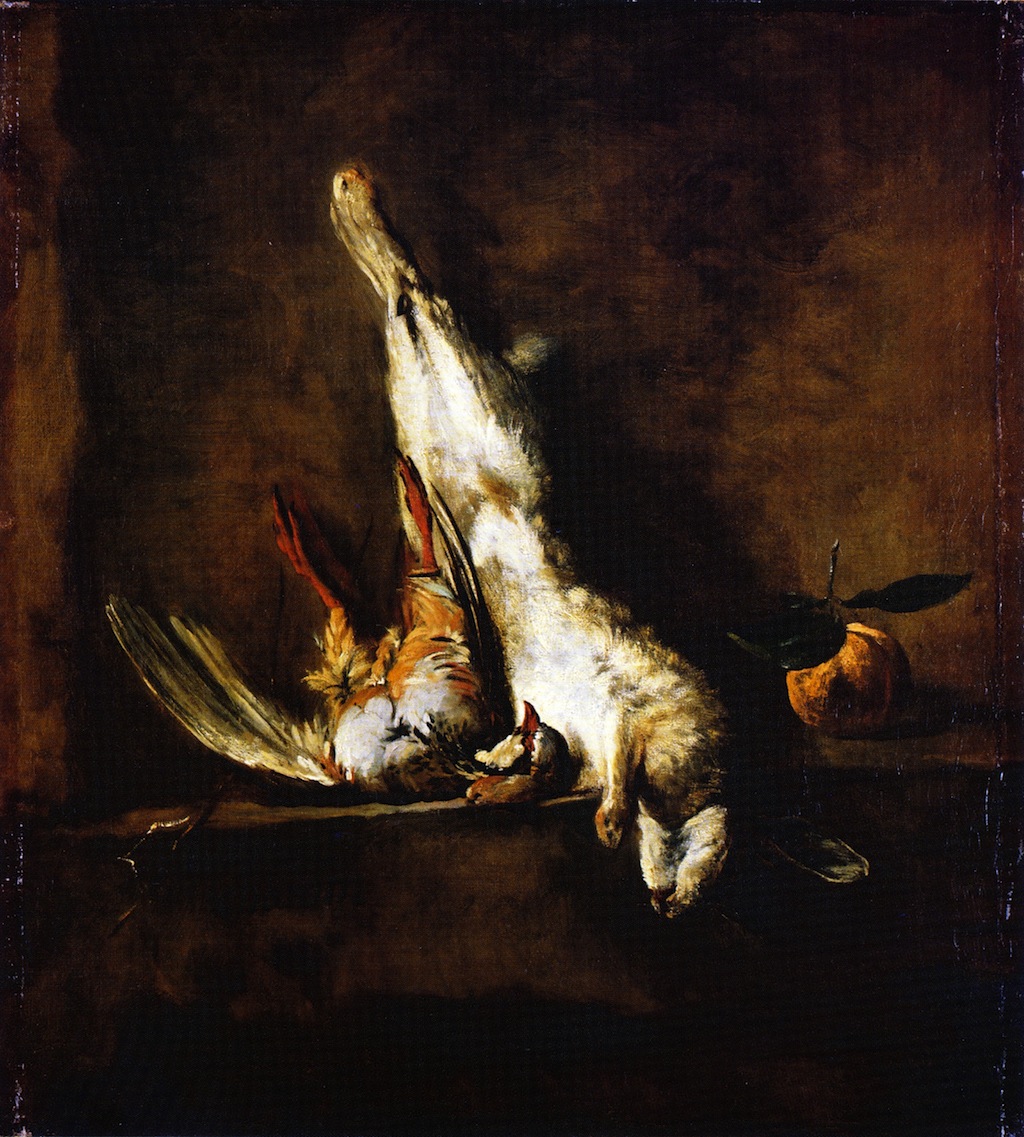
Seville and game painting

Rabbit with Red Legged Partridge and Seville Orange by Jean-Baptiste Chardin 1728-29

Below is a recipe for  Seville orange marmalade, but it is useful to know that the zest and juice of these oranges go very well with game and some shellfish such as scallops as the above painting shows.


If you like the blogs and podcast I produce, please consider treating me to a virtual coffee or pint, or even a £3 monthly subscription: follow this link for more information.

Seville Orange Marmalade

Oddly enough, marmalade was not made from Seville or any other orange at first, but quince (a knobbly cousin of apples and pears). It did come from Spain though, in fact the Spanish word for quince is marmalada. Every day’s a school day.

This recipe is Jane Grigson’s and it is a good strong bittersweet ‘Oxford’ style marmalade.

Ingredients

3 ¼ litres water

1 ½ (3 lb) Seville Oranges

3 kg (6 lb) granulated sugar

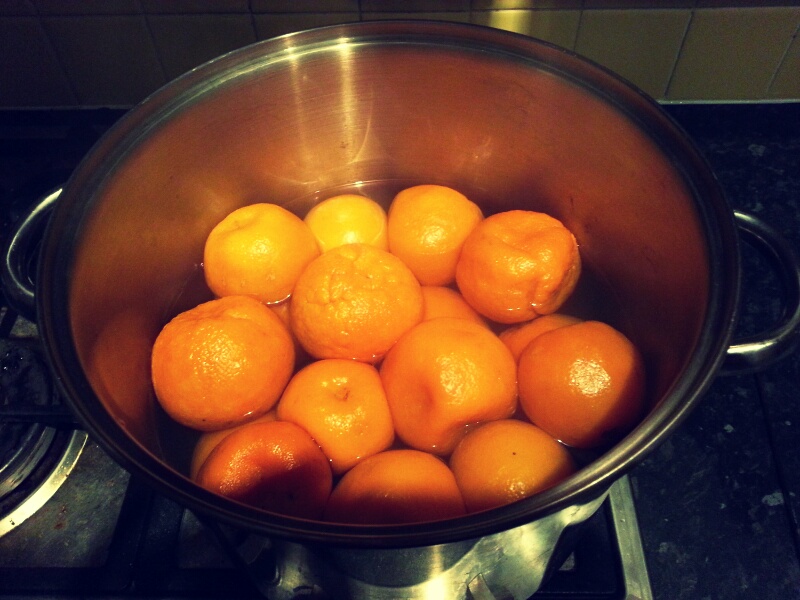
Give your oranges a good scrub and place them in a preserving pan or large stockpot with the water. Bring to a boil and simmer for about 1 ½ hours until the oranges are tender.

FxCam_1357499871481

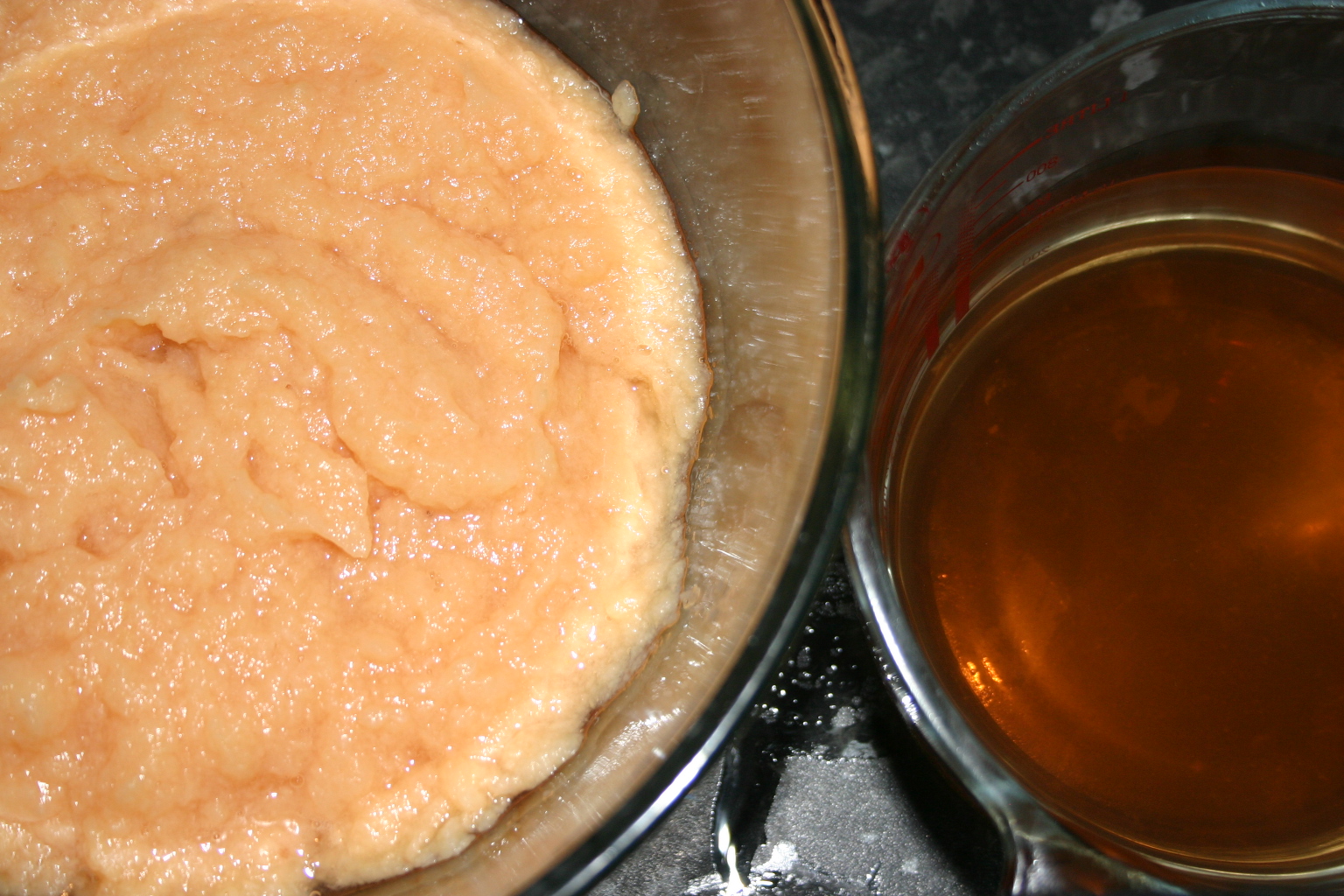
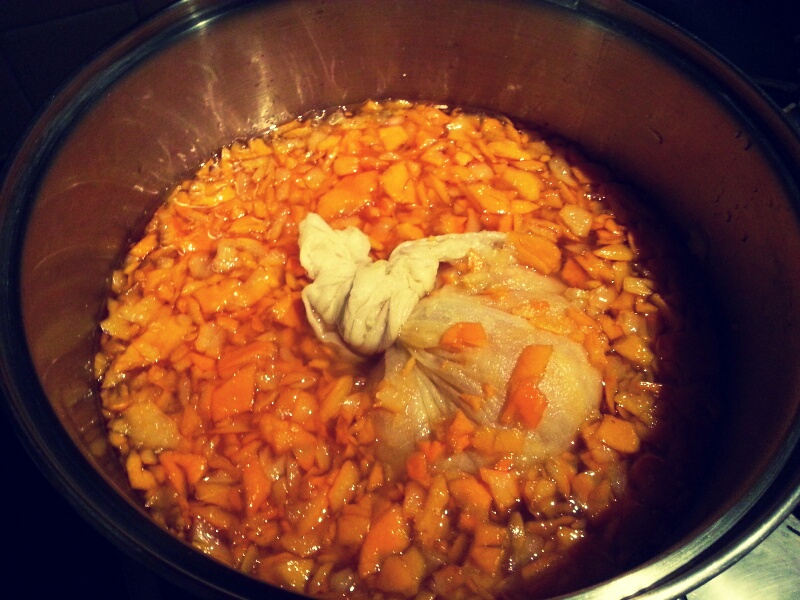
Take them out with a slotted spoon. They will probably collapse in on themselves, but don’t worry about that. Let them cool a little, then halve them and scoop out their innards. Tie up the scooped-out pulp in a piece of muslin. If you want a soft set, just put the bag of pulp straight into the pan, if you want it well set, give it a good squeeze to get as much pectin out of the pith and into the liquor as possible (I’m a soft set man).

FxCam_1357502382790

Next, shred the peel, you can be as careful as you want, and you can cut them as thick as you want. You can do this by hand or in the food processor by blitzing them using the pulse setting – be careful though, you don’t want a load of slurry. I’m usually dead against using food processors for this sort of thing, but I quite like the irregular pieces you get with this method. Tip them into the pan along with the sugar. Over a medium heat, stir until the sugar dissolves.

FxCam_1357505465756

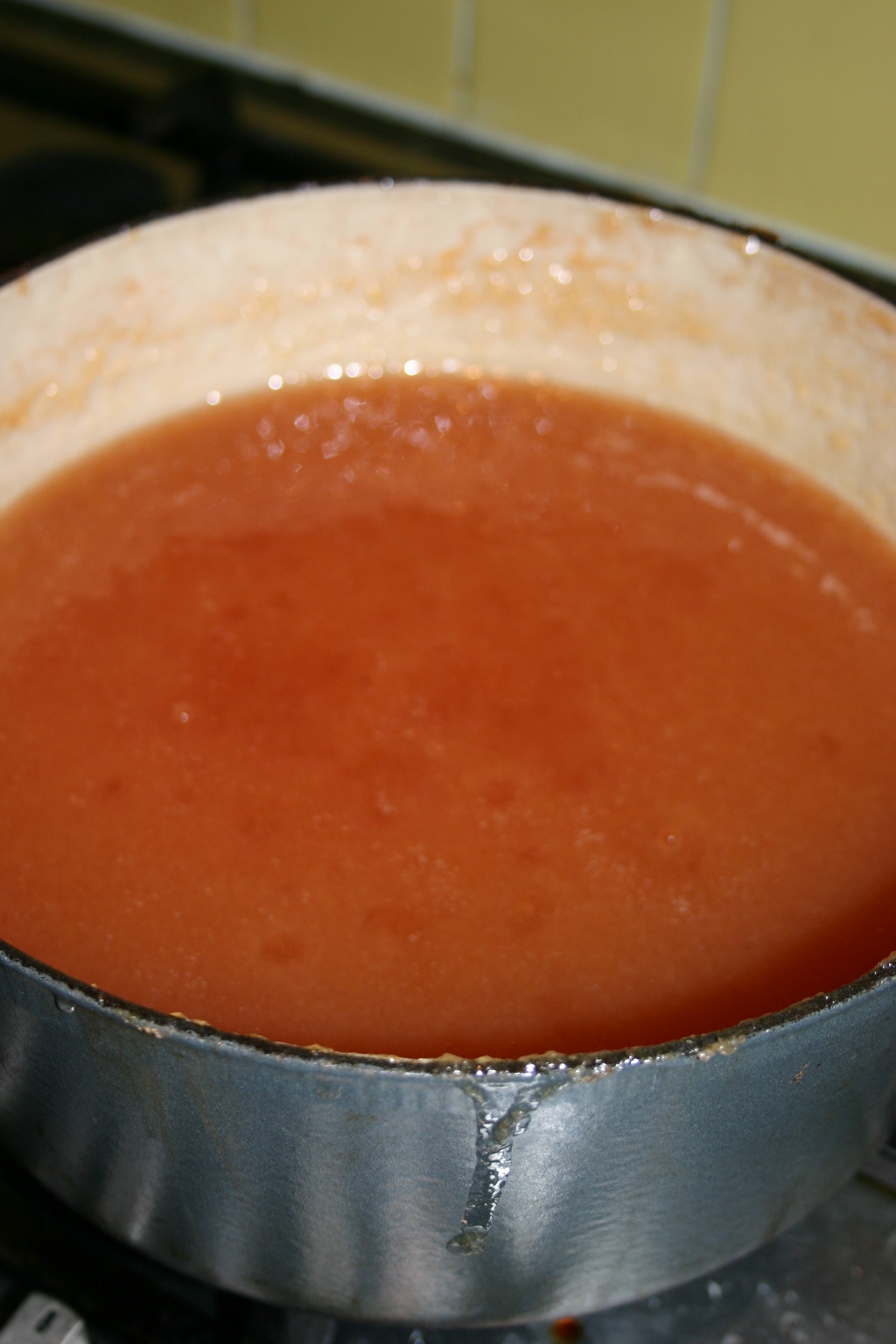
Now you need to be brave and bring it to a full rolling boil for at least 15 minutes , you need it very hot so that the marmalade can set. You have several options to test for a set, but I use a combination of a sugar thermometer and the wrinkle test. Pectin – a chemical that essentially glues plant cell walls together – will set to a gel at 105⁰C (221⁰F), so a thermometer is crucial if you want to know if you are getting close. It can take a while because water needs to evaporate to get five degrees above boiling point. Keep a close eye on it and when it gets close do the wrinkle test. For this test put a side plate in your freezer a little while before you want to make your marmalade, and when you’ve achieved 105⁰C (221⁰F), turn off the heat and spoon out a little of it onto your cold plate. Return it to the freezer for a couple of minutes. Push the jelly; if it wrinkles up, your pectin is set. If not, boil up again and retest after 10 minutes.

FxCam_1357586951956

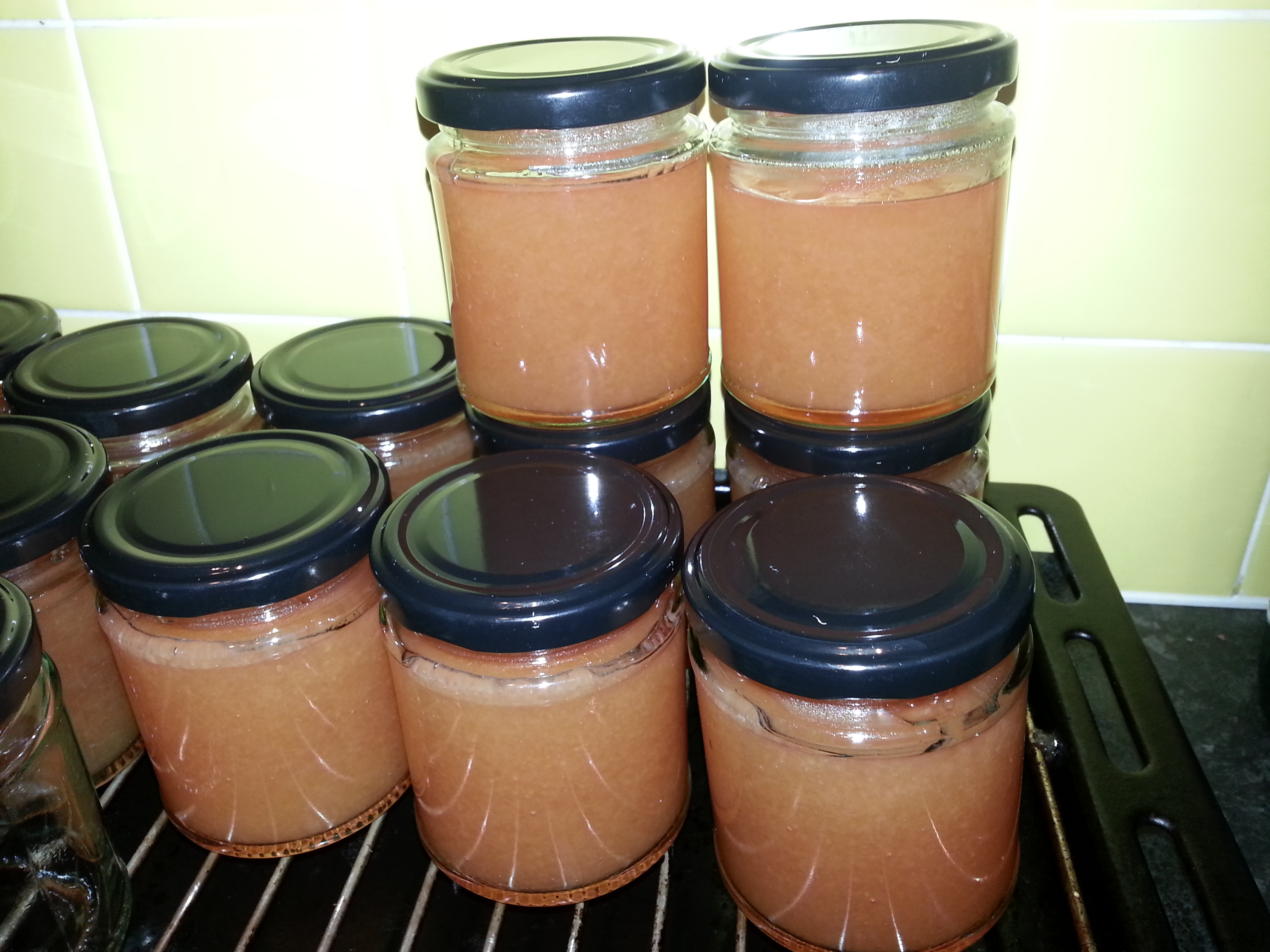
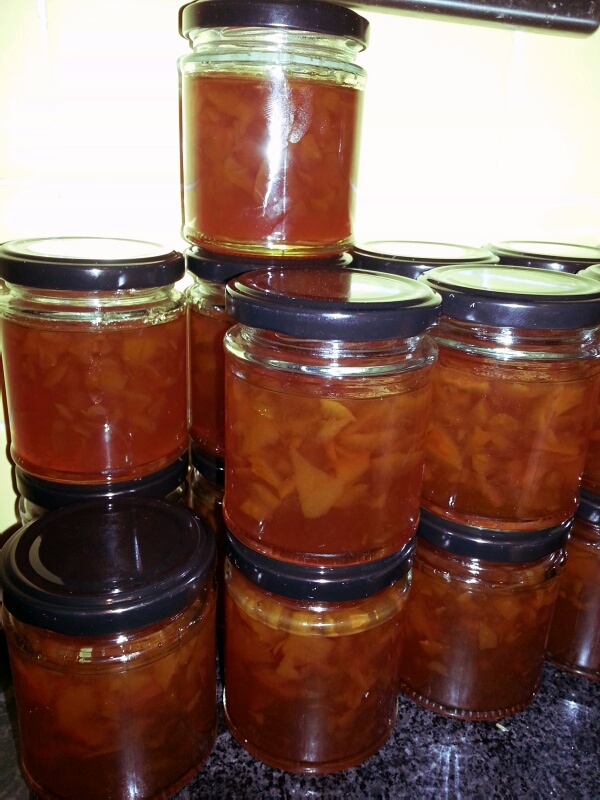
When ready, turn off the heat and allow it to cool for 15 minutes – this important step will stop your peel from floating to the top in a single layer – then pot into sterilized jars (bake them and their lids for 25 minutes at 125⁰C or 250⁰F).

IMG_2702

33 Comments

Filed under cooking, food, Fruit, General, history, Preserving, Recipes, Uncategorized

Mulled Cider

Merry Christmas!

Everyone seems to be drinking mulled cider rather than mulled wine this year so I thought I’d stick my oar in and give you my recipe for it (if you prefer mulled wine click this link for my recipe for that from last year). You may have been expecting a massive over-the-top Christmas feast post this time of year; well, I can only apologise as this is all I can muster. I promise to do something better next year…

Mulled cider has been drunk during the winter festivities at least as long as mulled wine and it is perhaps the descendant of a much older drink called wassail made from roasted apples that was knocked back by many in the south-west of England. Wassail night involves a most bizarre ritual that requires a man blacking himself up as revellers hang pieces of dry toast onto twigs. I shall leave that hanging there. It deserves its very own post – perhaps it shall be next year’s Christmas tipple recipe.

20121228_191019[1]

The recipe is pretty straight-forward – you need a good dry cider, a little sweetener and a little fortification of alcohol in the form of dark rum. Then it’s the usual spices that one would expect: cinnamon, cloves, nutmeg and allspice. It’s very delicious and much nicer than mulled wine I think. The amounts given below are for mere guidance as it is all to taste really:

1 litre (1 ¾ pints) dry cider

2 cox’s apples, sliced

2 clementines, sliced

2 sticks of cinnamon

6 allspice berries

4 cloves

small piece of nutmeg

2 to 4 tbs dark rum

2 or 3 tbs soft dark brown sugar

20121228_184345[1]

Place the cider, fruit and spices in a saucepan and heat gently so that all the flavours can infuse into the cider for 5 to 10 minutes– on no account let it boil, you don’t want to cook the alcohol away. Next, add the rum and sugar to taste and serve!


If you like the blogs and podcast I produce, please consider treating me to a virtual coffee or pint, or even a £3 monthly subscription: follow this link for more information.

8 Comments

Filed under Britain, Christmas, cooking, food, General, Recipes, Uncategorized

Jane Grigson’s Orange Mincemeat

It’s just occurred to me that I haven’t put on a Christmas recipe and it is only just over two weeks until the special day. This month has flown by at a scarily quick pace.

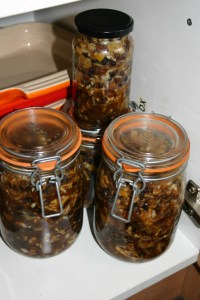
Luckily two weeks is just enough time to make this delicious orange flavoured mincemeat. Last year I gave you Mrs Beeton’s recipe, but this one comes from the wonderful Jane Grigson. It is very moist and because of the brandy, orange juice and orange liqueur. It is also vegetarian if you want it to be; the suet can be the vegetable-based sort, or you can leave it out altogether. Give it a go.

Jane Grigson

Jane Grigson

It is extremely easy to make: there is no cooking required so all you need to be able to do is chop, grate, mix and weigh. When you pot the mincemeat, it is very important you sterilise your jars. To do this first wash them in soapy water, then rinse and allow them to dry. Place the jars on a tray, with their lids sat beside them, facing upwards and pop them in the oven for 30 minutes at around 130⁰C. Let them cool a little before potting. If this seems a lot to make in one go, you can easily reduce the amounts as you see fit.


If you like the blogs and podcast I produce, please consider treating me to a virtual coffee or pint, or even a £3 monthly subscription: follow this link for more information.

Click here for the recipe I use for making mince pies.

Ingredients

250 g (8 oz) chopped candied peel

1 kg (2 lb) peeled, cored and grated apples

500 g (1 lb) suet (fresh or packed is fine, but fresh is best)

500 g (1 lb) currants

500 g (1 lb) raisins

500 g (1 lb) sultanas

500 g (1 lb) soft dark brown sugar

1 freshly grated nutmeg

125 g (4 oz) slivered almonds

Juice and zest of 2 oranges

4 tbs brandy

6-8 tbs orange liqueur

Mix all the ingredients together in a huge mixing bowl, then pot into sterilised jars. Store somewhere dark and cool, but not the fridge! Leave the mincemeat to mature for at least together before using it.

IMG_2519

9 Comments

Filed under baking, Britain, Christmas, cooking, Desserts, Festivals, food, Fruit, General, Preserving, Recipes, Teatime

Curried Beetroot Chutney

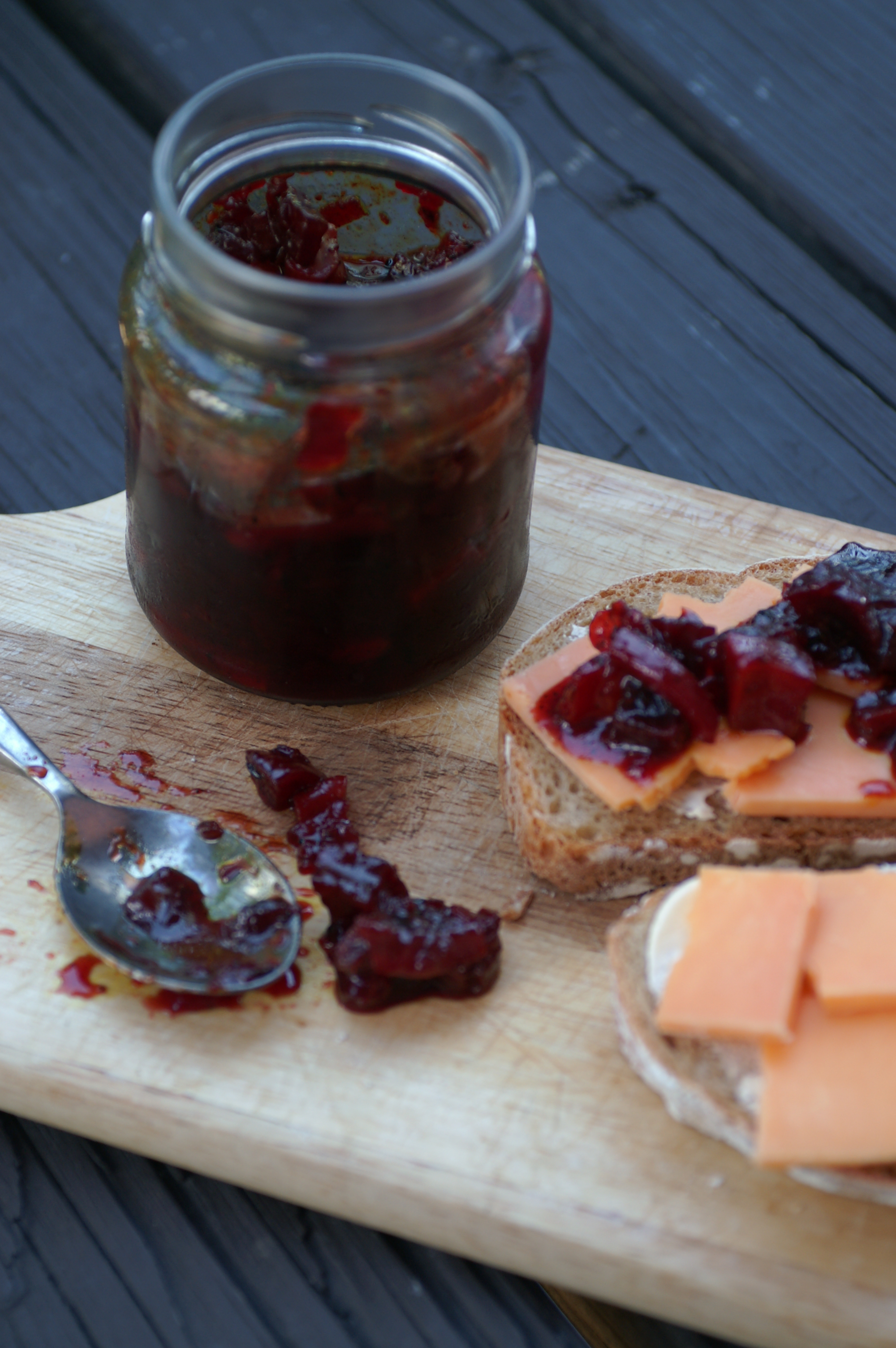
A while ago, I discovered a recipe for a 19th century British curry (see here for the original post). The recipe required me to prepare both a curry powder and a curry paste. It made a very good, strongly spiced curry, but ever since the jars have been sat in my fridge. I thought there must be something else I can do with these concoctions. After a little thought I came up with this chutney idea and it works very well: the earthy beetroot is very sweet which offsets the spices very well. I thought of beetroot because I often panfry beetroot in olive oil with cumin seeds and always thought the combination delicious. Because beetroot is so sweet and quite a lot of sugar is required for the syrup, I include a quantity of carrot, otherwise I think the sweetness and beetroot flavour may make it a little too rich.

It is delicious with cold meats or cheese and is also a great alternative to mango chutney as a condiment for a curry.

The recipes for the curry powder and curry paste needed for the pickle can be found here.

Ingredients

3 tbs flavourless cooking oil such as sunflower, canola, groundnut &c.

2 tsp cumin seeds

1 tbs 19th century curry powder

1 tbs 19th century curry paste

2 lbs beetroot, peeled and diced

1 lb carrots peeled and diced

1 med onion, chopped

2 tart apples, peeled, cored and grated

1 ¼ UK pints red wine vinegar

1 ½ lbs sugar

1 ½ tsp salt

Heat the oil in a stockpot or large saucepan – you need it quite hot, don’t be scared, the hotter the better. Toss in the cumin seeds and fry in the hot oil for around 30 seconds, then add the curry powder and paste. Stir and fry for around 2 minutes then add the remaining ingredients. Bring to a steady boil, then make sure the sugar has dissolved before letting it simmer away for around 90 minutes until the beetroot is tender and the vinegar and sugar have formed a thick syrup.

Pot into sterilised jars. The chutney can be eaten as soon as it is cool, but it is best to leave it for a couple of weeks to develop its flavour.


If you like the blogs and podcast I produce, please consider treating me to a virtual coffee or pint, or even a £3 monthly subscription: follow this link for more information.


3 Comments

Filed under Britain, food, General, Indian food, Nineteenth Century, Preserving, Recipes, Vegetables

Favourite Cook Books No. 1: The Be-Ro Book

I thought I would start a series of posts on the cook books – and books of cookery writing – that I think are the best out there. I end the post with my favourite recipe from the book – Butter Tarts.

So many of you might be thinking, why the heck is the first one up Home Recipes with Be-Ro (or as it is known to me, The Be-Ro Book)? Well it is this book that got me into cookery in the first place because it was the one my Mum used when I was growing up. Before I was even thought of my Mum owned a bakery and so we had the luxury of having most things baked or cooked from scratch. This was the go-to book for all the family staples, and when I was off school on holiday and it was raining outside she would entertain me and my brother by giving us pastry trimmings to cut out. As we got older we chose recipes from The Be-Ro Book and cooked them with help from Mum. So I was essentially brought up on this book and its recipes, and it is certainly where I got my enthusiasm for cooking; I have been conditioned to feel at home in the kitchen.

The copy I have is the Centenary Edition, though it doesn’t say anywhere in the book when in was printed. I know that the Be-Ro Flour Company was formed in the 1880s, so it dates the book to the 1980s. My Mum has an even older copy this one, though the recipes are identical. Be-Ro still makes flour and Be-Ro recipe books are still printed today, these days of course you can go onto the Be-Ro website you will find the same recipes, which haven’t changed.

Well almost; the main difference between my copy of The Be-Ro Book and the modern version is that it suffers rather from a post-war rationing complex – most recipes ask for margarine rather than butter. Luckily shortbread escapes this, but buttercream does not. In fact there’s a lot of nasty margarine-based buttercream.

You are forgiven for not holding this book in as high esteem as I do, yet the classics are here, and they bring back great childhood memories. I also have to say it has really good basic skills teaching too, so don’t underrate it.

Many of the recipes are coming back into fashion, especially now that budgets are a little less flexible and the weather is cold and wet. Personal favourites of mine include a really excellent moist and light milk chocolate cake; its secret is the inclusion of evaporated milk and my Mum still bakes it. The steamed sponge puddings are excellent too as are the many tea loaves. It does fail on a terrible recipe for flapjacks that uses cornflakes instead of oats. You can’t win them all though, can you?


If you like the blogs and podcast I produce, please consider treating me to a virtual coffee or pint, or even a £3 monthly subscription: follow this post for more information.


Butter Tarts

In my opinion these butter tarts are the best things in this book, though I have made a few changes to the original recipe. The filling is a mixture of raisins in a sweet caramel sauce that forms a delicious chewy crust as it bakes.

This recipe makes 12 butter tarts.

Ingredients

shortcrust pastry made with 8 oz flour and 4 oz of butter (or butter and lard)

1 oz butter

2 oz caster sugar

2 oz soft dark brown sugar

4 oz raisins

a few drops of vanilla extract

Roll out the pastry thinly and cut out circles using a pastry cutter measuring 3 ½ inches in diameter and line a steep-sided patty pan tray. You can use a tart tin, but I find you can’t get enough of the filling in.

Melt the butter in a saucepan, take off the heat and stir in the remaining ingredients. Add 2 teaspoons of mixture per tray – this should be just enough for 12 tarts.

Bake for 15-20 minutes at 200⁰C (400⁰F) and cool on a wire rack.

93 Comments

Filed under baking, Books, Britain, food, General, Recipes, Teatime

The Duck Press

The duck press was invented in France during the 1800s by a chef called Mechenet to make what is one of the most extravagant and macabre dishes ever created: Caneton de Rouen à la Presse, also known as Duck in Blood Sauce. It was popularised by Chef Frèdèric who was head chef at the famous restaurant La Tour d’Argent where it became the signature dish. It is reckoned over a million were served there. What is particularly impressive is that the dish was made at the table in front of the guests.

At La Tour d’Argent you are given a card

telling you the ‘number of your duck’

The dish became very popular in Britain during that famously excessive (and thankfully brief) period of history, the Edwardian Era. London’s high society went to huge efforts to appear sophisticated; French cuisine has always been associated with sophistication and the dish Caneton de Rouen à la Presse was one of the best. The Savoy in the 1900s, which then had the formidable chef Escoffier at the helm, regularly served it.

Escoffier

To make the dish you first of all need a duck press which a large metal press usually made of bronze. It contains a spout low down on the press itself so that the blood and bone marrow can be collected easily and it stands on two our four heavy feet so that the whole thing remains stable; you don’t want to cover some count in blood goo unless you can really help it. Some of them have webbed duck feet. If you want to buy a duck press though it will set you back around £1000.

Once you have procured your press you need to prepare your duck. The best for this recipe would be a Rouen duckling, but a mallard would be a good substitute. First of all kill your duck by strangulation so that the blood remains inside the tissues than pluck it. Next day remove the innards, keeping aside the heart and liver, and roast it on the very highest setting on the oven for 15 to 20 minutes. Liquidise the bird’s liver and heart. This is the point where the press and the duck are wheeled to the dining table for the guests to watch.

Remove the legs and set them aside for later, then remove the breast meat cutting it thinly and keeping it warm and covered on a serving dish with a cloche. Push and shove the carcass in the press to extract the blood and bone marrow from the bird, collecting it in a jug placed beneath the spout.

Make a sauce by gently warming the blood with the liquidised liver, some duck or veal stock and some brandy or cognac. Lastly, whisk in a good knob of butter to thicken the sauce and make it glossy. Pour the sauce over the sliced duck breast. Serve with a green salad.

The legs are usually taken away and grilled to be served up during the next course.

So there you have it; a simple and affordable family meal. I have to say, I am a lover of rare meats and I don’t find this sort of food scary at all and it is being served in some restaurants today. If I make my millions, I’ll buy a press and get you all round for dinner.

I found this YouTube video of one being used, but if you’re squeamish, you’re best not looking, I’d say.

For more duck history and recipes, click upon this very link.


If you like the blogs and podcast I produce, please consider treating me to a virtual coffee or pint, or even a £3 monthly subscription: follow this link for more information.


8 Comments

Filed under Britain, food, French Cookery, General, history, Meat, Nineteenth Century, Recipes, The Edwardians

A good egg?

We all take eggs a little for granted these days, so to get us appreciating them a little more,  I thought I’d write a post on the humble egg…

Where to start with eggs? They are so integral to our life because of their versatility. Whole eggs can be boiled, fried, poached, coddled, scrambled and baked. Used as an ingredient in pastry, in sauces and soups, they enrich and they bind, then if you separate the white from the yolk, you can make amazing meringues, velouté sauces, mayonnaise, hollandaise sauce, sauce Béarnaise and – my personal favourite – custard (please don’t call it crème anglaise!). Twenty-six million eggs are produced per day in the UK. It beggars belief, it does.

Well I think I shall start with the age-old philosophical question: ‘What came first? The chicken or the egg?’ Just as Maguelonne Toussaint-Samat does her amazing book A History of Food. She very interestingly points out that from a culinary point of view it is the egg that came first because chickens were introduced into Europe in the 5th century BC after the Greeks and Italians had been eating the eggs of other birds like geese, ducks and guinea fowl.

Okay, I shall reword our question: ‘What came first, the fowl or the egg?’ Well, from a culinary perspective, the answer is the fowl. Eating eggs was a bit of a no-no because if one ate an egg, you were – in effect – eating a whole chicken, which is a huge waste. Due to this fact, superstitions naturally arose and still exist today. For example, the people of present-day Burkina Faso believe that children that eat eggs become thieves, plus there is a French saying  on a similar vein: ‘He who steals an egg will steal a horse’.

Eggs as food only really took off when chicken farming became common. It unfortunately took off in such a way that the poor old chickens – on the whole – have a miserably terrible time in their battery cages. That said I think there is legislation going through that says that all chickens should get some time to stretch their legs.

In the 1970s and 80s, our eggs were in a right old state – there was intense over-crowding and the chickens were fed a meal made from the carcasses of dead birds. Quality of life, and egg, was very low, and because of the sheer number of chickens in one place, it didn’t take long for disease to spread. In this case it was the bacterium Salmonella enteriditis (SE) that killed many chickens and quite a few humans too. Coupling this disease with the fact that eggs from different ‘farms’ were being mixed up together, the source of the disease couldn’t be found readily.

All this was addressed by the British government in the 1990s – chickens are now vaccinated against SE and with the introduction of the Lion Quality code that allows each individual egg to be easily traced back to its place of origin, so if there is an outbreak it can be tackled swiftly. Only one percent of eggs get contaminated nowadays, and even then there number of bacterial cells averages out at around 10 per egg – you’d have to be pretty unlucky to become ill these days.

I personally, only go for free range; I feel far too guilty about the conditions they have to endure and I can’t bring myself to buy battery. The best eggs are those you can get from farmers’ markets, and are usually pretty cheap too.

The good thing about modern farming methods is that we get fresh eggs all year round. Normally chickens stop laying during wintertime and therefore eggs had to be preserved, usually by pickling, in Britain. I quite like a pickled egg now and again. I often think how we’d cope as a nation if we suddenly had to eat our food seasonally. I reckon it’d be character-building. Eggs were off limits during Lent because they are from animals. No wonder they are so prominent during Eastertime.

The best way to enjoy an egg is to make a simple meal from it, and what couldn’t be simpler than the boiled egg? Actually there seems to be 101 different methods to boil an egg perfectly and it is far from easy to get consistency. It requires a post to itself. However I cannot let this story wait…

Louis XV of France loved boiled eggs and had them every Sunday for breakfast. He was so deft at eating them that the Parisian people would come and watch their king’s skills at work. A crowd would gather, then a high-ranking servant would shout: ‘The King is about to eat his egg!’, and everyone would watch agog as King Louis sliced the top of the egg with one swift stroke of his fork. It’s amazing what passed as entertainment, though I have to admit it’s quite a skill.

Louis XV


If you like the blogs and podcast I produce, please consider treating me to a virtual coffee or pint, or even a £3 monthly subscription: follow this link for more information.

There is only one egg dish that ranks highly when it comes to gastronomy though and that is the omelette. Don’t be deceived by the French name; it cannot be claimed by them. During the Middle Ages, the English would tuck into cheese omelettes pretty regularly, though in those days we used the word fraysse. Like much Franco-Angle foods, the exact origins are lost in time.

One final mention about hen’s eggs from a culinary perspective – they are a lot bigger than they used to be. Any recipe older than, say, around 1900, need a little modification and you might be best using two-thirds of the number stated.

Also, there are more than just hens’ eggs available if you know where to look for them…

Quail eggs – these are probably the most common after the chicken egg, though were a novelty in the 1970s. I don’t really use them and don’t see the point of putting tiny fried eggs on food just for the sake of being fancy, I’d rather have a nice real farm chicken egg. However, they do make great pickled eggs.

Duck eggs – these crop up more commonly these days, particularly in Chinese supermarkets. Apparently, ducks will lay their eggs anywhere, so to be safe a duck egg should be hard-boiled.

Goose eggs – I had never eaten a goose egg until recently when I spotted some for sale at Soulard Market in St Louis. They are massive. Naturally I snapped one up and ate is just like Jane Grigson said to: ‘fried in a little butter’. A ‘rare rich treat’ indeed. I can heartily recommend trying one.

Chicken eggs are dwarfed by goose eggs

Gull eggs – the only egg on the list I have not tried. In fact I have never seen them before anywhere. Ever.  I wonder if they are still available. If you know anything about getting hold of some, let me know.

Egg recipes so far:

Custard (general)

Proper ‘pouring’ custard

Leave a comment

Filed under Britain, Dairy, food, French Cookery, General, history, Uncategorized

Rillettes

A brief hop over the English Channel to France for this post…

I have a great love of potted meats – not the awful ones you get in those little glass jars on the supermarket shelves, but the proper job. Making them is easy and satisfying, but you can’t go too long flicking through the cook books and history books without eventually having to give a huge nod to French cuisine. Pâtés are of course well known and popular, but don’t forget the classic rillettes. They’ve been around for at least six hundred years, yet of recent times they have fallen out of favour in Britain, though they were very popular in Victorian and Edwardian Britain – the heyday for savouries such as these:

Rillettes: A French savoury meat preparation, used for hors-d’oeuvres and savouries

Charles Herman, Culinary Encyclopaedia 1898

See? I told you.

Rillettes are a classic, similar to a pâté in that you spread them on toast and eat them with some nice cornichons, but it is made in rather a different way; long slow cooking with plenty of fat is needed and, rather than being pulverised, they are stripped and potted along with their juices. They are subtly flavoured – the glory comes from the slowly cooked meat and the mild herbs. If I were to be a ponce, then I would say they are sublime. However I am not, so I shan’t.

Any kind of meat, or even fish, can be used to make rillettes but the classics are pork, duck, rabbit and goose. The best rillettes come from Tours and Reins.


If you like the blogs and podcast I produce, please consider treating me to a virtual coffee or pint, or even a £3 monthly subscription: follow this link for more information.

 Rillettes de Porc (Potted Pork)

Here’s the recipe I have tried out a couple of times now for rillettes de porc. I can’t wait to get back to England and try some rabbit rillettes (wild rabbits are a rarity in America). There is little variation in any recipe you see, whether found online today or in an eighteenth century cookbook.

Technically you can use any cut of meat as long as it has plenty of fat. I have been using pork belly, but neck would be okay, and for the less squeamish amongst you, the head.

Ingredients

2 lbs pork belly (weight after removal of rind and bones)

2 tbs salt

1 lb back fat

2 cloves of garlic, crushed

3 or 4 sprigs of thyme

2 bay leaves

Freshly ground black pepper

Freshly ground nutmeg

Around 10 fl oz water

Cut the pork belly into strips around 1 ½ inches wide, place them in a bowl and rub in the salt. Cover and leave for around 8 hours. Cut the back fat into cubes and place it, along with the pork belly, in an ovenproof casserole or similar. Tuck the herbs and garlic under the meat in the centre and sprinkle over a good seasoning of pepper and a little nutmeg then pour over the water. Cover with a tight-fitting lid or foil and bake in a very low oven, 140⁰C (290⁰F), for 4 hours.

Remove the foil and take out the bay leaves, garlic and thyme – they have imparted their flavours. Place a sieve over a good-sized bowl and toss the contents of the pan into the sieve so it can drain.

rillettes before

Next – and this the good bit – grab two forks and start stripping the meat and fat into shreds.

rillettes after

If it is easier, do this in a separate bowl. Pot lightly into jars, ramekins or earthenware pots and cover with the salty-fatty juices. Keep covered in a cool place, failing that the fridge.

Serve with thin toast and pickles.

It is very important that the rillettes are spreadable, so if they are kept in the fridge, make sure you let them get to room temperature before eating them.

10 Comments

Filed under food, French Cookery, General, Meat, Preserving, Recipes, Uncategorized

Treacle Tart

A classic British nursery pudding, the treacle tart is much-loved. It is probably the ultimate child’s dessert because it is so unbelievably sweet; it makes my teeth hurt just looking at one! That aside, I have never really lost my sweet tooth and I love treacle – meaning golden syrup of course in this case (see here for a post on treacle). Treacle tart was very popular with poorer families – the two main ingredients being bread and treacle – no expensive fruits and spices here.

The pudding itself as we know it has only been in existence since the late nineteenth century since golden syrup was invented in the 1880s. However, the earliest recipe I have found for a treacle tart actually dates to 1879 – before the invention of golden syrup! The recipe is by Mary Jewry and is a tart made up of alternating layers of pastry and treacle. The treacle here is black treacle, and this highlights the problem in researching the origins of this pudding; treacle meant any viscous syrup that was a byproduct of sugar refinery and specifics are not always pointed out, even after golden syrup became popular. The other problem is the recipe Mary Jewry gives is nothing like the beloved treacle tart from our childhood.

 The terrifying Childcatcher from Chitty Chitty Bang Bang

coaxing the children with shouts of  “treacle tart! All free today!”

Shudder.


Prior to the 17th century, treacle was used as a medicine; it was considered very good for the blood and was therefore used in antidotes to poisons. It starts cropping up in recipes for gingerbread in the mid-18th century. Jane Grigson mentions a gingerbread recipe from 1420 in her book English Food where spices and breadcrumbs were mixed together with plenty of honey to make a gingerbread that seems pretty similar a modern treacle tart, but without the pastry. Heston Blumenthal in his book Total Perfection also mentions a 17th century ‘tart of bread’ where bread and treacle are mixed with bread, spices and dried fruit and baked in an open pastry shell. Then just to complicate things further, Jane Grigson mentions that the predecessor to the treacle tart is the sweetmeat cake – again a 17th century invention – that uses candied orange peel, sugar and butter as a filling and no treacle or bread whatsoever!

All this confusing history waffle is giving me a headache. Here’s the recipe that I use for a treacle tart. It is adapted from Nigel Slater’s. I like it (and I have tried several recently) because it has a lot more bread in it than most other recipes – treacle tart should be chewy with a hint of   and must hold its shape when cut, many recipes fail in this respect. I use brown bread crumbs – it gives a good flavour and increases the chewiness level a little further.

There’s a pound and a half of golden syrup in this tart so the sweetness really needs cutting with some lemon juice and zest, and if you like, a tablespoon or two of black treacle; it’s not just a nod to treacle tarts of the past, its bitterness really does tone down the sweetness. This tart makes enough for ten people I would say. Be warned – if you go for some seconds, you may fall into some kind of sugar-induced diabetic coma…


If you like the blogs and podcast I produce, please consider treating me to a virtual coffee or pint, or even a £3 monthly subscription: follow this link for more information.

For the pastry

4 oz salted butter or 2 oz each butter and lard cut into cubes and chilled

8 oz plain flour

3 tbs chilled water

For the filling

1 ½ lbs golden syrup

2 tbs black treacle (optional)

juice and zest of a lemon

10 oz white or brown breadcrumbs

The pastry is a straight-forward shortcrust. Rub the fat into the flour with your fingertips, a pastry blender, the flat ‘K’ beater of a mixer or blitz in a food processor. Mix in two tablespoons of water with your hand and once incorporated, add the last tablespoon. The pastry should come together into a ball. Knead the dough very briefly so that it is soft and pliable. Cover with clingfilm and put in the fridge to have a little rest for 30 minutes or so.

Now roll out the pastry and use it to line a 9 inch tart tin. Put back into the fridge again – you don’t have to do this step, but sometimes the pastry can collapse a bit when it goes in the oven at room temperature.

Whilst the pastry is cooling, get on with the treacle filling. Treacle can be a tricky customer: weigh it out straight into a saucepan on tared scales and then pour the golden syrup straight in. Add the black treacle if using. Place the pan over a medium heat and stir until it becomes quite runny, then stir in the lemon juice and zest and the breadcrumbs.

Pour this mixture into the lined tart tin and bake in the oven at 200⁰C (400⁰F) for 15 minutes, then turn the heat down to 180⁰C (350⁰F) for another 15 or 20 minutes.

Best served warm with cream, ice cream or custard.

treacle tart

26 Comments

Filed under baking, bread, Britain, Desserts, food, General, history, Puddings, Recipes, Seventeenth Century, Teatime, Uncategorized

Fruit curd

I love fruit curds, they might be my favourite of all the preserves, sweet or savoury. In fact I’m not even sure if a curd is a true preserve or not; it isn’t chock-full of sugar like a fruit jam, plus there are eggs and butter in there too; the eggs technically make it a kind of custard. These ingredients mean that fruit curd doesn’t keep for very long, maybe two months in all. That said, they rarely last that long.

Looking in the recipe books, the earliest mention of the term lemon curd I have found goes back to 1844 in The Lady’s Own Cookery Book by the splendidly named Lady Charlotte Campbell Bury. The recipe is rather different though because the lemon curd is literally that; lemon acidulating cream to form curds which could then be separated from the whey through some cheesecloth.

You can go further back to find recipes for lemon curd, though it is called lemon cheese, and it seemed to generally be used for lemon cheese cakes which are what I would call nowadays lemon curd tarts. When you look in the books, the old recipes give the instruction to rasp the lemons’ skins “well with sugar” to extract the zest and aromatic oils. This seems rather a curious thing to do; perhaps the zester or fine-grater hadn’t been invented, or maybe it was terribly difficult to lay one’s hands upon such a thing. It all makes perfect sense in the end though because the sugar in the larder wasn’t granulated in a bag like we get it now, but was a solid, long, tapering palisade – a sugar loaf. You could simply crack a piece off and rub it against your lemons to get all the flavour out of that pesky zest. I have found these instructions for recipes as recent as 1974 (Jane Grigson, English Food), if you to attempt it buy those posh sugar lumps that are all irregularly shaped, normal ones will just crumble.

 A 19th century sugar loaf and tongs

Curds can be used for so many things: cakes, tarts, pies, steamed puddings, American muffins, as a pancake topping or filling, or at its best on hot toast. Though I have always thought lemon curd ripple ice cream would be good.

Curds don’t just come in lemon yellow of course, you can make one from any fruit that the juice can be easily squeezed from: orange, grapefruit, passion fruit and pineapple are all ones I have spotted at one time or another.

Here’s my recipe for lime curd. Have a go at making it; it’s very easy to make because it’s difficult to curdle the eggs as they are stabilised somewhat by the acid and egg whites. It is wonderfully tart and not too sweet. Honestly, you’ll never go back to the bought stuff.


If you like the blogs and podcast I produce, please consider treating me to a virtual coffee or pint, or even a £3 monthly subscription: follow this link for more information.


Lime Curd

This recipe makes around 1 UK pint (that’s 20 fl oz for any non-Brits). If you think things might be too sharp, add an extra egg and a couple of ounces of butter.

Ingredients

the zest and juice of 5 limes

5 oz salted butter

8 oz sugar cut into small cubes

4 large eggs

Set a mixing bowl over a simmering saucepan of water and add the lime zest and juice, butter and sugar.

Let it warm up, the sugar dissolve and the butter melt. Beat the eggs in a separate bowl and strain through sieve into the juice. Stir with a wooden spoon until the eggs have amalgamated and  thicken – this will take at least five minutes. When very thick, take off the heat but keep stirring for a minute or two as the eggs may carry on cooking if left in contact with the still hot bowl’s inner surface.

Pot into sterilised jars and allow to cool. Unless you have a nice cool larder, I would store them in the fridge, especially once opened.

Also see this other post with more curd recipes…

52 Comments

Filed under baking, food, Fruit, General, history, Preserving, Recipes, Uncategorized